


Vining Lab Using Hydrogel System to Advance Understanding of Periodontal Disease
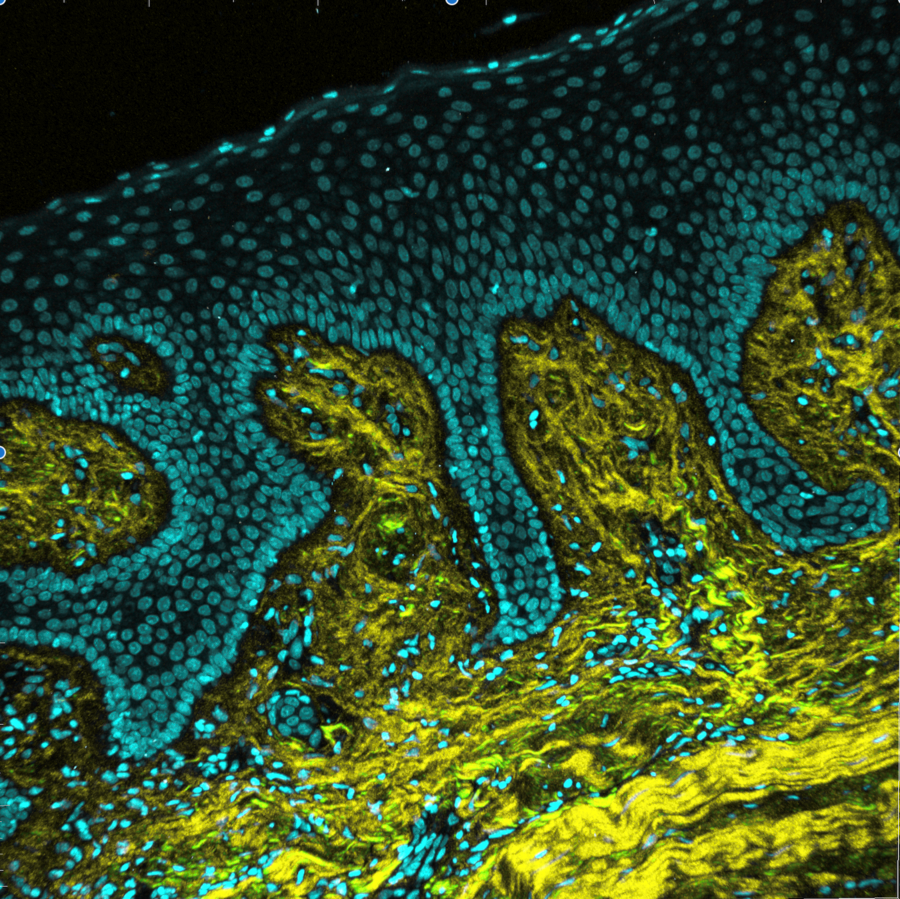
eriodontitis is a serious chronic inflammatory form of gum disease that affects millions worldwide. It can lead to tooth loss and the destruction of supporting bone. This disease has also been linked to other health problems, including diabetes, respiratory infections, and heart disease—impacting quality of life and increasing health care costs.
Current treatments target bacterial infection and inflammation through nonsurgical therapies, such as scaling and root planing, commonly known as “deep cleaning.” However, they do not repair the gum’s extracellular matrix (ECM), the gingival tissue’s structural support that is damaged by chronic inflammation. Without this foundation, gingival tissue cannot function properly, allowing inflammation to persist and slowing healing.
Now, new research led by Kyle H. Vining and Hardik Makkar of the School of Dental Medicine demonstrates how the physical properties of the gingival tissue impact periodontal health and disease. Their findings are published in Advanced Materials.
Other studies have shown that physical properties such as structure and stiffness influence inflammation in chronic conditions such as rheumatoid arthritis and fibrosis, explains Vining, an assistant professor in Penn Dental Medicine’s Department of Preventive and Restorative Sciences. But the role of these properties in periodontal disease, which shares characteristics with other chronic inflammatory diseases, is not well understood.
“So, in this study, we took a biomaterials approach to prove that rigidity—the stiffness—of the healthy gingiva is important for maintaining gingival health,” says Vining, who is also an assistant professor in the School of Engineering and Applied Science.
The team used a “tunable” hydrogel composed of natural biopolymers, resembling a form of Jell-O, to isolate how the mechanical environment influences cellular behavior. “Hydrogel stiffness can be tuned to model the properties of human gingiva, from the firmness of healthy tissue to the softened features of diseased tissue,” he says.
They first encapsulated gingival fibroblasts—the predominant cell type in the connective tissue of the gums that is responsible for secreting and maintaining the ECM—in this hydrogel system to test whether changes in tissue stiffness drive these cells to exacerbate the inflammatory response that characterizes periodontal disease.
“In periodontal disease, bacteria secrete enzymes that break down the ECM, causing the tissue to soften,” says Makkar, a postdoctoral fellow in Vining's lab. And as the tissue softens, he adds, cells shift into a higher inflammatory state that triggers even more tissue degradation, creating a destructive feedback loop in which tissue damage and inflammation feed each other.
“When we stiffen these tissues experimentally, the inflammatory response goes down,” says Makkar.
To validate these results, the team used enzymes—instead of the hydrogel—to restore stiffness in human gingival tissue samples obtained from Penn Dental’s dental clinic and found that when they exposed them to microbial triggers, the stiffened tissues showed a significantly lower inflammatory response.
“By using a more human-centric research model, we’ve demonstrated that simply restoring the physical stiffness of the tissue can fundamentally change how cells respond to infection,” says Makkar.
This work contributes to a better understanding of the mechanisms underlying the inflammatory response in periodontal disease, says Vining. But these findings could also pave the way for new biomaterial-based therapies to complement current treatments that target only microbes.
“We envision developing an injectable filler,” he says. “So, if you have uncontrolled periodontal disease, and even after deep cleaning, the tissue is frail, we could inject the filler to help the tissue heal.” Vining notes that these fillers could ultimately make grafts more successful or perhaps even unnecessary.
“There is a lot we can do with the tissue itself,” adds Makkar, including “strengthening it so that it becomes much more resistant to potential future infections.”
Next steps for the team are twofold. One, says Makkar, is to use small molecules to inhibit the inflammatory pathways to better understand the mechanisms underlying these findings. And the second is to do proof-of-concept studies of injectable biomaterials to help treat periodontitis.
“Dental research is moving far beyond traditional treatments,” says Vining. “Our work exists at the interface of materials science and bioengineering. Penn is one of the few places in the world with the collaboration and infrastructure required to bridge these fields, allowing us to develop next-generation therapies to treat dental, oral, and craniofacial diseases."
Kyle H. Vining is an assistant professor in Penn Dental Medicine’s Department of Preventive and Restorative Sciences and in Penn Engineering’s Department of Materials Science and Engineering.
Source: https://penntoday.upenn.edu/
 Related articles
Oral surgery 10 April 2026
A systematic literature search in MEDLINE, Embase, and the Guideline websites, from October 2007 to October 2012, produced articles that were critically evaluated.
Prosthodontics 27 February 2026
Prosthetic implant rehabilitation using the scan-analog protocol: a clinical case
A digital workflow for prosthetic implant rehabilitation can start either from intraoral scans or from the scan of the patient cast models. However, the possibility of scanning oral impressions is...
Periodontology 26 February 2026

A new classification of periodontal diseases aimed to identify periodontal disease based on a multidimensional staging and grading system has been recently proposed.
Oral surgery 23 February 2026

Full-arch rehabilitation has always represented the most challenging work both from the surgical and from the prosthetic aspect. One of the challenges in the treatment of full-arch implant supported...
Endodontics 13 January 2026
Regenerative endodontic treatment has provided a treatment option that aims to allow root maturation.
Read more
Products 13 October 2026

New Resources Help Dental Exhibitors Evaluate Their Investment and Explore the Personify ShowFlow™ Trade Show Success System
News 13 October 2026

New patient apps extend The Aspen Group’s mission to remove barriers to care, giving patients greater visibility, convenience, and control from booking through treatment
Editorials 13 October 2026

The forerunner of what’s now Texas A&M College of Dentistry opened 120 years ago in Dallas with the mission of educating dentists to provide quality care to patients in North Texas
Oral pathology 13 October 2026
This peer-reviewed oral pathology article summarizes clinical evidence from Oral oncology (2026). It focuses on findings that may help dental professionals evaluate treatment decisions, patient...



Copyright © 2026 - All Rights Reserved
ISSN 2767-1178