


Four-mm-long versus longer implants in augmented bone in atrophic posterior jaws: three-year post-loading results from a multicentre randomized controlled trial
Authors: Pietro Felice, Carlo Barausse, Roberto Pistilli, Zamira Kalemaj, Marco Esposito
PURPOSE.
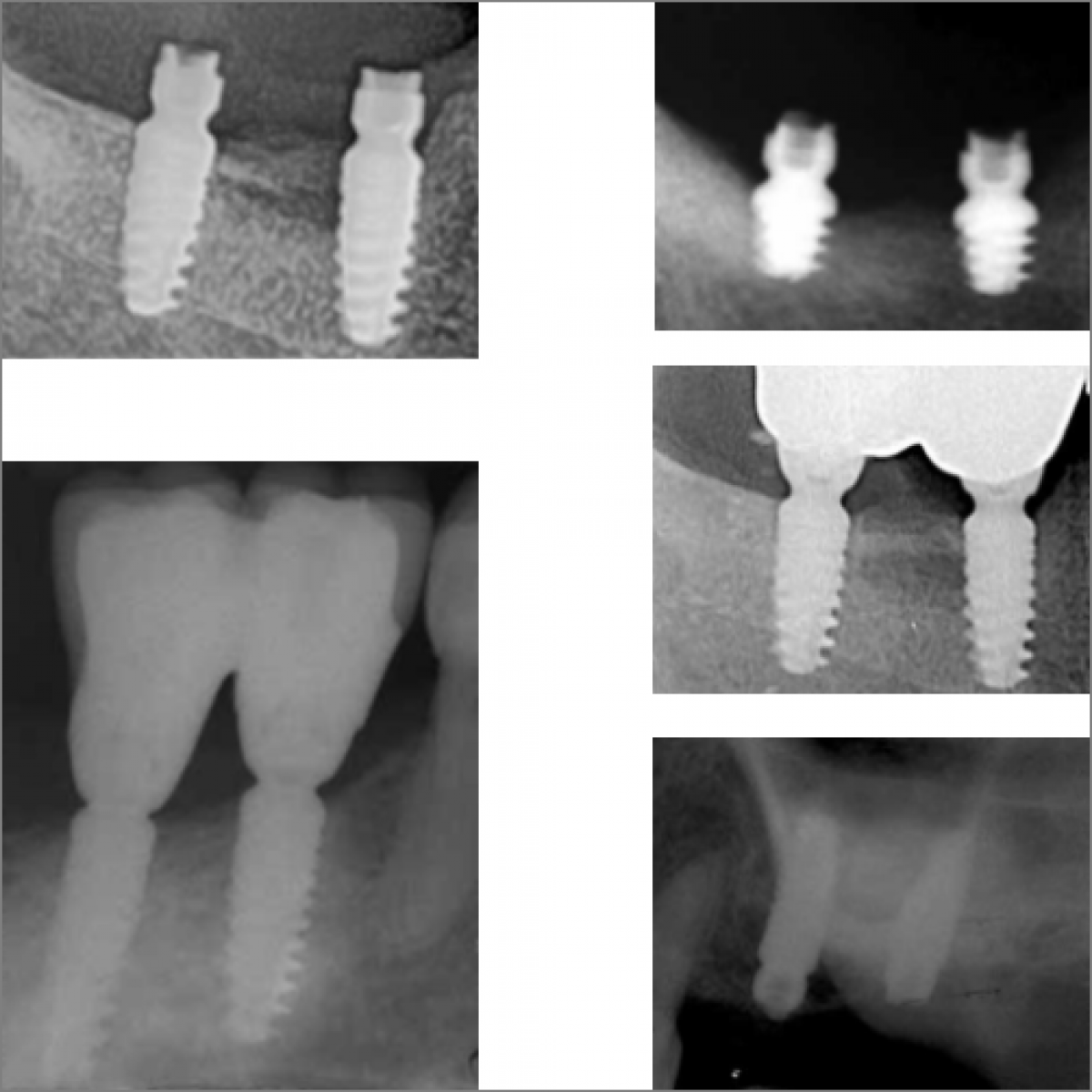
To evaluate whether 4-mm-long dental implants could be an alternative to bone augmentation with xenografts and placement of implants of length at least 10 in posterior atrophic jaws.
MATERIALS AND METHODS.
Forty patients with atrophic posterior (premolar and molar areas) mandibles having 5 to 6 mm bone height above the mandibular canal and 40 patients with atrophic maxillae having 4 to 5 mm bone height below the maxillary sinus were randomized according to a parallel-group design to receive one to three 4.0-mm-long implants or one to three implants of length at least 10 mm in augmented bone at two centers. All implants had a diameter of 4.0 or 4.5 mm. Mandibles were vertically augmented with interpositional equine bone blocks and resorbable barriers. Implants were placed 4 months after grafting. Maxillary sinuses were augmented with particulated porcine bone via a lateral window covered with resorbable barriers, and implants were placed simultaneously. Implants were not submerged. Four months later, screw-retained reinforced acrylic restorations were fitted, and replaced after 4 months by definitive screw-retained metal-composite prostheses. Patients were followed up to 3 years post-loading. Outcome measures were: prosthesis and implant failures, any complications, and peri-implant marginal bone level changes.
RESULTS.
Nine patients dropped out, six from the augmentation group and three from the short implant group. In six augmented mandibles (30%), it was impossible to place implants of length at least 10.0 mm, so shorter implants had to be placed instead. In mandibles, two implants from the augmentation group failed in two patients, versus two 4.0-mm-long implants in two patients from the short implant group. In maxillae, four short implants failed in three patients versus seven long implants in four patients (two long implants and one short implant dropped into the maxillary sinus). Three prostheses on short implants (one mandibular and two maxillary) failed or were placed at a later stage due to implant failure, versus eight prostheses (three mandibular and five maxillary) at augmented sites. There were no statistically significant differences in implant failures (P [Fisher’s exact test] = 0.159; difference in proportion = 0.05; CI 95% -0.11 to 0.21) or prostheses failures (P [Fisher’s exact test] = 0.919; difference in proportion = 0.02; CI 95% -0.14 to 0.18). There were more patients affected by complications in the augmentation group (18 patients affected by 30 complications versus 8 patients affected by 10 complications), but the difference was not statistically significant (P [Fisher’s exact test] = 0.587; the difference in proportion = -0.72; CI 95% -0.29 to 0.14). At 3 years post-loading, average peri-implant bone loss was 0.62 mm at 4-mm-long mandibular implants, 0.71 mm at 10-mm or longer mandibular implants, 1.14 mm at short maxillary implants, and 0.73 mm at long maxillary implants. The difference was not statistically significant in mandibles (mean difference -0.08 mm, 95% CI -0.37 to 0.20, P [ANCOVA] = 0.568), but was significant in maxillae, with greater bone loss at short implants (mean difference 0.41 mm, 95% CI -0.04 to 0.87, P [ANCOVA] = 0.037).
For the full article visit: www.clinicaltrialsindentistry.com
 Related articles
Implantology 04 September 2026
This peer-reviewed implantology article summarizes clinical evidence from Clinical oral implants research (2026). It focuses on findings that may help dental professionals evaluate treatment...
Implantology 20 August 2026
This peer-reviewed implantology article summarizes clinical evidence from Clinical oral implants research (2026). It focuses on findings that may help dental professionals evaluate treatment...
Implantology 06 August 2026
This peer-reviewed implantology article summarizes clinical evidence from Clinical oral implants research (2026). It focuses on findings that may help dental professionals evaluate treatment...
Implantology 24 July 2026
This peer-reviewed implantology article summarizes clinical evidence from Clinical oral implants research (2026). It focuses on findings that may help dental professionals evaluate treatment...
Implantology 10 July 2026
This peer-reviewed implantology article summarizes clinical evidence from Clinical oral implants research (2026). It focuses on findings that may help dental professionals evaluate treatment...
Read more
Products 13 October 2026


New Resources Help Dental Exhibitors Evaluate Their Investment and Explore the Personify ShowFlow™ Trade Show Success System
News 13 October 2026

New patient apps extend The Aspen Group’s mission to remove barriers to care, giving patients greater visibility, convenience, and control from booking through treatment
Editorials 13 October 2026

The forerunner of what’s now Texas A&M College of Dentistry opened 120 years ago in Dallas with the mission of educating dentists to provide quality care to patients in North Texas
Oral pathology 13 October 2026

This peer-reviewed oral pathology article summarizes clinical evidence from Oral oncology (2026). It focuses on findings that may help dental professionals evaluate treatment decisions, patient...



Copyright © 2026 - All Rights Reserved
ISSN 2767-1178