


An original procedure for the ovoid pontic technique in ortho-restorative cases
OBJECTIVES
In the multidisciplinary treatments, especially in case of missing teeth in aesthetic area, the compliance of patient during retention time post orthodontic therapy is evidently very high, even among teen patients, in particular when we adopt clear retainers comprising absent teeth.
The purpose of this paper is to show an original use of the ovoid pontic technique associated with retainers to model soft tissues and achieve an ideal emergence profile around pontic to give the illusion of a natural gingival margin around prosthodontic restoration.
MATERIALS AND METHODS
The ovoid pontic technique is a procedure developed to adapt the gingiva to the prosthodontic bridge element as naturally as possible.
The authors presented two clinical cases in which two different methods were utilized to perform ovoid pontic technique during retention time:
1. by means of the analogic technique, using a thermoformed 1.5 mm thick PETG essix;
2. by means of digital workflow, using a Vivera® retainer (Align Technology, San Josè, CA, USA). The objective of the ovoid pontic technique is not only to achieve the ideal emergence profile around prosthodontic restorations but overall to avoid a traumatic second surgery to implement soft tissues. For this purpose is strategic to select patients with thick gingival tissues for obtaining best final results. A minimum thickness of 3 to 5 mm of soft tissue is required from the gingival crest to the alveolar ridge.
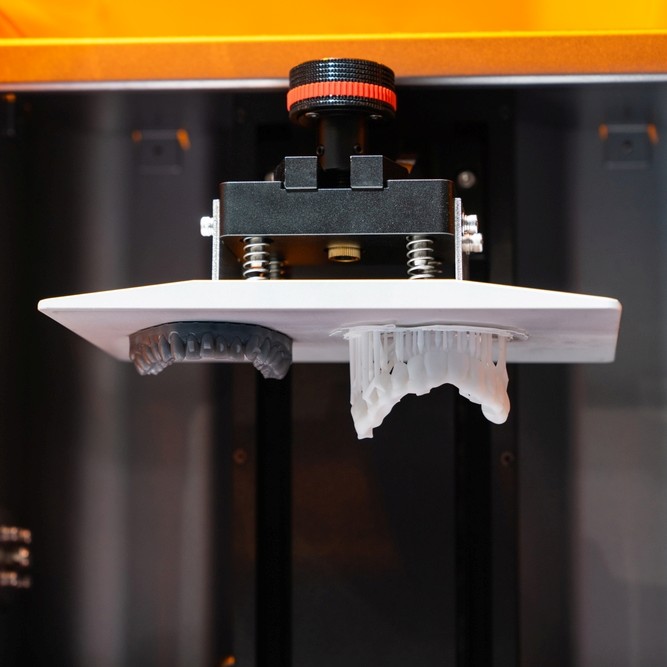
In both procedures, the pontic was gradually increased by using a light-cured biocompatible fluid composite to determine increasing pressure over the gingival tissue, modeling the edentulous area and finally leading to a natural look of the prosthodontic restoration. Then, a gradual and controlled hyperpressure can transform an unfavorable tissue configuration. There is also a possibility of closing undesirable interdental “black holes” through papilla “formation”, by pressuring the gingival tissues.
CONCLUSIONS
The proposed method allows to manage gingival tissues during retention time, which is usually a passive phase of the orthodontic therapy, accelerating the treatment for the final restorative phase and improving the esthetic outcome. In conclusion, according to the thermoformed retainer based ovoid pontic technique, orthodontists can manage gingival tissues on their own before referring the patient to a restorative dentistry specialist.
CLINICAL SIGNIFICANCE
This paper presents an original way of managing the ovoid pontic technique during the orthodontic retention time to accelerate the following restorative phase, allowing to take advantage from a passive treatment stage while conditioning soft tissues and thus limiting the aesthetic discomfort for the patient.
Authors: Gianluca Mampieri, Roberta Condò, Ercole Morucci, Aldo Giancotti
Source: https://www.dentalcadmos.com/
 Tag
Tag
Related articles
Editorials 27 September 2026
Dentistry33 survey highlights replacement care, deep caries and evolving restorative workflows
Reader survey finds direct composites remain dominant, secondary caries is the leading reason for restoration replacement, and clinicians want more training in pulp preservation
Reader survey finds direct composites remain dominant, secondary caries is the leading reason for restoration replacement, and clinicians want more training in pulp preservation
Editorials 20 September 2026
Dentistry33 survey shows small practices balancing growth, costs and technology modernization
Reader survey finds solo and small practices remain prominent while staffing, rising costs and digital adoption shape business priorities
Reader survey finds solo and small practices remain prominent while staffing, rising costs and digital adoption shape business priorities
Digital Dentistry 20 April 2026
To report a fully digital and guided immediate-load All-on-4 protocol conducted in Brazil on a 59-year-old male patient with an edentulous maxilla and a history of oropharyngeal cancer surgery,...
Digital Dentistry 03 April 2026
The purpose of this review is to provide the readers with current information and state-of-the-art of digital scanning systems within the orthodontics.
Editorials 03 February 2026

Dr. Alireza Sadr of the Department of Restorative Dentistry has been appointed as the first-ever UW School of Dentistry Director of Digital Dentistry and Innovation, effective Jan. 1, 2026.
Read more
Products 16 October 2026
Karen Davis on Philips Sonicare DiamondClean 9900 Prestige & Smarter Brushing

News 16 October 2026
Align Technology to Report Q3 2026 Financial Results October 28

(Nasdaq: ALGN), a leading global medical device company that designs, manufactures, and sells the Invisalign® System of clear aligners, iTero™ intraoral scanners, and exocad™ CAD/C
News 16 October 2026

Fewer people on intake, faster turnaround, and no lost cases: Relu’s new automation captures and centralizes every scan and Rx from every source within a minute of arrival
Editorials 16 October 2026

Achievement and service take center stage as the University of Colorado Anschutz School of Dental Medicine honors the Doctor of Dental Surgery (DDS) Class of 2026.
Implantology 16 October 2026
This peer-reviewed implantology article summarizes clinical evidence from Clinical oral implants research (2026). It focuses on findings that may help dental professionals evaluate treatment...



Copyright © 2026 - All Rights Reserved
ISSN 2767-1178