


Dentistry33 survey shows small practices balancing growth, costs and technology modernization
Reader survey finds solo and small practices remain prominent while staffing, rising costs and digital adoption shape business priorities
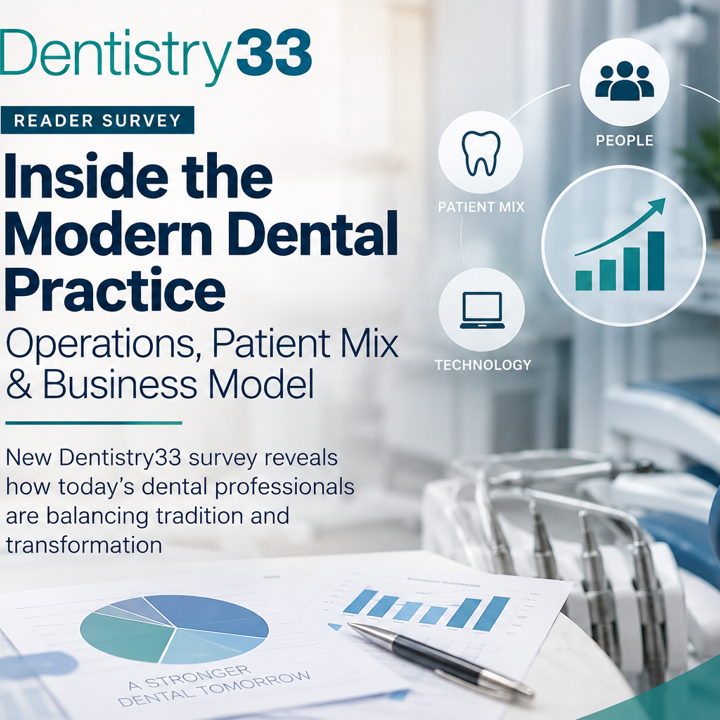
Small and independently structured dental practices remain prominent among respondents to a new Dentistry33 reader survey, but their priorities increasingly reflect the pressures of a changing practice environment—from staffing and rising costs to technology investment and patient experience.
The survey, Inside the Modern Dental Practice: Operations, Patient Mix & Business Model, examined practice structure, revenue sources, operational challenges, technology adoption and future business priorities.
Among the 48 respondents answering the practice-structure question, 22 selected solo private practice, while seven selected dentist-owned group practice. Four identified with a DSO or corporate model, and seven reported working in an academic or hospital setting.
The size of the practices showed a similar pattern.
Of 46 respondents, 18 reported working in a practice with only one dentist, while another 13 worked in practices with two or three dentists. Eight reported four to 10 dentists, and seven worked in organizations with 11 or more dentists.
Together, the responses suggest that relatively small practices continue to represent an important part of the Dentistry33 readership.
Dental practices face a broad range of operational pressures
No single operational issue dominated the survey, suggesting that dental practices are dealing with several pressures simultaneously.
Staffing and hiring received the highest number of selections, followed closely by rising supply costs. Insurance and reimbursement and workflow efficiency were also frequently identified, while respondents additionally cited technology integration, case acceptance, regulatory compliance, patient acquisition and retention.
The results point toward a business environment where practice owners must manage both rising operating complexity and the traditional demands of clinical care.
The payer mix was similarly diverse.
Among 42 respondents, 15 described their patient base as having a balanced mix of payer types, while 14 said their practices were primarily fee-for-service or private pay. Eight reported primarily PPO or insurance-based practices, and five reported Medicaid or public-insurance-dominant patient populations.
General and restorative dentistry remains an important revenue driver
General and restorative dentistry emerged as the strongest clinical revenue category.
Twenty respondents identified general or restorative dentistry as accounting for the largest share of their practice revenue. Hygiene and prevention received five selections, implants four, while smaller numbers identified oral surgery, pediatric dentistry and orthodontics or aligners.
The finding reinforces the continuing economic importance of core restorative and general dental care, even as practices expand into more specialized and technology-driven services.
Intraoral scanning leads digital adoption
Digital technology adoption showed one particularly clear leader: the intraoral scanner.
Of the 40 clinicians answering the technology question, 27 reported using an intraoral scanner, equivalent to approximately 68% of respondents.
CBCT or imaging systems were reported by 17 respondents, CAD/CAM by nine and 3D printing by eight. Seven reported using teledentistry, while five respondents each selected AI-assisted diagnostics and digital smile design.
At the same time, nine respondents indicated that they used none of the technologies listed.
The results suggest that digital dentistry is not advancing uniformly. Technologies that integrate directly into established clinical workflows—particularly scanning and imaging—appear to have achieved substantially greater penetration than newer applications such as artificial intelligence.
Growth, technology and patient experience compete for attention
When Dentistry33 asked respondents to identify their top business priority over the next two years, no single strategy dominated.
Practice growth, technology modernization and patient experience tied for the leading position, each selected by six of 34 respondents.
Improving efficiency and increasing profitability were each chosen by four respondents, while three prioritized reducing overhead. Staff retention, selling or transitioning a practice, and expanding services received fewer selections.
This fragmentation may itself be significant.
Rather than concentrating primarily on growth or profitability, respondents appear to be balancing investment, operational efficiency and the quality of the patient experience.
A survey dominated by experienced practitioners
The professional profile of respondents provides important context for interpreting the findings.
Among 36 clinicians answering the career-stage question, 26—72.2%—identified themselves as senior practitioners with more than 25 years of experience.
Six were mid-career practitioners with six to 15 years of experience, two were in the first five years of their careers and two reported between 16 and 25 years in practice. No dental students or residents answered the question.
That concentration of highly experienced clinicians makes the interest in technology modernization particularly noteworthy. Digital transformation is not solely a concern of younger dentists entering practice; within this survey, it also appears among the priorities of a readership heavily weighted toward veteran clinicians.
Clinicians remain interested in education—but relevance matters
The survey also examined attitudes toward sponsored professional education.
Approximately 59% of respondents said they were either very likely or somewhat likely to participate in sponsored educational activities when the content was clinically relevant. Fourteen respondents were very likely and eight somewhat likely to participate.
The emphasis on clinical relevance is important. Sponsorship itself does not appear to be an automatic barrier, but the perceived educational value of the content is likely to influence engagement.
Responses about Dentistry33's planned podcast pointed in a similar direction.
New research, technologies and industry trends received the greatest interest, selected by 16 respondents, followed by clinical techniques and treatment procedures with 13 and case studies and real-world applications with 11.
For episode duration, 15 to 30 minutes was the most frequently preferred format, selected by 13 respondents. Eleven preferred shorter episodes of five to 10 minutes.
The modern dental practice is evolving rather than being replaced
Taken together, the results suggest that the modern dental practice is not undergoing a simple transition from traditional independent dentistry to a single new business model.
Many respondents continue to work in solo or relatively small practices, and general and restorative dentistry remains central to practice economics. At the same time, these clinicians face staffing pressures, increasing costs and the need to evaluate new technologies.
Their priorities reflect that complexity.
Practice growth matters, but so do technology modernization and patient experience. Digital adoption is advancing, but at different speeds depending on the technology. And even among a respondent population dominated by senior practitioners, interest in new technologies, research and continuing education remains substantial.
For dental practices navigating the next several years, the challenge may therefore be less about choosing between traditional practice models and modernization—and more about integrating the two successfully.
This Dentistry33 reader survey represents a directional snapshot of participating respondents and should not be interpreted as a representative scientific sample of the dental profession.
 Tag
Tag
Related articles

Meet Ora, the first-of-its-kind to deliver on the promise of providing “all-in-one” practice management software to dental practices.

Kowalczyk will be focused on helping hygienists grow as clinicians and leaders in order to enjoy an even more rewarding career.
USA 23 February 2023 - 25 February 2023
Billed as one of the top scientific dental meetings in the country, the meeting will feature leading dental speakers presenting unparalleled continuing education and the industry’s top...

Dental practice management software can include charting, scheduling, treatment planning, document storage and more.
News 23 November 2022

Read more
USA 20 September 2026 - 30 November -0001

The American Academy of Implant Dentistry Annual Conference 2026 will take place from November 11, 2026 to November 14, 2026 in TBD, USA, offering dental professionals a focused environment for...
Edra Professional Books 19 September 2026
Piezoelectric surgery of impacted teeth: A Practical Reference for Dental Professionals

Piezoelectric surgery of impacted teeth is an Edra professional dentistry reference focused on clinical practice, education and treatment planning.
Products 18 September 2026
Hard Tissue Charting and Natural Voice Perio Added to Overjet Voice

Providers talk through exams naturally while Overjet Voice handles hard tissue findings, perio measurements, and clinical notes directly in the PMS.
News 18 September 2026

Partnership leverages BioHorizons’ commercial network to broaden availability of Xtant’s allogeneic growth factor technology, OsteoFactor Pro™, which BioHorizons will private brand
News 18 September 2026
(“Sonendo” or the “Company”), a leading dental technology company and developer of the GentleWave® System, recently announced several key initiatives to support the drive toward ca



Copyright © 2026 - All Rights Reserved
ISSN 2767-1178