


Chewing gum that may block SARS-CoV-2 moves to clinical trial

A recently launched clinical trial at the University of Pennsylvania will evaluate a novel chewing gum designed by Penn Dental Medicine’s Henry Daniell, W.D. Miller Professor in the Department of Basic & Translational Sciences. The gum traps SARS-CoV-2 — the virus that causes COVID-19 — in the saliva, potentially blocking transmission of COVID-19 from one person to another.
The trial will recruit participants from a pool of Penn Medicine employees that may be battling a COVID-19 infection, according to a Penn Dental Medicine story.
The gum was created to trap and neutralize SARS-CoV-2 in the saliva and, ideally, diminish the amount of virus left in the mouth. Researchers hope that less virus would mean a lower likelihood of passing the infection on to others.
Findings from a preclinical study of the gum’s efficacy in neutralizing SARS-CoV-2 and influenza virus in patient samples published in the journal Biomaterials in July showed the gum could reduce viral load to nearly undetectable levels. The results supported an application to the U.S. Food and Drug Administration for an Investigational New Drug, which went into effect in May and paved the way for the launch of the clinical trial.
The technology behind this experimental treatment has moved from the laboratory bench to the beginning of clinical experimentation all within Penn Dental Medicine, a first for the school. The partnership with colleagues from Penn Medicine enables the launch of the first-in-human clinical trial.
“This technology may have the ability to reduce the spread of COVID-19 and the flu as well as make it safer for dentists and other healthcare providers to provide care to patients who we know are infected,” said Dr. Mark Wolff, the Morton Amsterdam Dean of Penn Dental Medicine, also a coauthor on the Biomaterials study.
Source: “Chewing Gum Designed to Trap SARS-CoV-2 in the Saliva Moves to Clinical Trial from Dr. Henry Daniell's Lab,” Katherine Unger Baillie, Penn Dental Medicine, September 8, 2022.
 Related articles
Oral pathology 23 December 2024
Oral Pathology in COVID-19 and SARS-CoV-2 Infection—Molecular Aspects

This review article was designed to evaluate the existing evidence related to the molecular processes of SARS-CoV-2 infection in the oral cavity.
Periodontology 10 March 2023
Why periodontitis may be the missing link in understanding the severity of SARS-CoV-2

By Caroline Holland
Dr. Graham Lloyd-Jones, consultant radiologist, has investigated the development of lung disease in COVID-19 and attempted to answer why some people are so much more badly affected than others.
Researchers found at least one post-COVID-19 symptom in 67.5% of patients who had not needed hospital care, according to a new study with 700 patients conducted...
Oral Hygiene & Prevention 22 April 2022
Penn Dental Medicine Study Shows Gum with Plant Protein May Reduce SARS-CoV-2 Transmission

A chewing gum made with a plant-grown protein “traps” the SARS-CoV-2 virus, reducing viral load in saliva and potentially tamping down transmission, according to a study led by Henry Daniell at Penn Dental Medicine
The work, performed in collaboration with the Perelman School of Medicine and School of Veterinary Medicine, as well as The Wistar Institute and Fraunhofer USA, could lead to a low-cost tool in the...
Oral Hygiene & Prevention 01 November 2021
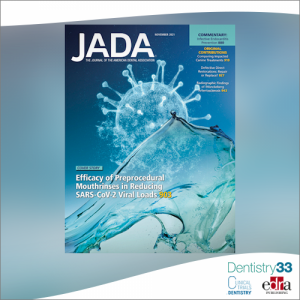
Mouth rinses reduce SARS-CoV-2 in saliva, new research on JADA
Editorial Team
Mouth rinses can reduce the SARS-CoV-2 viral load in saliva, according to a study published in the November issue of The Journal of the American Dental Association.The cover story, "Estimating...
Read more
Oral Hygiene & Prevention 05 January 2026

To assess effectiveness of an oral health education (OHE) programme on oral hygiene knowledge, practices, plaque control and gingival health of 13- to 15-year-old school children in Bangalore city.
Editorials 05 January 2026

Products 05 January 2026

Heartland Dental, the nation’s leading dental support organization, today announced that it has selected Dentira as the enterprise lab management platform for supported practices.
News 05 January 2026

Dentistry.One, a virtual-first dental care solution headquartered in Metuchen, NJ, announced it has been named the NJBIZ 2025 For-Profit Business of the Year (1–49 employees).
News 05 January 2026

Health-E Commerce, parent brand to FSA Store and HSA Store, the first and leading online stores dedicated to selling only FSA- and HSA-eligible products and services, recently announced a telehealth...



Copyright © 2026 - All Rights Reserved
ISSN 2767-1178