


Three-dimensional evaluation of dental movement in Orthodontics
Authors: Impellizzeri A., Horodynski M., Serritella E., Romeo U., Barbato E., Galluccio G.
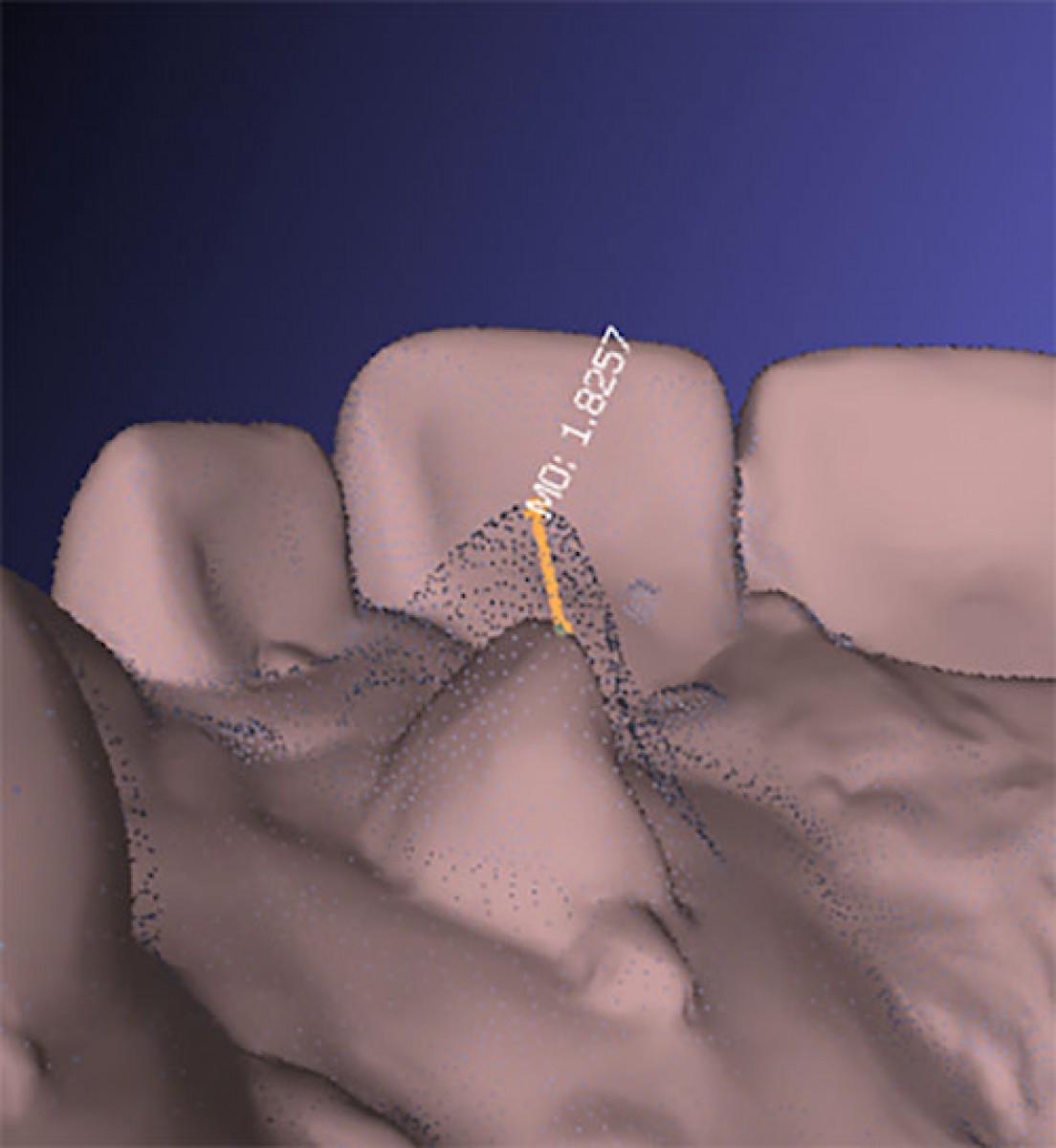
The aim of this study is to evaluate three-dimensionally the dental movement of impacted palatally canines, following an opercolectomy performed by laser. We also monitored patients with both digital and conventional method, with the purpose of evaluating the accuracy and validity of the monitoring methods compared.
Material and methods
We analyzed 10 patients, 5 with double inclusion and 5 with single inclusion, for a total of 15 canines, impacted in the palatal site, were considered. Patient’s orthopantomography were initially analyzed to evaluate the prognosis of the impacted canines, according to the analysis of Ericson and Kurol. Subsequently, preoperative CBCT scans were examined to assess the position and type of inclusion of the dental elements considered. Through the Invesalius 3.1 software (Centro de Tecnologia da Informação Renato Archer, Amarais- Campinas, SP, Brasile) it was possible to convert the CBCT files into three-dimensional models in STL format. For each patient we applied a digital and conventional monitoring protocol that included checks, according to the following timing: preoperative, at 1 week, at 2 months and at 4 months after surgery. At each check, both scans of the arch, using the Carestream 3500 intraoral scanner (Carestream Dental, Carestream Health, Inc, Rochester, NY, USA), were performed, and alginate impressions with which the plaster casts were made. The 3D models extrapolated from CT and intraoral scans were aligned and overlapped using the Meshlab software, which allowed us to make measurements over time of the canine eruption movement. The same measurements were replicated on the plaster casts, with compass and ruler. We performed a descriptive and inferential statistical analysis of each data obtained, both from conventional and digital monitoring, determining the statistical averages for each time considered, and the speeds. The two monitoring methods were compared, evaluating the errors of analog measurements, consisting of the differences between the values obtained by the two types of monitoring and performing the Student T Test for paired data.
Results
The average total (T0-T2) eruption calculated on digital models is 4.49 mm, with an average eruption speed of 0.037 mm / day. The comparison of the two monitoring methods revealed an error in the analog measurements equal to 1.09 mm in the evaluation of the total eruption. Student's T test was performed to compare the data emerging from the two monitoring methods, and set a p-value <0.05, we obtained statistically significant data (P = 3.25746E-08). Using digital technologies, such as intraoral scanner, conversion and overlay software, it was possible to calculate the real eruption of the impacted canines and to evaluate the characteristics of tooth movement after the experimental procedure of laser opercolectomy. The interpretation of these results reveals the greater precision of the monitoring with digital technologies compared to the conventional one.
Conclusions
The use of digital technologies has allowed us to evaluate the dental movement in a three-dimensional way with extreme precision. The comparison between the eruption values obtained from the STL models and those of the plaster casts, highlights the inherent errors of the conventional monitoring, which are due both to the distortions of the materials used, and to the lack of precision of the manual measurement methods.
Clinical implications
The present study evaluates the canine spontaneous eruption’s movement after laser surgery, without the need for orthodontic traction. The application of digital technologies has enabled us to eliminate errors in analogue measurements and monitor the patient over time by reducing working time, by introducing the concept of "digital workflow". Furthermore, we found an increase in compliance.
 Related articles
Orthodontics 21 August 2026

This peer-reviewed orthodontics article summarizes clinical evidence from Dental press journal of orthodontics (2026). It focuses on findings that may help dental professionals evaluate treatment...
Orthodontics 07 August 2026

This peer-reviewed orthodontics article summarizes clinical evidence from Dental press journal of orthodontics (2026). It focuses on findings that may help dental professionals evaluate treatment...
Orthodontics 25 June 2026

This peer-reviewed orthodontics article summarizes clinical evidence from PloS one (2026). It focuses on findings that may help dental professionals evaluate treatment decisions, patient outcomes, or...
Orthodontics 17 June 2026

This peer-reviewed orthodontics article summarizes clinical evidence from PloS one (2026). It focuses on findings that may help dental professionals evaluate treatment decisions, patient outcomes, or...
Orthodontics 04 June 2026

This peer-reviewed orthodontics article summarizes clinical evidence from PloS one (2026). It focuses on findings that may help dental professionals evaluate treatment decisions, patient outcomes, or...
Read more

Jen Kim Field, chief sustainability officer at Henry Schein and president of the Henry Schein Cares Foundation, answers questions for Dentistry Today about the group’s achievements
News 12 October 2026
The education-first program offered learning for the entire dental practice, with practical insights spanning the full patient journey and focused on improving workflows, collabora
News 12 October 2026

AAO and Stand for the Silent Unite Communities This Month to Shine a Light on Bullying Prevention
Editorials 12 October 2026
Expanded coverage: Texas A&M’s Plemons named 2026 Texas Dentist of the Year

Sometimes a small act of generosity can make a tremendous impression, especially on a 7-year-old.
Endodontics 12 October 2026
This peer-reviewed endodontics article summarizes clinical evidence from Journal of dentistry (2026). It focuses on findings that may help dental professionals evaluate treatment decisions, patient...



Copyright © 2026 - All Rights Reserved
ISSN 2767-1178