


The impact of repeated abutment changes on peri-implant tissue stability: five-year post-loading results from a multicentre randomised controlled trial
Authors: D'Avenia, Bressan, Grusovin, Neumann, Sbricoli, Luongo, Piombino, Buti, Esposito
Purpose
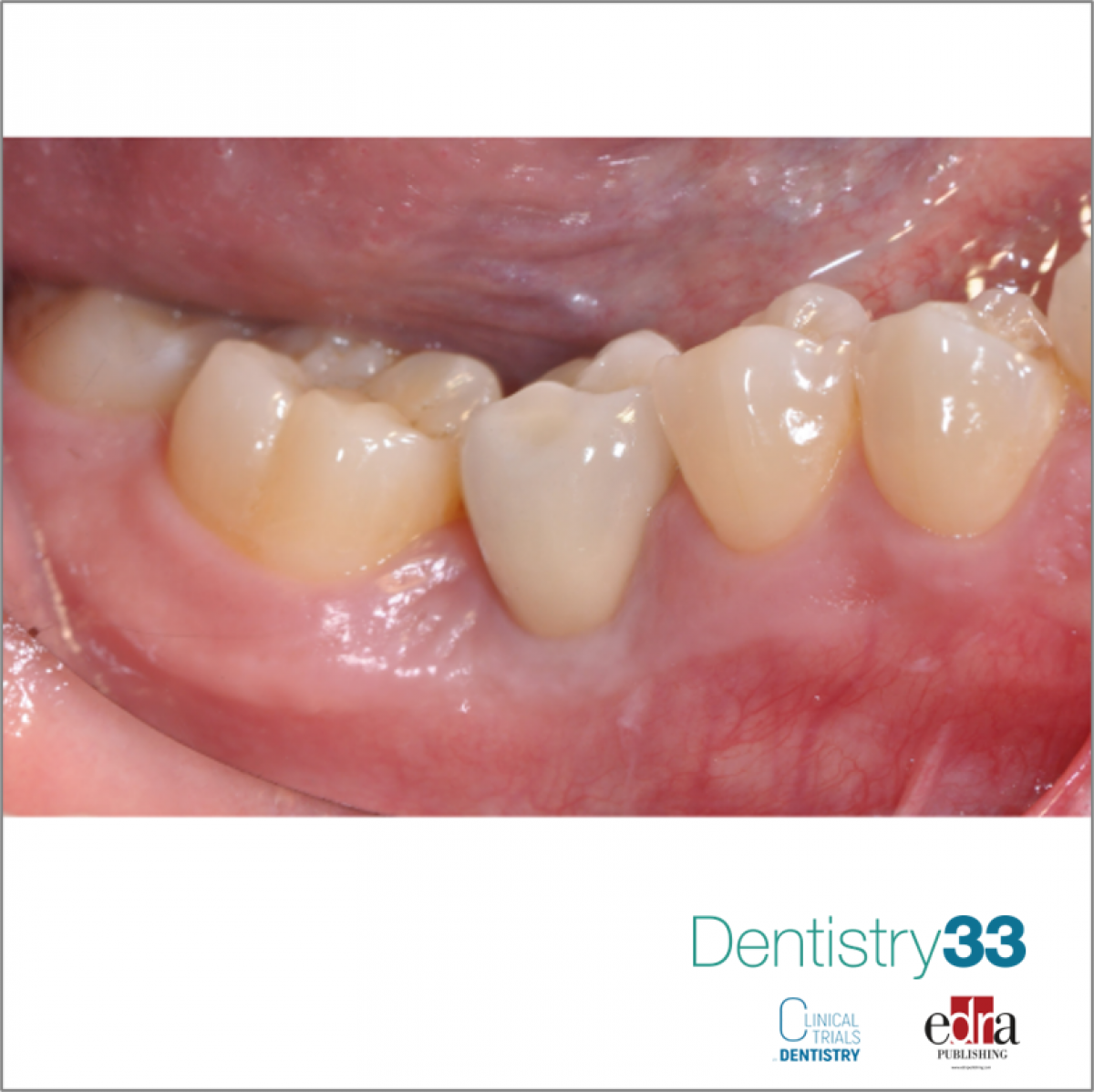
To evaluate the impact of at least three abutment disconnections on hard and soft tissues around conventionally loaded implants versus definitive immediately non-occlusally loaded abutments in implants. A secondary aim was to evaluate whether the presence of less than 2 mm of keratinised mucosa is associated with increased soft tissue recession and/or peri-implant marginal bone loss.
Materials and methods
Eighty patients requiring one single crown or one fixed partial prosthesis supported by a maximum of three implants were randomised, after implant placement at greater than 35 Ncm, according to a parallel-group design to receive either definitive immediately loaded abutments (definitive abutment or immediate loading group) or transmucosal abutments which were loaded after a delay of 3 months and removed at least three times. Patients were treated in four centres, and each patient contributed to the study with only one prosthesis, which was followed up for 5 years after initial loading. Outcome measures were: prosthesis failures, implant failures, complications, pink aesthetic score (PES), buccal recessions, patient satisfaction, peri-implant marginal bone-level changes and height of the keratinised mucosa.
Results
Forty patients were randomly allocated to each group according to a parallel-group design. Seven patients from the definitive abutment group versus six from the repeated disconnection group dropped out or died. No patient from the definitive group had implant failures versus three patients who lost five implants in the repeated disconnection group (difference = 9.1%; CI95%: -0.7% to 18.9% to; P = 0.227). Nine patients from the repeated disconnection group lost or had to have their prosthesis remade (four provisional and five definitive prostheses) versus one provisional prosthesis failure in the definitive abutment group; this difference was statistically significant (difference = 23.5%; CI95%: 7.6% to 39.4%; P = 0.017), but was due to the erroneous use of non-indexed abutments in indexed implants in patients from the repeated disconnection group alone. Seven patients from the definitive abutment group versus nine patients from the repeated disconnection group were affected by complications (difference = -5.9%; CI95%: -26.0% to 14.2%; P = 0.775), the difference being not statistically significant. PES scores assessed at 5 years post-loading were 12.1±1.8 for the definitive abutment group and 11.9±1.7 for the repeated abutment changes group (difference = 0.2; CI95%: -0.7 to 1.1; P = 0.615); however, there was a difference of 0.20 out of a maximum score of 2 in favour of the definitive abutment group for soft tissue contour alone (P = 0.045). Buccal recessions at 5 years post-loading amounted to -0.19±0.77 mm for the definitive abutment group and -0.07±1.24 mm for the repeated abutment changes group (difference = 0.12 mm CI95%: -0.42 to 0.66; P = 0.662). All patients declared being very satisfied or satisfied with the function and aesthetics of their prosthesis and would undergo the same procedure again. Mean peri-implant marginal bone loss 5 years after loading was 0.11±0.30 mm for the definitive abutment group and 0.48±0.73 mm for the repeated abutment change group (difference = -0.37 [SE=0.14] mm; CI95%: -0.66 to -0.09; P = 0.012), the difference being statistically significant. The height of keratinised mucosa at 5 years post-loading was 2.81±1.46 mm in the definitive abutment group and 2.83±1.84 mm in the repeated abutment change group (difference = -0.02; CI95%: -0.85 to 0.80; P = 0.956), and there were no significant differences in marginal bone loss (difference = 0.00, CI95%: -0.32 to 0.32, P = 0.990) or buccal recession (difference = 0.05, CI95%: -0.43 to 0.54, P = 0.826) at implants having less than 2 mm of keratinised mucosa at loading compared to those having more than 2 mm of keratinised mucosa.
Conclusions
Five-year post-loading data show that at least three repeated abutment disconnections significantly increased bone loss by 0.37 mm when compared to no disconnection, but this difference may not be clinically significant. There was a tendency close to statistical significance to lose more implants which were repeatedly disconnected. While it might be advisable to avoid unnecessary abutment disconnection whenever possible, if disconnections are required, no clinically significant side effects may be expected. Immediately non-occlusally loaded dental implants are a viable alternative to conventional loading, and no increased bone loss or buccal recessions were noted even at implants with less than 2 mm of keratinised mucosa.
 Related articles
Implantology 04 September 2026
This peer-reviewed implantology article summarizes clinical evidence from Clinical oral implants research (2026). It focuses on findings that may help dental professionals evaluate treatment...
Implantology 20 August 2026
This peer-reviewed implantology article summarizes clinical evidence from Clinical oral implants research (2026). It focuses on findings that may help dental professionals evaluate treatment...
Implantology 06 August 2026
This peer-reviewed implantology article summarizes clinical evidence from Clinical oral implants research (2026). It focuses on findings that may help dental professionals evaluate treatment...
Implantology 24 July 2026
This peer-reviewed implantology article summarizes clinical evidence from Clinical oral implants research (2026). It focuses on findings that may help dental professionals evaluate treatment...
Implantology 10 July 2026
This peer-reviewed implantology article summarizes clinical evidence from Clinical oral implants research (2026). It focuses on findings that may help dental professionals evaluate treatment...
Read more
Products 14 October 2026
Royal Philips (NYSE: PHG, AEX: PHIA) announced that the Philips Sonicare Next-Generation DiamondClean 9900 Prestige, its most advanced and intelligent toothbrush to date, is now av

Key transaction by Heartland Dental and its supported practices expands opportunities for supported doctors, teams, and practices while strengthening Heartland Dental’s supported f
News 14 October 2026
Henry Schein Cares Celebrates 25 Years of Corporate Citizenship
Henry Schein Cares, Henry Schein, Inc.’s global corporate citizenship program, is celebrating a quarter century of bringing together Team Schein Members, customers, supplier partne
Editorials 14 October 2026
Scholarship at the CU Anschutz School of Dental Medicine reflects the collective contributions of our faculty, staff, residents and students.
Oral Hygiene & Prevention 14 October 2026
Propolis-containing formulations in caries prevention - a systematic review and meta-analysis.
This peer-reviewed oral hygiene & prevention article summarizes clinical evidence from Clinical oral investigations (2026). It focuses on findings that may help dental professionals evaluate...


Copyright © 2026 - All Rights Reserved
ISSN 2767-1178