


Pitt School of Dental Medicine: new approach helps bones mend themselves
By University of Pittsburgh Health Sciences News
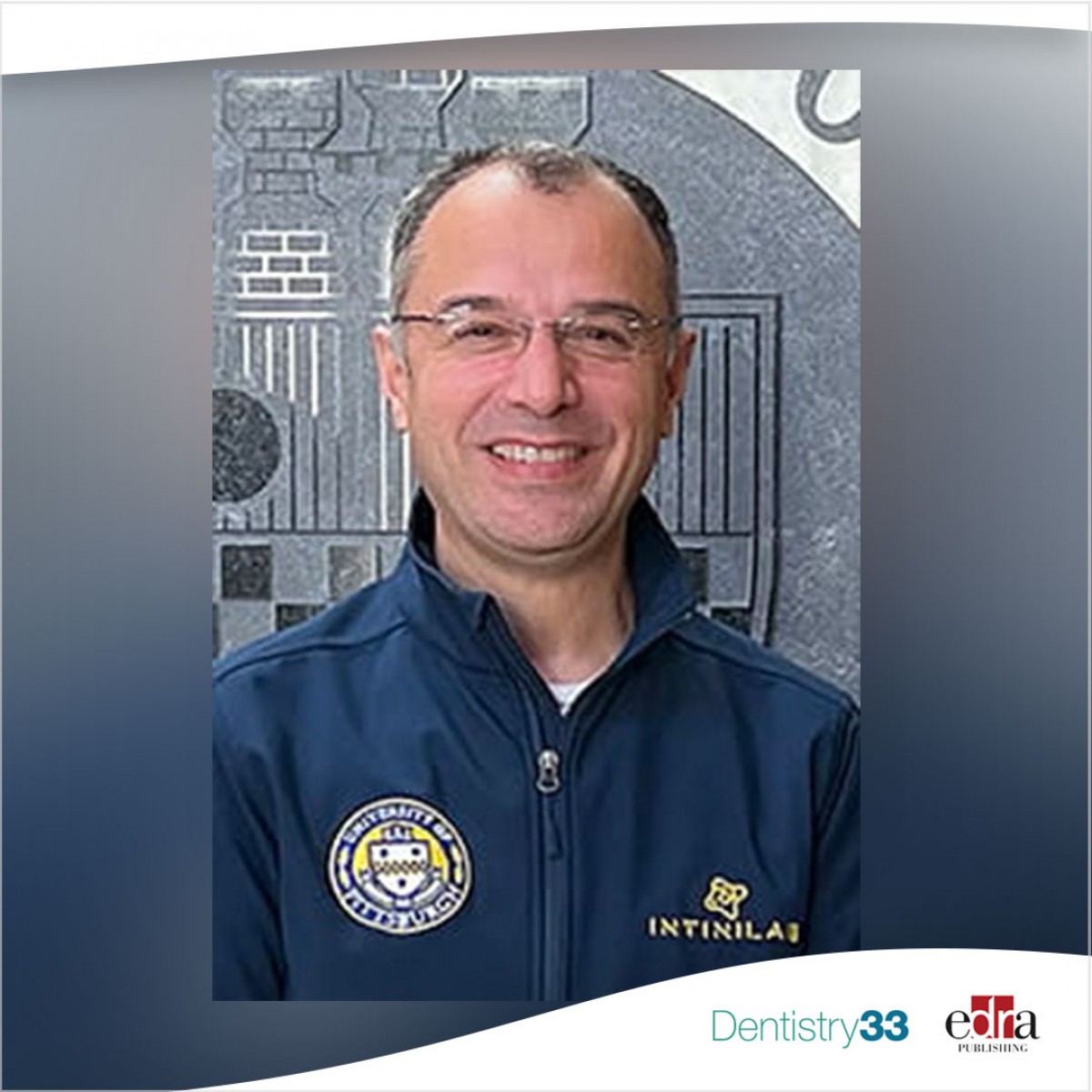
Young babies and newborn mice can naturally heal damage to the bones that form the top of the skull, but this ability is lost in adults. In a new study published in Proceedings of the National Academy of Sciences, University of Pittsburgh researchers developed a novel approach that promoted bone regeneration in mice without implantation of bone tissue or biomaterials.
According to a university news story, the technique uses a device similar to an orthodontic wire used to realign teeth to carefully stretch the skull along its sutures, activating skeletal stem cells that reside in these wiggly seams. In adult mice, the technique repaired damage to the skull that otherwise would not have healed on its own.
“Our approach is inspired by babies because they have an amazing ability to regenerate bone defects in the calvarial bones that make up the top of the skull,” said senior author Giuseppe Intini, D.D.S., Ph.D., associate professor of periodontics and preventive dentistry at the Pitt School of Dental Medicine, member of the McGowan Institute for Regenerative Medicine and an investigator at UPMC Hillman Cancer Center. “By harnessing the body’s own healing capacity with autotherapies, we can stimulate bone to heal itself. We hope to build on this research in the future to develop novel therapies for people,” he said.
Trauma, congenital defects and surgery to treat cancer or other diseases are common causes of damage to the skull. After people reach the age of about 2 years, such injuries don’t heal on their own.
“In babies, the calvarial bones are not completely fused, so the sutures where stem cells reside are still open,” said Intini. “We wondered whether the unfused sutures had something to do with the bone regenerative capacity observed in babies and hypothesized that we could reverse engineer this in adults by mechanically opening the sutures to activate the stem cell niche and boost stem cell numbers.”
In mice — which have very similar skull development to humans — the researchers used a so-called bone distraction device to carefully apply a controlled pulling force to the calvarial bones, strong enough to slightly widen the sutures but not enough to cause a fracture. Using single-cell RNA sequencing and live-imaging microscopy, they found that the number of stem cells in the expanded sutures of these animals quadrupled.
As a result, mice treated with the device regenerated bone to heal a large defect in the skull.
“If you can effectively activate the stem cell niche, you can increase the number of stem cells and sustain regeneration of bone defects,” said Intini. “Remarkably, we showed that the defect can heal even if it’s away from the suture.”
Although the approach was effective in healing skeletally mature 2-month-old mice, the age that roughly translates to young adulthood in humans, it did not work in 10-month-old, or middle-aged, rodents.
“In older mice, the quantity of stem cells in calvarial sutures is very low, so expanding this niche is not as effective in boosting healing capacity,” Intini explained. “Overcoming this challenge is a focus of research to come.”
Current treatments for damage to the skull are usually bone grafts or implantation of biomaterials that act as scaffolds for bone regeneration, but these approaches are not always effective and come with risks, said Intini.
The researchers are investigating how their findings could be used to inform novel therapies in people, not just to heal skull injuries but also fractures in long bones such as the femur. Bone distraction devices are already used to treat certain conditions such as a birth defect called craniosynostosis, in which the calvarial bones fuse too early, so expanding this technique to promote bone regeneration could be a future focus of clinical trials.
Intini and his team are also investigating non-mechanical approaches to activate skeletal stem cells such as medications.
Other authors who contributed to the study were Zahra A. Aldawood, D.M.Sc., of the Harvard School of Dental Medicine and Imam Abdulrahman Bin Faisal University; Luigi Mancinelli, Ph.D., Xuehui Geng, M.D., M.S., Taiana C. Leite, D.D.S., M.S., and Roberta Di Carlo, Ph.D., all of Pitt; Shu-Chi A. Yeh, Ph.D., and Charles P. Lin, Ph.D., both of Massachusetts General Hospital; Jonas Gustafson, of Seattle Children’s Research Institute; Katarzyna Wilk, M.S., Joseph Yozgatian, D.D.S., M.M.Sc., Ph.D., Sasan Garakani, D.D.S., and Seyed Hossein Bassir, D.D.S., D.M.Sc., of the Harvard School of Dental Medicine; and Michael L. Cunningham, M.D., Ph.D., of the Seattle Children’s Research Institute and the University of Washington.
This research was supported by the National Institutes of Health’s National Institute of Dental and Craniofacial Research (grants #R00DE021069 and #R01DE026155).
Read the original story on the university's news site.
Zahra A. Aldawood et al. "Expansion of the sagittal suture induces proliferation of skeletal stem cells and sustains endogenous calvarial bone regeneration." Proc. Natl. Acad. Sci. April 11, 2023. 120 (16) e2120826120. https://doi.org/10.1073/pnas.2120826120
 Tag
Tag
Related articles
Implantology 07 April 2026
The loss of tooth can be psychologically traumatizing. Attempts to replace teeth have been seen even in ancient civilizations.
News 25 February 2026
Bioactive Crystal Technology (BCT): The Science Behind Predictable Bone Regeneration

OsteoGen™ bone grafting materials feature non-sintered, biomimetic calcium phosphate crystals that promote regenerative bone growth

An interdisciplinary group of University of North Carolina at Chapel Hill researchers were recently awarded a grant to study and develop a novel, phytochemical-based triple-agent biomaterial designed...
Products 16 January 2025
Neoss Launches NeoGenix Extraction Allograft for Simplified Bone Regeneration

Neoss Inc., a leading innovator in dental implant solutions and digital workflows, is excited to extend its line of biomaterials with the NeoGenix Extraction Allograft.
Products 13 November 2024
Neoss Launches NeoGenix Extraction Allograft for Simplified Bone Regeneration

Neoss Inc., a leading innovator in dental implant solutions and digital workflows, is excited to extend its line of biomaterials with the NeoGenix Extraction Allograft.
Read more
Products 15 October 2026
The belief in the healing power of light goes all the way back to ancient Egypt and the worship of Rah, the sun god.
Nearly half the world’s population is affected by oral disease—and the number of cases is rising.
News 15 October 2026
New office at 3170 R Street adds walk-in availability and same-day care options in a region where dental providers are in short supply

Each year, the University of Colorado Anschutz School of Dental Medicine (SDM) Excellence Awards recognize individuals whose dedication, leadership and innovation strengthen our mi
Oral surgery 15 October 2026
This peer-reviewed oral surgery article summarizes clinical evidence from International journal of oral and maxillofacial surgery (2026). It focuses on findings that may help dental professionals...



Copyright © 2026 - All Rights Reserved
ISSN 2767-1178