


When doing nothing is the best investment strategy
Author: Luigi Campopiano

Often in times of crisis, either real or imagined we are encouraged to act. If your house is on fire or if you witness a car accident you must do something and quick. When dealing with investments instead it is not at all obvious if you should act immediately or for your long term interests. Nevertheless, when faced with alarming news or in highly volatile markets, many investors feel obliged to act. Stressful times like these can provoke an instinctive reaction, that leads us to fight or to flee. We insist that both these constitute actions as such, so we can contrast “fight or flight” with “wait and see”.
On the other hand, choosing to do nothing in turbulent times can turn out to be the wisest course an investor can follow. After carefully examining the situation at hand, non action may be the way to stay on the strategic path you have chosen, whereas actions that deviate from your plan may impede you from reaching your long term goals. We will use a correction (sudden and strong -15-20 % caused by sentiment) to illustrate a case, and we will attempt to demonstrate that selling part or the whole of one’s portfolio could be a grave mistake.
Case analysis. The potential costs of decisive action
Selling everything during a correction may make you feel better. You are acting decisively and you could have the satisfaction of seeing markets fall even lower. However soon this satisfaction could change into regret. Generally market corrections are caused by psychological factors or by false fears and often cease just like they started. Rapid and unpredictable. Trying to foresee the tempo of these corrections could turn out to be disadvantageous. If you sell after the start of the correction and buy back only partially during the recovery, you could miss out on the upside and just consolidate losses. To give you an idea of the impact of deciding to sell after a fall, and thus not participating fully in the subsequent rise, observe figure 1 that traces the path of two hypothetical investors during the market correction between May 21, 2015 and January 2, 2016. In this example prices are expressed in US dollars, and even if the results may vary for different currencies, the lesson to be learned is the same. For the sake of example let us suppose that each investor placed $ 1 million on MSCI Worlds Index on the January 2 2015. Investor A stays invested throughout the period, whereas, investor B sold out on February 11, 2016, the bottom of the correction, when panic and bad news was highest. A short while later, investor B reinvests, having remained liquid for just one month, but in this brief lapse of time world markets have regained 11 %. The loss of this opportunity causes B’s net worth to fall well below that of investor A by year-end 2016. Investor B’s has registered a loss over the year while investor A has a 6.6% gain in the same period. This is an extreme example but it serves to illustrate how trying to anticipate the trend and timing of the correction can seem prudent at the time but in time turns out to be counterproductive and detrimental to the portfolio.
Figure 1. Staying on the sideline can be disadvantageous

*NB: this example is purely hypothetical aimed at illustrating a theory and does not reflect real performance and must not be used as a forecast. Source: FactSet, 10/01/2019. Performance dell’MSCI World Index including net dividends and Bank of America US Treasury Bill (3-Month) Total Return Index, 31/12/2014 – 30/12/2016. Three month T-bill has been used to approximate the calculation of the yield of liquidity. Indexed to 1.000.000 USD alt31/12/2014. The value of investments and relative yields depends on the fluctuations of markets and currencies exchange rates worldwide.
How to be strong in difficult times
Doing nothing in times of trouble does not make you feel good, but it is an active decision, that can turn out to be the best in the longer term. In a crisis situation it is very hard to stay still when everyone around seems to do the smart thing by selling. Often advisors and consultants are also suggesting you sell. What are you supposed to do? Ask yourself if the decline is due to fundamentals or to sentiment.
The easy answer is that if it is sentiment that you think is unjustified by fundamentals then the decision to do nothing and ride out the market volatility is the best choice. Unfortunately being patient is not easy, especially when markets are tossing about. Over the eons of evolution we have developed the instinct to take action when under pressure. However the challenges that we face with stock markets are very different from those that we faced over the greater part of our history. We therefore have to adopt different strategies to develop patience and lucidity in our investment decisions.
Think long-term.
Remind yourself of your objectives over time and how best to reach them. If you want to increase your net worth over time, then holding stocks is probably the best strategy. Prepare yourself mentally for corrections and downtrends.
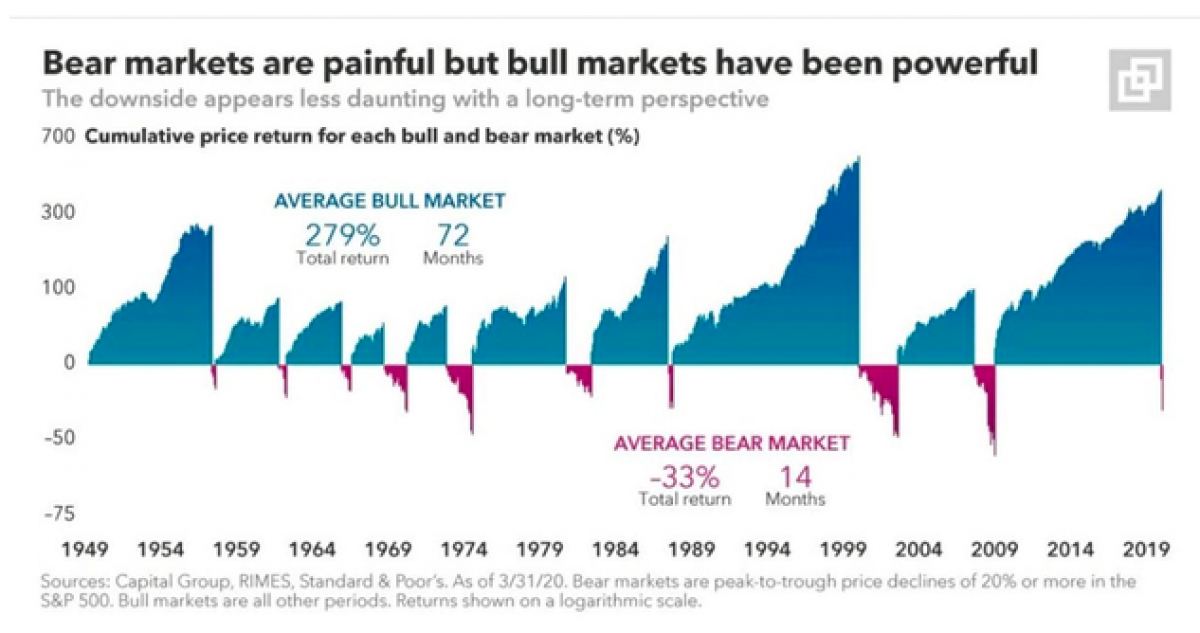
Markets are by definition volatile. Try to understand whether the decline of a stock reflects fundamentals or just temporary hype. If it is just sentiment then do not worry too much. Take comfort from the long history of capital markets. Declines have been usually temporary and short lived, and sooner or later reverse. Holding stock is one of the best ways of benefiting from economic growth, from innovation, and from compound interest. Obviously it is not easy, but we hope that this advice can help you concentrate on the long term and find consolation in the exceptional performance of stocks over time. The average long-term yearly performance of the MSCI World Index, has been 8.8% including bear markets and corrections. This suggests that trying to forecast market trends is useless if you have a long-term perspective.
Being patient and prudent are probably the two best attitudes. In the next turbulent phase try and think of doing nothing as an active choice that can be the best choice over time.
 Related articles
News 21 September 2026

The Aspen Group (TAG), a leading healthcare support organization headquartered in Chicago’s West Loop, today announced two key additions to its marketing leadership team: David Chr
News 11 August 2026

Gargle’s marketing assessment helps dental practices understand their online visibility across AI search, Google Search, website performance, and local marketing.
News 16 February 2026

Clerri, the dental industry’s largest and most trusted membership platform, today announced the launch of an advanced marketing toolkit designed to help dental practices bridge the gap between...
News 29 April 2025

Golden Proportions Marketing, a leader in dental marketing solutions, is proud to announce an exclusive upcoming webinar, “Purpose-Driven Partnerships & Marketing Strategies for New Dental...
Products 27 February 2025
Scott Leune Announces DentalMarketing.com as the Official Sponsor of The Dental CEO Podcast

Scott Leune is proud to announce DentalMarketing.com as the official sponsor of The Dental CEO Podcast, a new platform dedicated to providing dentists with the strategies, insights, and leadership...
Read more
Products 13 October 2026


New Resources Help Dental Exhibitors Evaluate Their Investment and Explore the Personify ShowFlow™ Trade Show Success System
News 13 October 2026

New patient apps extend The Aspen Group’s mission to remove barriers to care, giving patients greater visibility, convenience, and control from booking through treatment
Editorials 13 October 2026

The forerunner of what’s now Texas A&M College of Dentistry opened 120 years ago in Dallas with the mission of educating dentists to provide quality care to patients in North Texas
Oral pathology 13 October 2026

This peer-reviewed oral pathology article summarizes clinical evidence from Oral oncology (2026). It focuses on findings that may help dental professionals evaluate treatment decisions, patient...



Copyright © 2026 - All Rights Reserved
ISSN 2767-1178