


Dr. Travis Campbell, Dental Insurance Guy: More dentists are dropping network contracts
Mary Guiden

Dr. Travis Campbell has been a practicing dentist since 2009, after graduating from the Baylor College of Dentistry in Dallas, Texas. He is an author, trainer, speaker, dental coach and consultant. Having gained a reputation as a resource for other dentists, Campbell has become The Dental Insurance Guy with an extensive online presence and membership program. From understanding insurance to developing strategies to accelerate practice growth, Campbell delivers practical, actionable content that dentists and team members can use immediately. His best-selling book, “Understanding dental insurance: a guide for dentists and their teams” is available through Edra Publishing. He recently spoke with Dentistry33 about trends he’s seeing, and how other dentists can benefit from his knowledge.
Q: What are the most common myths around dental insurance policies?
A: One of the common myths surrounding dental insurance is that most problems which occur with claims don’t have solutions to them. I hear complaints about lots of issues. Insurance is not the easiest thing in the world to understand and process. But a majority of the problems that we encounter with insurance do have solutions.
The no. 1 complaint I hear is on the topic of denials, which typically result from missing or inadequate information, or a lack of understanding of the policy specifics. In many cases, claims are rejected due to incomplete documentation from the clinical provider.
One question I hear all the time is: ‘Well, this same type of claim was paid 10 years ago without problems. Why am I having problems now?’ It’s simple: the process has changed over the last decade.
Most of today’s insurance documentation requirements are not that bad. Carriers just want to make sure the service is necessary and within the policy’s limitations. On the dentist's side, it does mean that we must do a better job with our documentation than we did a decade ago.
Another big myth is that insurance companies can dictate all of your office fees, even when they’re not covering a specific procedure or treatment. In 43 states, this would be illegal. That doesn’t mean the insurance company’s software won’t send you a denial incorrectly or inadvertently. Their software was not designed to deal with current state laws. Updating the software can be a complicated process and many insurance companies are decades behind the curve, in some cases leading to incorrect EOBs.
The other major issue I see is dentists misunderstanding their contracts. I don’t blame them, reading legal contracts is not fun. But I’ve spent a great deal of time reading dental insurance contracts. These contracts have a fair amount of information about when and how you can charge patients more for certain procedures or treatments. That’s a positive. The contracts outline what you can and cannot do.
These are among the myths I help people understand, how they affect us day to day and what dentists and their teams can do to increase production and collections.
Q: What, if any predictions do you have in terms of the economy and dentistry as we approach the end of 2022?
A: A current trend is insurance companies reducing their contractual fee schedules as well as reducing the amount of claim reimbursement. There will be aspects of this continuing in the coming years.
This trend is driven in large part by employers who are the major purchasers of dental insurance. As with most businesses, employers are trying to reduce their own costs and overhead in response to inflation.
When premium rates don’t go up and inflation increases, insurance companies must do something to modify their own costs. For the insurance company, the path of least resistance is reducing fees on the dentist’s end because we’re the ones who complain the least.
We may need to complain more as a whole. It also means that we need to understand what’s going on in the market.
There’s also a growing trend of dentists dropping network contracts. Some dental corporations and DSOs are considering dropping insurance contracts altogether, which would be a first in history.
If that does begin to happen, it will be interesting to see how insurance companies will respond. They don’t really care whether an individual dentist or 50 or 100 drop a network, but they will definitely take notice if thousands drop and some of these larger DSOs could drive significant change in dental insurance practices.
A long-term prediction is that a major shift will occur in the dental industry, whether it’s absorbed by medical or whether it takes a whole new direction. A move to medical coverage is the most likely now, but it will be an interesting shift when it does happen.
 Related articles

Learn from the best
Drs. Travis Campbell, Tony Feck and Chris Phelps are authors under the Edra Publishing label. We share some of their best soundbites and advice from recent...
International events 31 August 2022
Edra Publishing books contain all the dentistry 'hits' in new business bundle
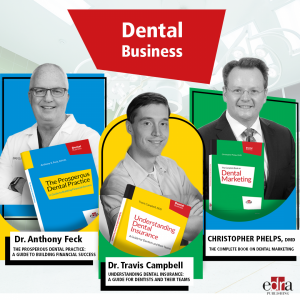
Edra Publishing's dental business bundle scientific content, launched its big hit, the book Understanding Dental Insurance, authored by Dr. Travis Campbell, a specialist in the insurance market...
USA 10 December 2021 - 17 December 2021
Does dealing with dental Insurance as a dentist make you want to cry?

Maximize Your Happiness with Dental Insurance by Dr. Paul Goodman and Dr. Travis Campbell will help you re-center your attitude towards dental Insurance. Whether you are totally FFS, OON, or...
Edra Professional Books 10 October 2026

Esthetics and function in complete denture prosthesis is an Edra professional dentistry reference focused on clinical practice, education and treatment planning.
Edra Professional Books 03 October 2026
Diode laser Manual in dentistry and stomatology: A Practical Reference for Dental Professionals

Diode laser Manual in dentistry and stomatology is an Edra professional dentistry reference focused on clinical practice, education and treatment planning.
Read more
Products 13 October 2026


New Resources Help Dental Exhibitors Evaluate Their Investment and Explore the Personify ShowFlow™ Trade Show Success System
News 13 October 2026
New patient apps extend The Aspen Group’s mission to remove barriers to care, giving patients greater visibility, convenience, and control from booking through treatment
Editorials 13 October 2026

The forerunner of what’s now Texas A&M College of Dentistry opened 120 years ago in Dallas with the mission of educating dentists to provide quality care to patients in North Texas
Oral pathology 13 October 2026
This peer-reviewed oral pathology article summarizes clinical evidence from Oral oncology (2026). It focuses on findings that may help dental professionals evaluate treatment decisions, patient...


Copyright © 2026 - All Rights Reserved
ISSN 2767-1178