


The Big Teeth That Can Cause Big Trouble
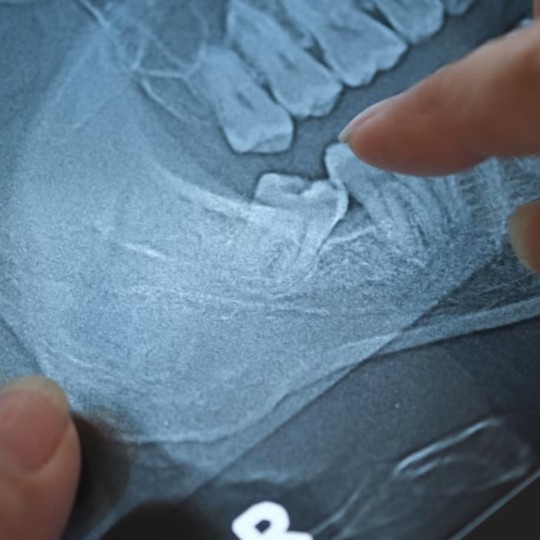
Wisdom teeth are among the largest, strongest teeth in the human mouth. At the same time, they are also among the most likely to be missing, small, or malformed, These four (two on the top, two on the bottom) molars typically come in last, generally when we’re in our mid- to late-teens.
“I don’t think that there’s any literature to support that they actually provide any additional wisdom,” jokes Johanna Hauer, D16, assistant professor in the Department of Oral and Maxillofacial Surgery at Tufts University School of Dental Medicine. “We actually just call them third molars,” she says of dental professionals.
While Hauer performs a variety of surgical procedures—removing benign tumors, addressing trauma, grafting tissue, reconstructing nerves—a very common one is wisdom tooth extraction. “Every single day, I would say, I remove wisdom teeth,” she says. Some 5 million Americans have some or all of their third molars removed every year; wisdom teeth are the most frequently extracted teeth in adulthood. Most people who have their wisdom teeth removed are between 17 to 25 years old.
Hauer spoke with Tufts Now to answer all our questions about wisdom teeth.
Is it true that something like 80% of people are born with fewer than four wisdom teeth? If so, why, and what does it mean?
The data does suggest that not all people have four wisdom teeth. (On the other hand, some people have another tooth behind the wisdom tooth. It’s not super common, but it does happen.) The third molars are the most frequently missing or misshapen teeth, and I believe that the incidence of people without all four wisdom teeth is rising—and there’s no clear answer why.
There is some thought that, because we are not using our third molars, that in the future they might not develop anymore. Evolution happens over tens of thousands of years, so we’re unlikely to see that in our lifetime. That said, scientists are working on preventing the development of third molars, because while wisdom tooth surgery is very, very safe, it does carry risks.
It seems like having wisdom teeth removed is almost a rite of passage in the United States. Why are third molars extracted with such frequency?
Oral and maxillofacial surgeons used to just take out the third molars because they’re there. Dentists thought there was a higher likelihood that they would crowd the rest of the teeth. But that’s changed. The most recent American Association of Oral and Maxillofacial Surgeons guidelines recommend only extracting wisdom teeth when there’s a good reason to do so.
Wisdom teeth that don’t come all the way into the mouth and remain impacted are at risk for developing cysts or tumors. Wisdom teeth are very far back in the mouth, making them hard to monitor using small dental X-rays, so tumors and cysts around wisdom teeth can become pretty decent-sized before they’re identified. And even when they’re benign, they can cause damage. Some patients don’t want to have to monitor their wisdom teeth for this.
In general, the lower jaw has gotten somewhat smaller over time, maybe because the human diet has changed. It may be related to increased consumption of processed foods. Foods are softer, contributing to less lower jaw bone growth. And with more access to fluoride, patients are less likely to lose teeth to decay before their wisdom teeth come in, and the absolute length of all the teeth combined is bigger than the available space in the jaw bone. That means teeth are either super crowded or don’t come into the mouth completely, conditions that require extraction.
What’s changed in wisdom tooth extraction during your career so far?
If anything, I’m doing extractions of wisdom teeth on younger patients than I did 10 years ago. It's a trend, and it’s starting to be published about. We have good data to suggest that patients who have their wisdom teeth out before they’re 26 heal better. Relatedly, third molars are developing when people are younger. It used to be unheard of to take out a 13 or 14-year-old’s wisdom teeth, but not anymore.
If wisdom teeth don’t fully come in in the right position, is extraction the only option, or are there other ways to manage the situation?
If third molars aren't coming in properly, it’s exceptionally difficult to reposition them. Teeth need a place to anchor if they’re going to be moved. Wisdom teeth, being the very last, have nothing to provide an anchor behind them. It’s very uncommon to move third molars, and not usually very successful.
So in the absence of some very specific circumstances, we extract them. Some people’s teeth are almost all the way in, with a small overhang of tissue. Sometimes we trim the gum tissue to help the tooth work properly, but we can only do that if it’s 99% or 98% of the way in and fully functional.
There’s also a procedure called a coronectomy, which is removing the top part of the tooth (the crown) and leaving the roots behind. We do that for patients who are at high risk for a nerve injury, which we would be able to see on an X-ray. This procedure is less likely to cause permanent nerve injury than a full extraction.
What is your advice for recovering well from having wisdom teeth removed?
After a wisdom tooth extraction, we most frequently advise: no smoking, no spitting, and no straws. More generally, if you’ve just had your third molars removed, treat yourself like you would with any kind of injury. Rest and take care of your body. Eat nutritious foods. As you recover, ice your jaw, elevate your head, and let your jaw rest—avoid chewing aggressively, and eat soft foods. Give yourself a little grace, because it can be very uncomfortable.
Astronauts are supposed to have their wisdom teeth removed before they go into space. Can you talk about that?
I’m not surprised at that. Similarly, somebody being deployed for the military needs to have their wisdom teeth out before leaving. I would imagine, if you were going to live in Antarctica for a year, you should probably think about having them out.
I think the rationale is that some people have impacted, or partially impacted, wisdom teeth that haven’t ever bothered them. But when a wisdom tooth becomes a problem—be it a cavity or bacteria getting trapped under the gums—infections can develop very quickly. They can be life-threatening.
In the last three weeks, I’ve had three relatively young patients come in through the emergency room and the ICU, with life-threatening infections from their wisdom teeth. For the most part, the pain had developed in a few days and if they hadn’t had access to emergency surgery, they might not be with us.
Source:
 Related articles
Editorials 27 August 2026
From California to Canada: CU Anschutz School of Dental Medicine at ADEA, GRC and IADR 2026
The CU Anschutz School of Dental Medicine will showcase a wide breadth of educational innovation, faculty development, clinical training and research at three major gatherings this
Editorials 06 August 2026
From California to Canada: CU Anschutz School of Dental Medicine at ADEA, GRC and IADR 2026
The CU Anschutz School of Dental Medicine will showcase a wide breadth of educational innovation, faculty development, clinical training and research at three major gatherings this
Editorials 23 July 2026
From California to Canada: CU Anschutz School of Dental Medicine at ADEA, GRC and IADR 2026
The CU Anschutz School of Dental Medicine will showcase a wide breadth of educational innovation, faculty development, clinical training and research at three major gatherings this
Editorials 22 July 2026
Taylor accepted as a Fellow of the American Dental Education Association Council of Deans

Reginald Taylor, associate professor and director of predoctoral orthodontics at Texas A&M College of Dentistry in Dallas, was recently accepted into the American Dental Education
For the second year in a row, the American Association of Orthodontists will celebrate Smiles at 7 Day on July 7.
Read more
Products 15 September 2026

News 15 September 2026
Henry Schein to Present at Baird Global Healthcare Conference

Henry Schein, Inc., the world’s largest provider of healthcare solutions to office-based dental and medical practitioners, announced today that the Company will present at the foll
News 15 September 2026
PDS Health and United Concordia Launch Saliva Screening Pilot

United Concordia Dental and PDS Health®, leaders in oral health and dental-medical integration, respectively, launched a saliva screening pilot in Southern California earlier this
Editorials 15 September 2026

The forerunner of what’s now Texas A&M College of Dentistry opened 120 years ago in Dallas with the mission of educating dentists to provide quality care to patients in North Texas
Oral pathology 15 September 2026
This peer-reviewed oral pathology article summarizes clinical evidence from Oral oncology (2026). It focuses on findings that may help dental professionals evaluate treatment decisions, patient...



Copyright © 2026 - All Rights Reserved
ISSN 2767-1178