


Would You Drink Your Dental Unit Water? The Truth About DUWLs and SOPs
Let’s start with a question that tends to make people shift in their seats a little: Would you drink from your dental unit waterline?
Not after a long flush. Not after telling yourself, “It should be fine.” I mean confidently, without hesitation.
If the answer is anything other than a solid yes, then we need to talk about your systems. Not your intentions or your team. Your systems. Because success with waterlines is not about trying harder. It is about having a disciplined, repeatable protocol that works even on your busiest day. 1
DUWL management is not a water problem. It is a biofilm problem. And biofilm does not care that your schedule is full. It does not care that someone flushed the lines this morning or threw a waterline management tablet in the bottle a few times a week. It thrives in inconsistency.
Narrow tubing, low flow, and stagnant periods create the ideal environment for microbial growth. Once established, biofilm continuously sheds bacteria into the water that your patients are exposed to. 2 And we all know that exposing patients to bacteria-laden waterlines can cause serious health issues. 3
Unfortunately, you cannot see it or smell it, and you definitely cannot flush it away.
That is why “we run the lines every morning” is not a protocol. It is a habit, but habits alone do not control biofilm. Regulatory guidance from organizations like the CDC and EPA sets a benchmark of ≤500 CFU/mL for water used in nonsurgical dental procedures. 4
SOPs: The Difference Between Hope and Control
A Standard Operating Procedure is where intention becomes execution. Without it, each team member fills the gaps differently. With it, everyone operates from the same playbook.
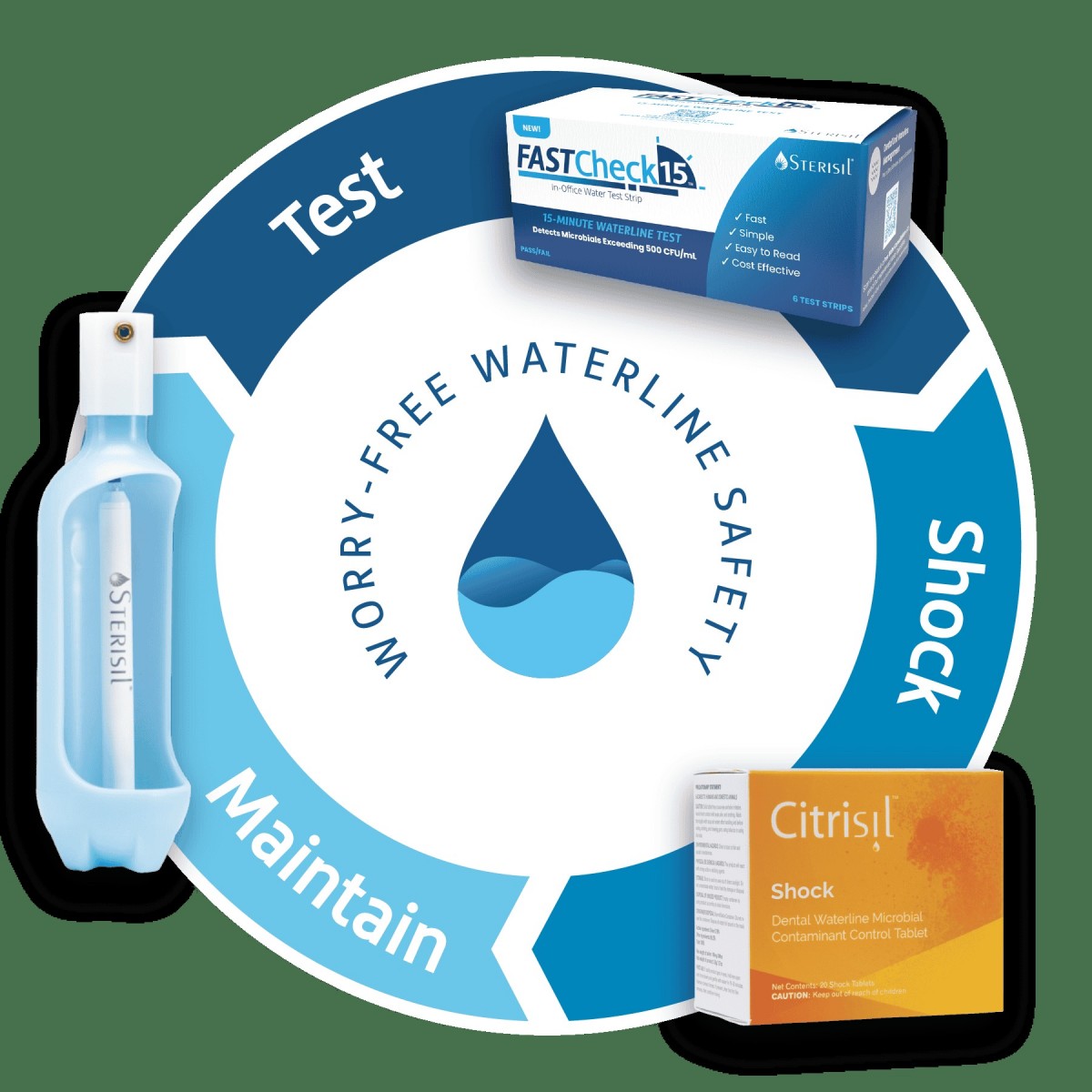
And here is where the framework I suggest becomes incredibly practical. I break down DUWL success into three simple, non-negotiable steps:
Not one of the three. Not two when you remember. All three. They work together.
Testing tells you what is actually happening inside your lines, not what you think is happening. Shock removes existing contamination and disrupts biofilm, while maintenance prevents regrowth through consistent daily treatment.
Miss one, and the system can easily fail.
Testing is especially critical. In my training, I highlight how you cannot manage what you are not measuring. Testing is the step that reveals hidden failures before they become bigger problems. 5 A strong SOP builds this framework into daily, weekly, and monthly workflows so that it becomes automatic rather than optional.
The DUWL Champion: Because “Everyone” Means “No One”
Let’s talk about the real breakdown point in most practices: ownership.
When DUWL management belongs to everyone, it ends up belonging to no one. And this is exactly the kind of human behavior gap I am constantly calling out. Systems fail not because people do not care, but because roles are unclear and accountability is diminished.
Assigning a DUWL Champion is essential because they own the SOP, track testing results and trends, and ensure shock protocols are completed correctly. They are also responsible for verifying that daily maintenance is happening and for keeping documentation clean and audit-ready.
And maybe most importantly, they ask the uncomfortable questions: “Did we actually do this, or are we assuming we did?”
In many practices, this naturally aligns with a hygienist’s or dental assistant’s role because they are already trained to think in terms of prevention, biofilm, and long-term patient safety. 4 However, the title matters less than having one person with clear responsibility.
Why Most SOPs Fail (Even When They’re Good)
Here is the part that does not get talked about enough. You can have a clinically sound SOP and still fail. Why? Because if it is too complicated, it will not be consistently followed.
All protocols must be designed for real-life dentistry, not ideal conditions, accounting for busy schedules, team turnover, human error, and competing priorities. If your system requires too many steps, too much guesswork, or too much time, it will break under pressure. And when it breaks, biofilm sneaks in and takes over.
The Role of Products: Supporting the System, Not Complicating It
This is where product selection becomes more than a preference and more of a strategic decision. The right products not only treat waterlines; they also support your SOP. They reduce variability, making the right thing easier to do every single day. Because let’s be honest, if your protocol depends on perfect human behavior, it is not a strong system.
The Sterisil ® SAFEWater Protocol: Designed for Consistency
Systems like the Sterisil ® SAFEWater protocol align closely with the Test, Shock, Maintain philosophy. 6 Instead of piecing together multiple products and hoping they work together, the approach is structured and intentional.
The system combines the Sterisil ® Straw for continuous silver ion treatment (which is proven superior in performance to iodine) 7 , Citrisil™ Shock for biofilm disruption and shock treatment, and both FAST Check15 ® and Sterisil ® R2A with FAST Read™ testing to verify performance. Each component addresses a different part of the protocol, but together they create a more unified and repeatable approach to waterline management.
Because the products are designed to function as a coordinated system from one manufacturer, practices benefit from less guesswork, fewer workflow complications, and a protocol that is easier for teams to implement consistently.
This approach is powerful because chemistry and simplicity combine. With fewer steps, clear guidance, and repeatable outcomes, it aligns exactly with what a successful SOP needs. Creating a perfect protocol on paper is a waste of time unless you create a system your team can execute consistently without friction.
However, it is not just about products or protocols. Office culture is a major factor. You need to create a culture where testing results are reviewed, not ignored; failures are investigated, not hidden; team members feel responsible, not confused; and systems are followed, not bypassed.
When DUWL safety becomes part of the practice identity, not just another task, everything changes. Effective DUWL management comes down to three pillars: a clear SOP built around Test, Shock, and Maintain with zero guesswork; appointing a defined DUWL champion who owns the system and removes diffusion of responsibility; and a simplified product protocol.
Using the full suite of Sterisil ® SAFEWater Solution products supports consistency instead of relying on it. Miss one step, and cracks start to form. But get all three right, and something shifts. Your team stops guessing. Your systems start working. And that uncomfortable question at the beginning? It becomes a lot easier to answer.
And that is the level of confidence your patients should never have to question.
 Related articles
Editorials 25 September 2026

Editorials 10 September 2026

News 15 July 2026
Young Innovations, a leading global manufacturer and distributor of dental supplies and equipment, announced the appointment of Rebecca Whitney as Chief Executive Officer, effectiv
Editorials 14 July 2026
Smile, you’re in demand: Dental hygienists find a friendly job market but limited benefits
The 30 newest graduates of Texas A&M College of Dentistry’s dental hygiene program earned both their dental hygiene pins and diplomas last month.
News 03 June 2026
America’s ToothFairy is inviting dental professionals , educators, and community organizations to take part in its annual Share Your Smile campaign throughout the month of June in
Read more
Europe 27 September 2026 - 30 November -0001
Digital Dentistry Society Global Congress 2026: Event Preview and Professional Highlights

The Digital Dentistry Society Global Congress 2026 will take place from October 22, 2026 to October 24, 2026 in TBD, Rotating Europe, offering dental professionals a focused environment for...
Editorials 27 September 2026
Dentistry33 survey highlights replacement care, deep caries and evolving restorative workflows
Reader survey finds direct composites remain dominant, secondary caries is the leading reason for restoration replacement, and clinicians want more training in pulp preservation
Reader survey finds direct composites remain dominant, secondary caries is the leading reason for restoration replacement, and clinicians want more training in pulp preservation
Edra Professional Books 26 September 2026
Manual of oral surgery: A Practical Reference for Dental Professionals
Manual of oral surgery is an Edra professional dentistry reference focused on clinical practice, education and treatment planning.
Products 25 September 2026
Shofu Dental’s line of dental restorative materials now includes FX-LC, a next-generation, light-cure, resin-reinforced glass ionomer formulated to deliver high strength, efficient 4
News 25 September 2026
The scholarships are part of an ongoing workforce solutions strategy to help address the need for skilled dental hygienists



Copyright © 2026 - All Rights Reserved
ISSN 2767-1178