


What’s Really Lurking in Your Waterlines?
Let’s be honest: dental unit waterlines aren’t the most glamorous topic in dentistry. They don’t make the cover of trade magazines and they rarely come up at study clubs. But they should, because what’s flowing through those narrow tubes and into your patients’ mouths may be more dangerous than most clinicians realize.
A 2023 RDH Magazine survey painted a troubling picture. Ten percent of dental professionals reported doing nothing to treat their dental unit waterlines (DUWLs), and even more concerning, 24 percent reported not testing their waterlines at all.1 Those numbers should give every practice owner pause, especially in light of the legal, regulatory, and clinical consequences of neglecting this critical aspect of infection control.
The Science Behind the Problem
The problem isn’t your water—it’s your waterlines. Water that’s safe at the source doesn’t guarantee it’s safe at the dental chair. Studies have confirmed that DUWLs are frequently contaminated by large numbers of microorganisms from multiple sources: the municipal water supply, suck-back of patient saliva from high-speed handpieces during the slowdown phase, and even bottled water systems.2,3
The conditions inside dental unit tubing are essentially a perfect incubator:
- Narrow lumens of just 0.5–2 mm with a high surface-to-volume ratio of 6:14-6
- Intermittent water flow during working hours and complete stagnation overnight and on weekends
- Dark, warm environments where pathogens thrive, particularly between 77°F and 113°F7
Together, these factors give microorganisms ample opportunity to build up a strong, matrix-encapsulated biofilm that resists antimicrobial treatments. Biofilms constitute the main reservoir for continued contamination and can push bacterial levels thousands of times higher than those allowed in drinking water.8 The key pathogens of concern include Pseudomonas, Legionella, and Nontuberculous Mycobacterium Abscessus (NTM). NTM infections are particularly devastating. Treatment often requires surgical removal of infected tissue including permanent teeth, and IV antibiotics that can cause permanent hearing loss.
Here’s what should concern every clinician: even if your handpieces are thoroughly sterilized, connecting them to a contaminated water supply renders those efforts ineffective.3 The chain of infection control is only as strong as its weakest link, and for too many practices, that weak link is the waterline.
When Waterlines End Up in the Courtroom
If the clinical risks aren’t enough to demand attention, the legal landscape should be. Litigation related to waterline contamination has increased significantly in recent years, and the cases that have gone to court are deeply unsettling.
In Clayton County, Georgia, almost two dozen children between the ages of 6 and 10 contracted NTM infections after pulpotomies at a pediatric dental clinic. Water testing after the outbreak revealed microbial levels more than 182 times the maximum acceptable level. The lawsuit contended that the clinic failed tomonitor water quality, disinfect waterlines, and maintain adequate infection prevention protocols. The fallout: Georgia enacted new legislation requiring quarterly waterline testing to meet EPA standards of 500 CFU/mL or less.9
In Anaheim, California, a 2016 bacterial outbreak at a children’s dental clinic sickened dozens of children ranging in age from 2 to 11. Orange County Healthcare Agency officials concluded the bacteria came from the office’s water system.10 The crisis hospitalized 73 children while hundreds more faced dangerous infections, and 150 families filed lawsuits.11 The clinic had already shut down twice in 2016 after tests showed bacteria in the water.12
The CDC Weighs In
In 2022, the CDC issued a Health Alert Network Advisory reinforcing the importance of maintaining and monitoring dental waterlines to meet the EPA standard of ≤500 CFU/mL.13 The agency’s recommendations are clear:
- Maintain a formal infection prevention plan with policies and procedures dedicated to water quality
- Provide staff training on waterline maintenance based on manufacturer instructions, for all new hires and at least annually
- Document all maintenance records, monitoring results, and employee trainings
- Report infections suspected to be associated with dental care to public health authorities14
Between the lawsuits, new state regulations, and the CDC advisory, the message is clear: waterline management is no longer something practices can afford to overlook.
The Solution: Test, Shock, Maintain
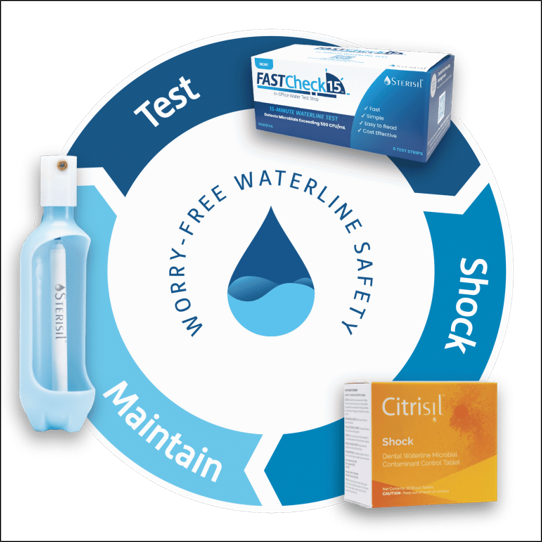
So, what does effective waterline management actually look like? It doesn’t have to be complicated. The Sterisil® SAFEWater Solution is the only end-to-end system for dental unit waterlines, built around a simple three-step protocol that takes the guesswork and daily burden out of water safety.
Test with FASTCheck15®. You can’t manage what you can’t measure. FASTCheck15 is a 15-minute in-office waterline test strip that gives you fast, reliable, real-time results without waiting days for lab reports. That speed matters, because you can validate water quality and take immediate corrective action while the information is still actionable. It’s the kind of practical, chairside tool that makes routine testing realistic rather than aspirational.
Shock with Citrisil™ Shock. When test results indicate elevated bacterial counts, or when waterlines have been stagnant over a long weekend or holiday, a shock treatment is essential. Citrisil Shock is specifically formulated to clean dental unit waterlines and restore peak safety levels. Because it’s designed to work with the Sterisil Straw, there are no straw changes or dummy straws required during the process. That means less downtime, fewer steps for staff, and a faster return to normal operations.
Maintain with Sterisil® Straw. This is where the SAFEWater Solution really shines. The Sterisil Straw continuously treats waterlines for a full 365 days with no daily maintenance required. No emptying bottles at the end of the day. No flushing lines. No remembering one more compliance task when your team is already juggling a dozen others. It provides year-round protection against biofilm formation and microbial contamination, working quietly in the background so your team can focus on patient care.
What makes these products unique isn’t just their individual performance. It’s that they’re designed to work better together as an integrated system. Regular in-office testing combined with proper shock protocols helps practices pass more tests and keep every operatory running. In an era of increased scrutiny and evolving regulations, the Sterisil SAFEWater Solution offers something every practice needs: worry-free waterline safety, simplified.
Source: https://www.cdc.gov/
 Related articles
When patients brush their teeth before heading to bed, many assume their manual brush removes enough plaque.
When patients brush their teeth before heading to bed, many assume their manual brush removes enough plaque.

Just like natural teeth, implants require daily brushing and flossing to keep your mouth healthy 

Read more
Products 20 October 2026

News 20 October 2026

In recognition of National Dental Hygiene Month, Delta Dental highlights key findings from its 2026 State of America’s Oral Health and Wellness Report , a nationwide analysis of co
News 20 October 2026
Abra Health Group has launched The Dental Bank, a new community impact initiative designed to make essential oral health resources more accessible to individuals and families throu
Editorials 20 October 2026
Woman’s skull likely proof of ancient nose amputation, says College of Dentistry professor

Qian Wang, professor in biomedical sciences at Texas A&M College of Dentistry in Dallas, identified what he and other researchers believe is likely one of the first examples of an
Endodontics 20 October 2026
This peer-reviewed endodontics article summarizes clinical evidence from Clinical oral investigations (2026). It focuses on findings that may help dental professionals evaluate treatment decisions,...



Copyright © 2026 - All Rights Reserved
ISSN 2767-1178