


Edge Effect: Comparing the Strength of Ceramic Materials
Dinesh Sinha, BDS, PhD, interviews Nathaniel C. Lawson, DMD, PhD, director of the division of biomaterials at the University of Alabama at Birmingham School of Dentistry, about the strength testing of dental ceramic materials.
Q: Why is it important to understand the strength of dental ceramic materials?
A: Dental ceramics are the most commonly used materials for fixed restorations, with some national laboratories reporting 90% of their restorations being fabricated from dental ceramic. Understanding their strength is essential for dentists to determine the clinical parameters under which they should be used (eg, minimal restoration thickness, connector dimensions, areas of the mouth to be placed in, etc) in order to ensure patient safety and the longevity of restorations.
Q: What are the common methods used to measure ceramic strength?
A: In order to standardize testing methodology between industry, academia, and regulatory agencies, most testing laboratories will follow the International Standards Organization (ISO) protocols for measuring physical and mechanical properties. The ISO standards specify test specimen geometries and testing conditions that have been developed by a consensus of experts in the field.
Q: What are these ISO tests for measuring strength?
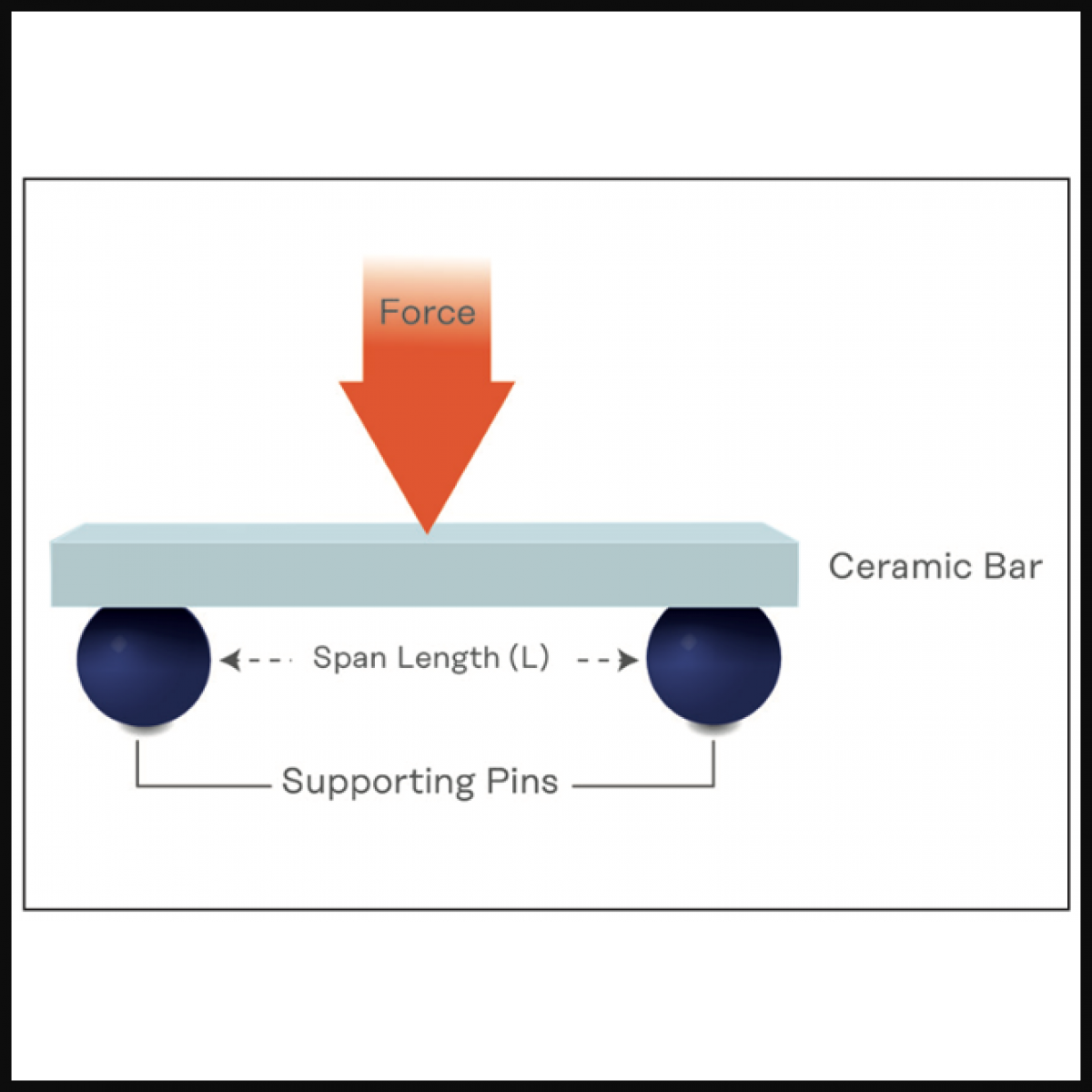
A: The ISO 6872:2015 is a standard that describes the methodology for testing various mechanical properties of dental ceramics, including strength. Three different methods are described for measuring strength: the 3-point bend flexural, 4-point bend flexural, and biaxial flexural (piston-on-3-balls) tests. The bending tests (3-point and 4-point) involve a bar-shaped specimen supported on either end that is loaded with either a single indenter at its midpoint (3-point) or 2 indenters centered at its midpoint (4-point). The biaxial flexural test involves a disc-shaped specimen supported by 3 balls loaded at its center.
Q: Why do ceramics fail?
A: Ceramics are brittle materials, meaning that they have the tendency to fracture without bending. The reason that ceramics fracture rather than bend is that their microstructure is composed of a lattice of atoms held together with covalent bonds. These bonds cannot slip past each other as can metallic bonds (which is the reason that metals can bend). Therefore, once a crack initiates in a ceramic, the crack is likely to propagate through the material. Zirconia is a unique ceramic as it can halt the progression of cracks by changing the structure of the crystals near the crack in a process called transformation toughening.
Q: Are there any advantages or disadvantages of using bar-shaped specimens (eg, 3-point bending [Figure 1]) vs disc-shaped specimens (eg, biaxial [Figure 2]) to compare ceramic materials?
A: In order to produce specimens for testing the strength of dental ceramics, the specimens are typically sectioned out of a block or puck using a circular saw. The challenge with producing bar specimens (eg, a 3-point bending test) is that it is technically challenging to produce flawless edges of the bars. It is common to have small chips at these edges where 2 faces of the bar meet. When breaking a 3-point bend specimen, fractures can easily originate from one of these small chips at the edge of the bar directly under the indenter. The area of the bar under the indenter will have the maximum bending moment in the bar, and any chips in that area are particularly susceptible to initiating a catastrophic crack. This issue is known as the edge effect. In order to mitigate this issue, the ISO recommends beveling the edges of the bars. Another option is to employ the biaxial flexural strength test, in which a disc-shaped specimen is loaded at its center. In this configuration, the indenter is in the center of the specimen farthest away from its edges, avoiding edge effects (Figure 2). Due to the edge effect, the strength measured with biaxial flexural strength testing is typically higher than that measured with 3-point bend flexural strength testing.
In the real world, in dental ceramics such as crowns and veneers, edges are very common—for example, at the margins of a crown. Additionally, these edges may experience high stress. Therefore, using test specimens subject to the edge effect (eg, in a 3-point bending test) may be a more clinically relevant method for comparing the strength of ceramics than comparing disc-shaped specimens (biaxial).
Source: www.kuraraydental.com
 Related articles
News 24 September 2026
An Expert’s Views on Comparing Fair Value Versus Fair Market Value of Dental Practices

There are a number of states that use fair value for determining the valuation amount of a dental practice, and it’s important for dental practice owners to understand the factors
News 20 August 2026

Contribution to multiple-choice CBT development supports ongoing efforts to establish competency standards in aligner orthodontics

Vyne Dental, a leading provider of dental revenue technologies and electronic health information exchange solutions, today announced a strategic partnership with Carestream Dental
News 15 April 2026

Bridge Dental Group is proud to announce its newest partnership with Foothill Family Dental Group and Peak Dental Specialists, two respected practices in Glendora, California, led by Dr. Mariam...

HSDM researchers uncover a key mechanism for bone health that could lead to potential therapeutic agents to mimic the effects of exercise
Read more
Products 15 October 2026
The belief in the healing power of light goes all the way back to ancient Egypt and the worship of Rah, the sun god.

Nearly half the world’s population is affected by oral disease—and the number of cases is rising.
News 15 October 2026

New office at 3170 R Street adds walk-in availability and same-day care options in a region where dental providers are in short supply
Each year, the University of Colorado Anschutz School of Dental Medicine (SDM) Excellence Awards recognize individuals whose dedication, leadership and innovation strengthen our mi
Oral surgery 15 October 2026
This peer-reviewed oral surgery article summarizes clinical evidence from International journal of oral and maxillofacial surgery (2026). It focuses on findings that may help dental professionals...


Copyright © 2026 - All Rights Reserved
ISSN 2767-1178