


Multiple radiolucencies in a 12-year-old boy
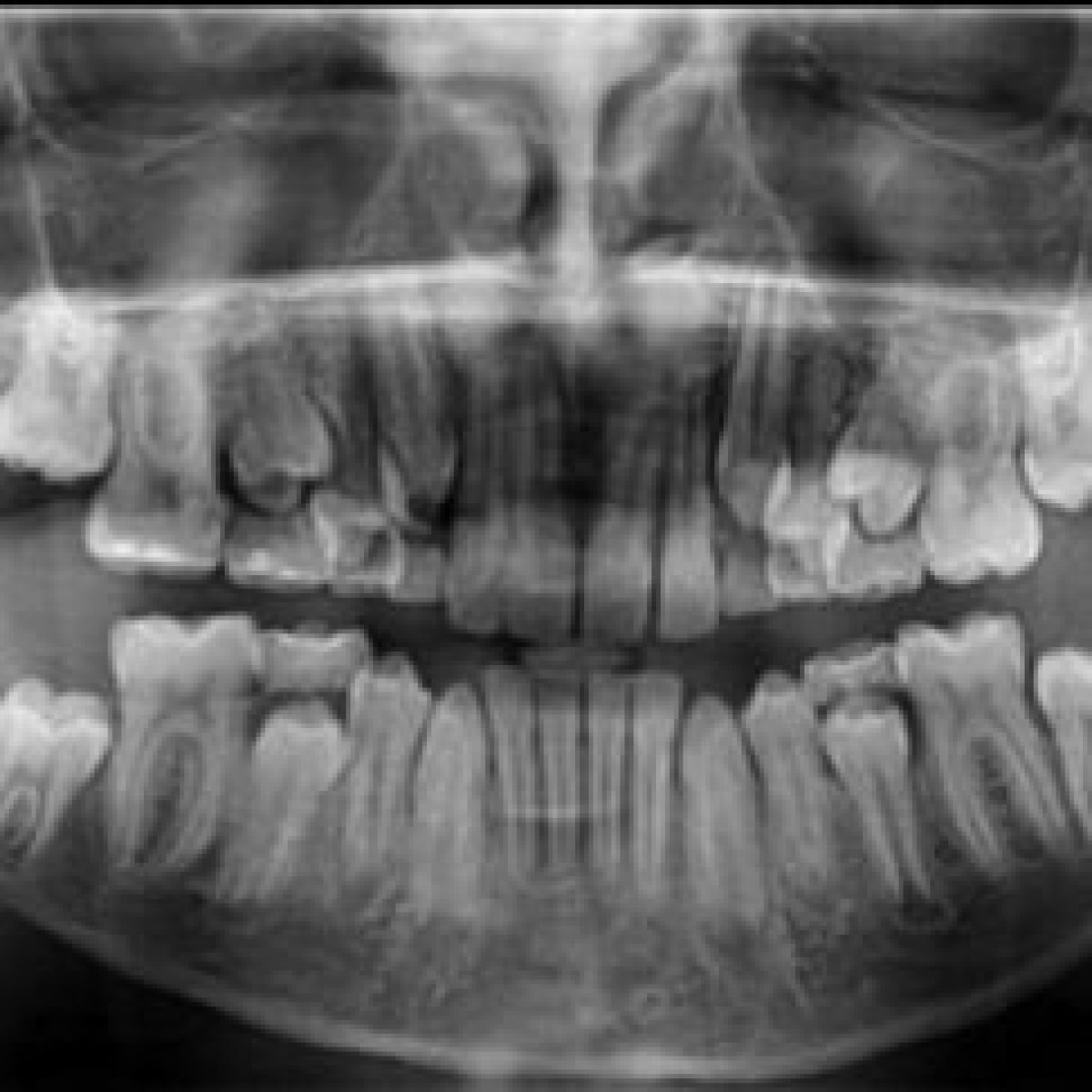
A healthy 12-year-old boy (The American Society of Anesthesiologists Physical Status Classification I) was initially referred by a general dentist to the University of Illinois Chicago oral and maxillofacial surgery clinic for evaluation of an incidentally found asymptomatic lesion associated with the apex of tooth no. 8. His medical record included a distant history of sports-related trauma to the anterior maxilla and a family history of jaw lesions in his father and sister.
He was also previously evaluated by a dermatologist for nonpainful, nonpruritic bumps on his extremities and desquamation of his feet. At the initial consultation at the oral and maxilloficial surgery clinic, radiographic imaging revealed enlarged follicles of teeth nos. 17 and 32 and a periapical radiolucency associated with tooth no. 8 without clinical signs of asymmetry (Figure 1). The father of the patient declined a plan to perform a biopsy of the apical lesion associated with tooth no. 8.
The patient was then lost to follow-up but returned a year and a half later with asymmetry in the lower facial one-third, with the right mandible larger than the left. On intraoral examination, the region of tooth no. 8 was not tender to palpation, without fluctuance, and the pulpal and periapical testing results for tooth no. 8 were normal. Asymmetric firm bony expansion of the posterior mandible was appreciated bilaterally, with more expansion being apparent on the right.
A cone-beam computed tomographic scan revealed large homogeneous, well-demarcated, pericoronal radiolucent lesions with hyperostotic borders associated with and displacing the follicles of teeth nos. 17 and 32 distally and inferiorly to the inferior border of the mandible (Figure 2A). A third similar-appearing lesion was visualized in the anterior maxilla apical to tooth no. 8 (Figure 2B). No cortical breakthrough was seen radiographically. Incisional biopsies were performed for the 3 lesions, revealing thick cheesy exudate surrounded by a friable cystic lining.
Authors: Osman Khan, DDS, Andrew Bertagna, DMD, MD, Douglas Damm, DDS, Ashleigh Weyh, MD, DMD, MPH, Nicholas Callahan, MPH, DMD, MD, FACS
Source: https://jada.ada.org/
 Related articles
Pediatric dentistry 09 October 2026
This peer-reviewed pediatric dentistry article summarizes clinical evidence from BMC oral health (2026). It focuses on findings that may help dental professionals evaluate treatment decisions,...
Pediatric dentistry 29 April 2026
Exploration and innovative application of digital technology in pediatric dentistry
Pediatric dentistry treats patients aged 0-18 years, encompassing the characteristics of general dentistry.
Pediatric dentistry 14 April 2026
Comparison between dexmedetomidine and esketamine in pediatric dentistry surgery
Dexmedetomidine (D) and esketamine (K) are used for the sedation of pediatric dental surgery. This study was designed to compare the effect of intranasal D and K in producing moderate sedation for...
Existing studies on adverse events (AEs) in pediatric dentistry have been limited in scope.
Read more
Products 15 October 2026
The belief in the healing power of light goes all the way back to ancient Egypt and the worship of Rah, the sun god.
Nearly half the world’s population is affected by oral disease—and the number of cases is rising.
News 15 October 2026

New office at 3170 R Street adds walk-in availability and same-day care options in a region where dental providers are in short supply

Each year, the University of Colorado Anschutz School of Dental Medicine (SDM) Excellence Awards recognize individuals whose dedication, leadership and innovation strengthen our mi
Oral surgery 15 October 2026
This peer-reviewed oral surgery article summarizes clinical evidence from International journal of oral and maxillofacial surgery (2026). It focuses on findings that may help dental professionals...



Copyright © 2026 - All Rights Reserved
ISSN 2767-1178