


Transparent aligners: expertise on the part of general dentists
Lara Figini

Orthodontic therapy using transparent aligners (CAT) is gaining more and more popularity as it is preferred to fixed orthodontic treatment by both professionals and patients due to its advantages in terms of comfort, aesthetics, easier oral hygiene, greater maintenance of dental and periodontal health and reduced chair time required. From being able to treat only simple cases, CAT has evolved to be able to manage a wide range of different malocclusions and thanks to particular additional approaches and instruments (for example, miniscrews and corticotomy), with CAT we are currently able capable of treating multidisciplinary and complex patients, such as pre-prosthetic and orthognathic patients.
However, the tooth movement expected from CAT treatment may not be fully achieved, with varying degrees of predictability for different types of tooth movements. This requires orthodontists to have high-level skills and knowledge of advanced CAT techniques.
Literature data report that orthodontists with different levels of orthodontic training differ in their experience and ability in managing patients with clear aligners and that there are significant differences in the clinical applications of CAT between experienced orthodontists and general dentists. It has been found that general dentists received limited training in orthodontic diagnosis and treatment during dental school, and that practitioners with advanced aligner training are better able to eliminate potential risks. Therefore, systematic education on CAT is crucial for professionals. However, to the best of our knowledge, there is no systematic orthodontic curriculum on CAT.
Materials and methods
In a multicenter study, published in the International Dental Journal, the authors determined the knowledge of professionals and offer ideas for future personalized courses on the subject of transparent aligners. The study authors distributed an online questionnaire that covered basic information, the predictability of tooth movements through aligners, and the knowledge about aligners required by professionals. The average CAT tooth movement predictability was derived from the responses of four senior experienced orthodontists to provide a standard reference. The authors performed descriptive statistics, one-way analysis of variance (ANOVA), Student's t test, and multivariable logistic regression analysis with significance set at P < .05.
Results
A total of 190 professionals participated in the study. Participants overestimated the predictability of complex orthodontic cases with difficult-to-achieve tooth movements (e.g., molar mesialization; P < .0001). For the management strategy for the resolution of the most problematic and complex cases and extractive cases, a higher knowledge of the CAT and a high level of preparation on the subject are required. The type of practice, the number of CAT cases completed and the number of those submitted, years of practice, educational background and time using CAT were the factors that influenced questions regarding the predictability of tooth movement using aligners and the knowledge required thereof.
Conclusions
From the data of this study, which must be confirmed in other similar works, it can be concluded that the predictability of tooth movement which is difficult to obtain through therapy with transparent aligners is often overestimated by professionals with limited clinical experience.
 Related articles

Clarity Aligners from Solventum are nearly invisible and extruded in 2 thicknesses to express different mechanical force levels.
News 27 October 2025
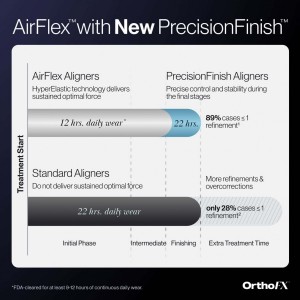
OrthoFX, a leading innovator of shorter wear time aligner systems, announces AirFlex with new PrecisionFinish Aligners.
Products 19 September 2025
Medit, a global leader in digital dentistry solutions, today announced the launch of Medit Aligners, a premium digital clear aligner solution designed to deliver faster turnaround times and more...
Products 04 July 2025

VideaHealth, the leader in AI-powered dental solutions, today announced the launch of its Aligner and Implant Recommendations, OrthoAI and ImplantAI—a new enhancement to its VideaAI platform that...
News 27 June 2025

The global clear aligner market, valued at $5 billion in 2024, is expected to soar to $13.4 billion by 2031, according to iData Research’s 2025 Global Clear Aligner and Other Orthodontics Market...
Read more

Jen Kim Field, chief sustainability officer at Henry Schein and president of the Henry Schein Cares Foundation, answers questions for Dentistry Today about the group’s achievements
News 12 October 2026
The education-first program offered learning for the entire dental practice, with practical insights spanning the full patient journey and focused on improving workflows, collabora
News 12 October 2026
AAO and Stand for the Silent Unite Communities This Month to Shine a Light on Bullying Prevention
Editorials 12 October 2026
Expanded coverage: Texas A&M’s Plemons named 2026 Texas Dentist of the Year
Sometimes a small act of generosity can make a tremendous impression, especially on a 7-year-old.
Endodontics 12 October 2026
This peer-reviewed endodontics article summarizes clinical evidence from Journal of dentistry (2026). It focuses on findings that may help dental professionals evaluate treatment decisions, patient...


Copyright © 2026 - All Rights Reserved
ISSN 2767-1178