


Cervical pain in temporomandibular disorders: review study
Author: Massimo Ragonesi
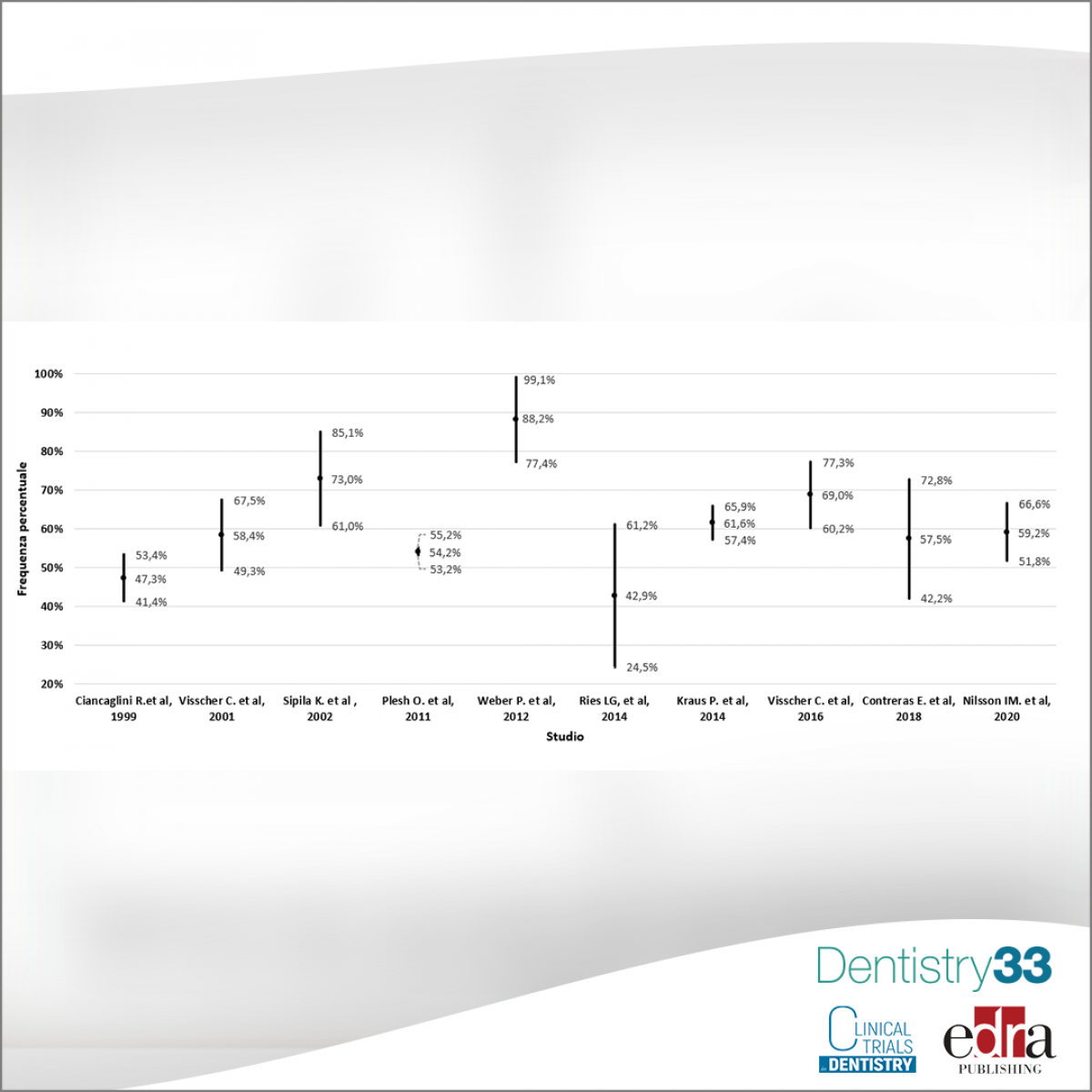
Over the years the mutual relationship between the various painful and limiting conditions of the craniofacial region has attracted attention of clinicians and researchers. Non-specific cervical pain (CP) has been considered a predisposing or perpetuating factor for temporomandibular disorders (TMD). The aim of the present study was to review the literature on the prevalence of CP in subjects with TMD. Secondary objective was to investigate the literature trend over the past twenty years in the number of publications on the specific topics covered by our review..
MATERIALS AND METHODS.
From the 524 articles identified by a defined search strategy, we selected ten relevant observational study and for each the following information were recorded: TMD sample size, demographic features (age and sex, when reported); methods for TMD and CP diagnosis, prevalence of CP. Then we measured odds, 95% confidence interval (95% CI) estimate for each CP prevalence and the statistical significance of the frequency distributions (p <0,05). A bibliometric analysis was also carried out on the trend of publications over the last twenty years.
RESULTS
The topic of our review has shown increasing interest in the literature of the last twenty years, with an increase in the number of publications over time (r = 0.88; P <0.05). Ten papers were included in the review (six studies from general population, three from patients and one from a mixed sample). The percentage prevalence of CP was between 42.9% (95% CI: 24,5% 61,2%) and 88.2% (95% CI: 77,4% 99,1%), with odds ranging between 0.8 and 7.5. Specifically, among samples extracted from patient populations the prevalence of CP was between 47.3% and 73%. In six studies (6/10) a statistically significant prevalence of CP versus non-CP was recorded (P <0.05).
CONCLUSIONS
Scientific literature was oriented towards a specific neurophysiological relationship between TMD and CP, nevertheless the prevalence of CP was highly variable among the selected studies and ranged from 1/2 to 2/3 of patients with TMD. Absence of homogeneity between the studies considered and the limits of this work did not allow generalization of the results and meta-analysis of the data, but only a descriptive synthesis. In the future will be necessary to produce more information from both clinical experiences and scientific research to define more clearly the relationship between the different painful and limiting conditions of the craniofacial region.
CLINICAL SIGNIFICANCE
CP was a frequent phenomenon in the TMD clinical practice . Although definitive conclusions could not be produced, acquisition of CP knowledge and skills was suggested to dentists interested in TMD and orofacial pain management.
 Related articles
Editorials 06 March 2026
HSDM researchers join national effort to improve care for temporomandibular disorders

Multidisciplinary research initiative aims to transform how temporomandibular disorders are understood, diagnosed, and treated
Prosthodontics 13 June 2025

The second part of this review, evaluating the literature on the relationship between dental occlusion and temporomandibular disorders (TMDs), focuses on the aetiological importance of tooth loss and...
Oral Hygiene & Prevention 28 November 2023
New Center Will Investigate And Discover Treatments for Temporomandibular Disorders

It has a disc in the middle and then two bony structures that articulate together to open and close the jaw. But, with all that talking and eating, the jaw joint is used more than the knee. Between 5...
Oral surgery 12 September 2023
Rutgers team treats patient suffering from trigeminal neuralgia

By Kardelen Koldas, Rutgers School of Dental Medicine
Alberto Gracia had trigeminal neuralgia. It’s a condition where the trigeminal nerve — responsible for sensation to the face — is contacted by a blood vessel. This creates episodic electric...

The inconclusiveness and scarcity of research focusing on the association between oral behavior and painful TMD accentuates the necessity for further studies in this specific area.
Read more
Products 14 October 2026
Royal Philips (NYSE: PHG, AEX: PHIA) announced that the Philips Sonicare Next-Generation DiamondClean 9900 Prestige, its most advanced and intelligent toothbrush to date, is now av

Key transaction by Heartland Dental and its supported practices expands opportunities for supported doctors, teams, and practices while strengthening Heartland Dental’s supported f
News 14 October 2026
Henry Schein Cares Celebrates 25 Years of Corporate Citizenship

Henry Schein Cares, Henry Schein, Inc.’s global corporate citizenship program, is celebrating a quarter century of bringing together Team Schein Members, customers, supplier partne
Editorials 14 October 2026
Scholarship at the CU Anschutz School of Dental Medicine reflects the collective contributions of our faculty, staff, residents and students.
Oral Hygiene & Prevention 14 October 2026
Propolis-containing formulations in caries prevention - a systematic review and meta-analysis.
This peer-reviewed oral hygiene & prevention article summarizes clinical evidence from Clinical oral investigations (2026). It focuses on findings that may help dental professionals evaluate...



Copyright © 2026 - All Rights Reserved
ISSN 2767-1178