


EDTA with silicon nanoparticles: an innovative dentin conditioning agent
Lara Figini
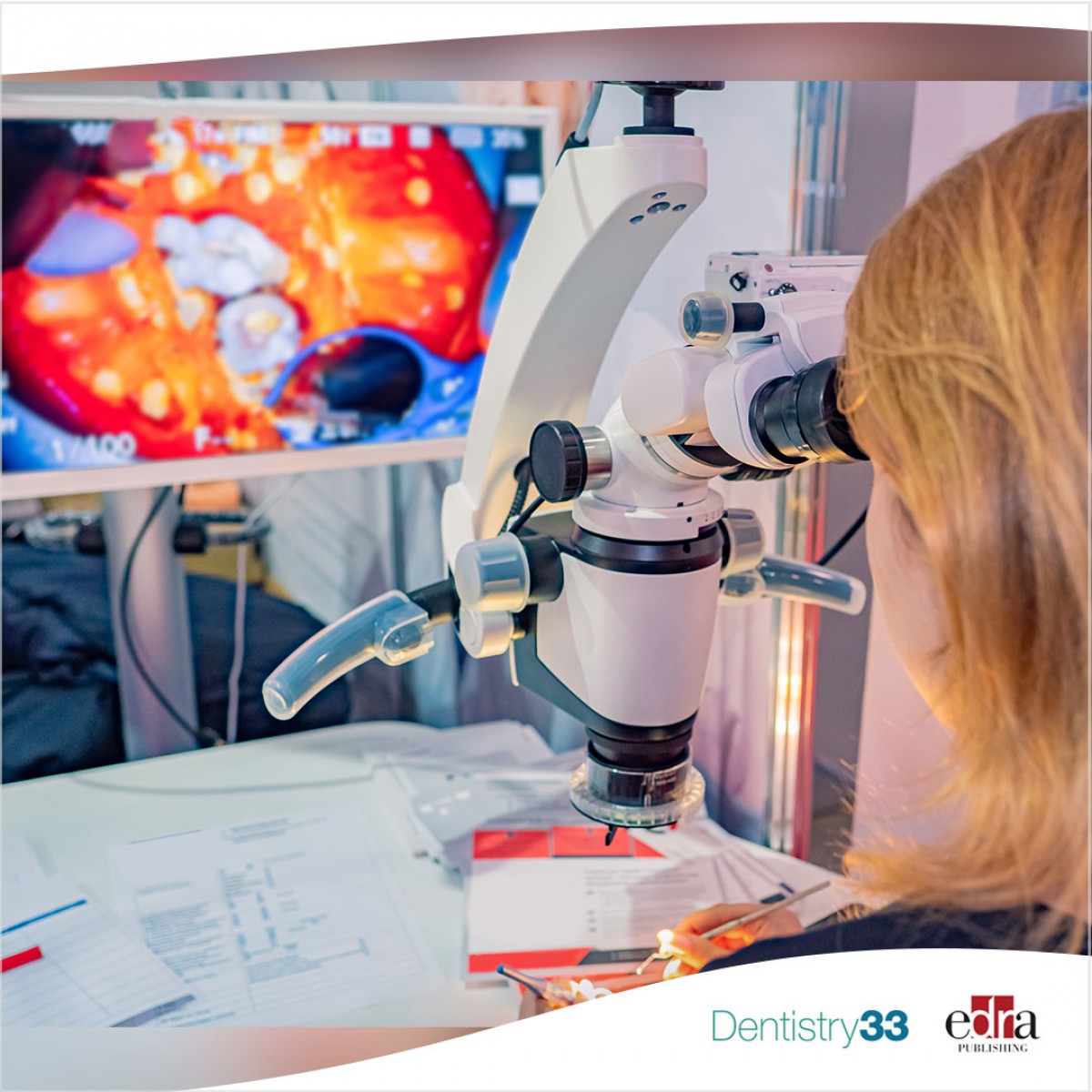
Dentin is a mineralized collagen-based tissue composed of 45% by volume of minerals and 33% by volume of organic materials.
The dentin minerals can be divided into extrafibrillar and intrafibrillar minerals based on their positions relative to the collagen fibrils. The former is in the spaces between the fibrils, and the intrafibrillar is mainly located in the gap zone of the collagen molecules. Although more than half of the minerals in dentin are extrafibrillar, intrafibrillar minerals are key to maintaining the mechanical properties of dentin and the topography of the collagen fibrils.
Literature studies have confirmed that molecules smaller than 6 kDa can freely access the intrafibrillar water compartment, while molecules between 6 and 40 kDa can partially penetrate and those larger than 40 kDa are excluded. The molecular weights of phosphoric acid and acidic monomers are much less than 6 kDa, leading to intrafibrillar demineralization regardless of whether it is etch & rinse or self-etching techniques. Due to the nanostructure of the dentinal collagen fibrils, complete infiltration of the resin monomers is impossible for both etch & rinse and self-etching techniques.
The intrafibrillar spaces are too small for the resin monomers to fully displace water within the fully demineralized dentinal intrafibrillar compartments. Furthermore, intrafibrillar demineralization by acid gels can activate the endogenous protease within the collagen matrix regardless of the E&R or S&E procedure adopted, endogenous protease which will further degrade the collagen fibrils inside. Consequently, it is believed that preserving the intrafibrillar minerals will prolong the life of the dentin bond.
In some studies, the authors have obtained partial demineralization of dentin using low concentration phosphoric acid and other studies have proposed ethylenediaminetetraacetic acid (EDTA) as a substitute for phosphoric acid for etching enamel and dentin. However, the molecular weights of phosphoric acid and EDTA are less than 6 kDa, leading to intrafibrillar demineralization, so it is speculated that if an etching agent with a larger gap zone diameter (about 36.18 nm) is obtained extrafibrillar demineralization of dentin can be achieved. By adding inorganic materials to the etchant, such as silica nanoparticles (SiO2), it is possible to obtain a more delicate demineralization of the dentin and avoid the denaturation of the collagen, by inhibiting the activity of the matrix-metalloproteinase MMP.
Materials and methods
In an in vitro study published online April 2023 in the Journal of Dentistry, the authors investigated the possibility of using ethylenediaminetetraacetic acid (EDTA-SiO2)-functionalized silica nanoparticles as a dentin conditioning agent using the etch- and-rinse to promote the durability of the dentin bond.
SiO2-EDTA was synthesized from N-[(3-trimethoxysilyl) propyl-ethylenediamine triacetic acid (EDTA-TMS) and SiO2 (50 nm). Analyses were performed by Fourier infrared spectroscopy (FTIR), thermogravimetric analysis (TGA), X-ray photoelectron spectroscopy (XPS) and transmission electron microscopy (TEM).
The ability of SiO2-EDTA to chelate calcium ions from dentin was examined by inductively coupled plasma optical emission spectrometry (ICP-OES). SiO2-EDTA conditioned dentin surfaces were detected by scanning electron microscopy (SEM), TEM and microhardness testing. For dentin adhesion, the dentin surfaces were treated with a wet or dry bonding technique to which an adhesive (AdperTM Single Bond2) and a composite resin (Filtek Z350) were applied. Dentin bond strength was evaluated by microtensile bond strength testing, in situ zymography, and nanoleakage testing.
Results
The results of FTIR, TGA and XPS analyzes showed that SiO2-EDTA contained N elements and carboxyl groups. The SEM, TEM and microhardness results indicated that the SiO2-EDTA group created extrafibrillar demineralization and retained more intrafibrillar minerals within the dentin surface. Regarding dentin binding, the SiO2-EDTA group achieved acceptable binding strength, reduced matrix metalloproteinase activity and nanoleakage along the binding interface.
Conclusions
From the data of this study, it can be concluded that SiO2-EDTA can be a promising dentin conditioning agent, able to create extrafibrillar demineralization of dentin and improve the duration of restoration bonding.
For more information: "EDTA-functionalized silica nanoparticles as a conditioning agent for dentin bonding using etch-and-rinse technique."
 Related articles
Endodontics 01 September 2025

Many recent technological advancements have been made in the field of endodontics; however, comparatively few studies have evaluated their impact on tooth survival.
Endodontics 18 August 2025
Factors influencing the long-term results of endodontic treatment: a review of the literature

The purpose of this review of the literature is to examine the factors and their influence on the outcome of endodontic treatments, and also to attempt to have an authors’ consensus concerning the...
Endodontics 27 February 2025

Apical extrusion of infected debris to the periradicular tissues is one of the principal causes of postoperative pain and discomfort.
Endodontics 12 February 2025
Evaluation of the Role of Probiotics in Endodontic Treatment

The principal goal of endodontics is the prevention of periapical infection. Acute and chronic apical periodontitis occur due to the persistence of pathogenic microorganisms such as Enterococcus...

Root canal instrumentation is performed using endodontic instruments, aided by irrigation systems, in aseptic working conditions. Canal instrumentation can be performed using manual or motorized...
Read more

Continuous innovation across the DEXIS ecosystem helps clinicians work with greater clarity, confidence, and efficiency
News 23 October 2026
CrownPoint Partners announced the successful closing of a $9.2 million, five-property dental sale-leaseback portfolio located throughout Michigan.
News 23 October 2026
Dentsply Sirona, Midwest Dental Expand Technology Relationship
Beginning November 1, Dentsply Sirona will expand its long-standing relationship with Midwest Dental Equipment & Supply beyond consumables to include its complete technology portfo
Editorials 23 October 2026
Honoring Excellence: Graduation Awards for CU Anschutz Dental Students and Faculty

As the University of Colorado Anschutz School of Dental Medicine celebrates the graduating DDS Class of 2025, we are proud to recognize the students and faculty members whose excep
Implantology 23 October 2026

This peer-reviewed implantology article summarizes clinical evidence from Clinical oral implants research (2026). It focuses on findings that may help dental professionals evaluate treatment...



Copyright © 2026 - All Rights Reserved
ISSN 2767-1178