


A new frontier in dental simulation at CU School of Dental Medicine
By Robert Thurston-Lighty
Imagine having the opportunity to join a multi-dentist practice during your first days in dental school. Imagine that within that practice, you are able to establish a long-term relationship with a patient whose evolving case and progress is your responsibility throughout your entire dental education. Now imagine that your patient is an avatar with a complex mixture of social, medical and dental histories and challenges that develop in response to your treatment decisions.
Such experiences would have sounded like sci-fi fantasy to previous generations of dental school graduates. For students at the University of Colorado School of Dental Medicine (CU SDM), however, that precise scenario is now a reality in the school’s new Dental Advanced Simulation Hub (DASH). Highlighted in a university news story, DASH, which opened in the spring of 2023, is the product of an ambitious innovation agenda that supports multiple initiatives throughout the school’s curriculum and operations.
“We are known for advancing new technologies that have the potential to enhance educational experiences, expand access and ultimately improve patient outcomes,” said SDM Dean Denise Kassebaum, DDS, MS. “The DASH is the latest manifestation of that school-wide commitment.”
The launch of the DASH also marks the culmination of a multi-year brainstorming, planning and implementation process fueled by the insights and enthusiasm of SDM faculty, staff, students and consultants. Senior Associate Dean of Academic Affairs and Innovation Tracy de Peralta, DMD, PhD, MClinEd, noted, “The DASH is a product of our entire community. Faculty such as Dr. James DeLapp, Dr. Doug Wilson and others from the Simulation Innovation Task Force at the SDM have put forth great efforts in considering new paths to curriculum in this space.”
DASH-ing into the future
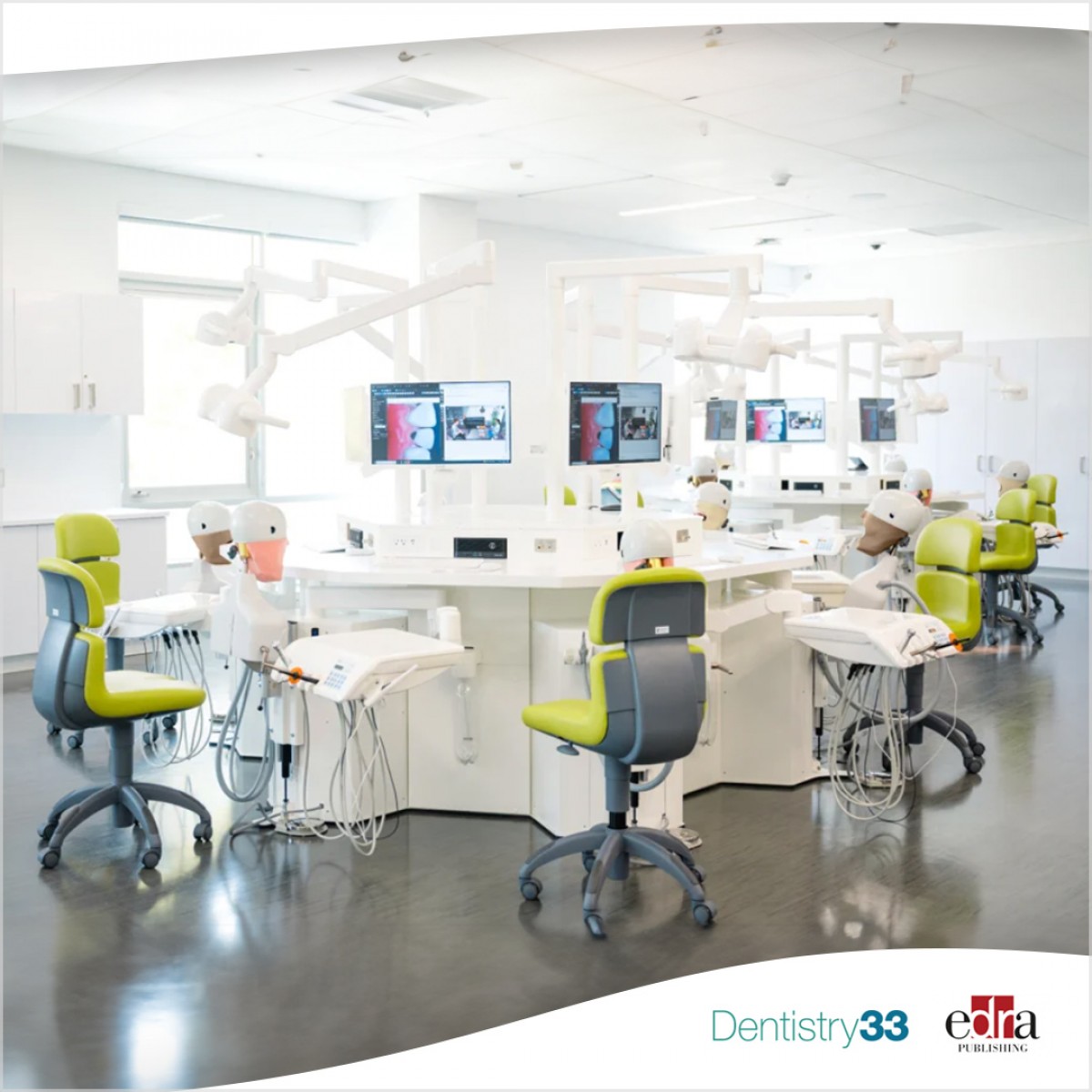
When they enter the DASH for their lab sessions, students encounter a groundbreaking suite of simulation curricula and tools that represent the future of dental education and practice—a deployment of hardware, software and workstations unlike anything else. Instead of traditional lab benches and instructor’s podium, the space comprises eight pods with four to six patient simulation stations and avatars per pod. A shared conference table in the center of the lab supplants the traditional podium as the place where students and instructors gather to debrief on the day’s activities.
Each pod represents a virtual dental practice staffed by students who manage their collaborative endeavor through a shared website. “The professional-office component of a pod adds another layer of veritas to the simulations,” noted de Peralta. “Pod colleagues can cover for one another during an unavoidable absence, for example, or consult on each other’s cases. We also have the ability to simulate the need for an emergency appointment by sending an electronic notice through the patient portal the night before a regularly scheduled lab session.
The physical components of a pod include four to six simulation stations (42 in total), each with an adjustable-height patient head and torso (referred to as dental simulators) that students work on as they would a patient. The 42 stations contain all the necessary equipment — power and data ports, digital monitor, dental light, curing light, intraoral camera — to deliver the services you would find in a typical dental clinic. Each station also features a five-position instrument panel with compressed air, two air-driven motor positions for high- and low-speed instruments and an electric motor position for endodontics and other applications.
Associate Professor David Gozalo, DDS, MS, has been instrumental in planning for the integration of scanning, designing, milling and 3D printing technologies in the space. All computers in the DASH have digital design software to go along with these digital dentistry technologies which are the same as those in clinical care settings.
“Beyond the individual simulation stations, we’ve outfitted the DASH with a full complement of the shared equipment you’d find in a contemporary dental office,” said Facilities Manager Todd Hinshaw. “Intraoral x-ray boxes and digital sensors, digital scanners, milling machines, furnaces—technologies that support a wide range of basic and advanced skills practice. And, of course, we have ample storage for small equipment, shared instruments and instructional materials as well as several work sinks.”
The humanity behind the avatars
What truly brings the 42 dental simulators to life are their avatars—software personas that deliver dynamic social, medical and dental patient histories to each workstation. Assistant Professor and Director of Diversity Programming Amisha Singh, DDS ’15, has devoted countless hours to constructing a highly diverse patient population that reflects society at large. Her software creations are constructed using extensive, anonymized case data from actual, de-identified patients and distribute unique sets of avatars to each DASH pod.
“The software implemented by Dr. Singh, with the help of Program Director of Digital Education and Academic Technology Michael Lampe, enables us to establish one-to-one relationships between students and patient avatars,” de Peralta explained. “We can standardize case difficulty and progression across the entire DASH cohort and ensure that each pod is learning the same techniques while dealing with similar challenges. And because every student maintains a treatment relationship with their virtual patient throughout their education, they gain more skills related to case completion than if they were just working on traditional typodont models within the dental simulator.”
A stronger transition to live dentistry
The ultimate goal of all simulation training is to prepare students to work safely, competently and confidently with the live tissue and life circumstances of real patients. In that sense, the DASH is a huge leap forward in dental education. The complex human dynamics embodied by the avatars enables students to practice the holistic skills of dentistry—behavioral psychology, public health, critical thinking, medical ethics—well before they encounter live patients.
Avatar-enhanced simulations also lead to greater patient safety, according to de Peralta. “The DASH doesn’t replace the experience students gain by applying their knowledge and skills to real patients. It does, however, greatly improve the quality of students’ transitions from simulation to real-life dentistry because the DASH environment replicates so many aspects of a typical clinical environment. Students will feel much more at home in live environments, and we can confidently provide them with earlier and more frequent access to live patients with increasingly complex treatment requirements over time.”
As is the case with all aspects of the SDM’s innovation agenda, the DASH is not about technology for technology’s sake. “Our mission is to transform the landscape of care,” de Peralta said. “To accomplish that, we must graduate practitioners with behavioral and cultural competencies that are useful in both high- and low-tech environments. The multidimensional, longitudinal simulations we provide with the DASH are a key part of producing future-ready dentists for all populations and locations.”
 Tag
Tag
Related articles
News 17 September 2026
Millennium Dental Technologies Founder Honored for Leadership

City Proclamation Recognizes Contributions to Patient Care, Dental Innovation, Clinician Education and Community Service

City Proclamation Recognizes Contributions to Patient Care, Dental Innovation, Clinician Education and Community Service
Restorative dentistry 17 April 2026
Patient Perceptions of New Robotic Technologies in Clinical Restorative Dentistry
Patient perception research has failed to focus on burgeoning technology within the dental field.
News 14 April 2026
Dentsply Sirona’s Advanced Endodontic Sealers Based on Clinically Proven Technologies

Bioceramic ProRoot Bio Sealer and AH Plus Ribbon give practitioners the confidence they need to successfully perform endodontic treatments
Digital Dentistry 19 March 2026
Implementation of advanced technologies – the basis for the development of modern dentistry

Purpose of the paper is to analyse the development of dentistry from ancient times to the present day, to reveal the role of advanced technologies in the development of modern dentistry and to...
Read more
Products 15 October 2026
The belief in the healing power of light goes all the way back to ancient Egypt and the worship of Rah, the sun god.
Nearly half the world’s population is affected by oral disease—and the number of cases is rising.
News 15 October 2026
New office at 3170 R Street adds walk-in availability and same-day care options in a region where dental providers are in short supply
Each year, the University of Colorado Anschutz School of Dental Medicine (SDM) Excellence Awards recognize individuals whose dedication, leadership and innovation strengthen our mi
Oral surgery 15 October 2026
This peer-reviewed oral surgery article summarizes clinical evidence from International journal of oral and maxillofacial surgery (2026). It focuses on findings that may help dental professionals...



Copyright © 2026 - All Rights Reserved
ISSN 2767-1178