


From California to New Jersey for Diagnosis
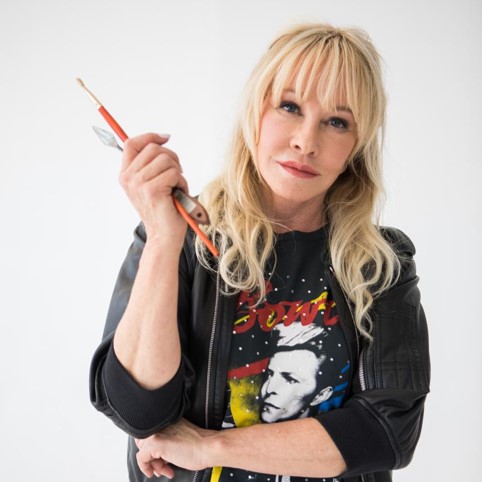
Becky Robbins began to experience twitching on the left side of her face in 2021. She first thought it was temporary, but it returned a few months later. And then again. And again.
“I just didn't know what in the world was happening to me,” said Robbins, an artist, mentor, and a former nurse living in California.
She went to a neurosurgeon in San Diego. “He was not with me more than five minutes and told me I needed brain surgery,” she recounted. “I'm a pretty strong person, but I walked out, sat down on the bench outside, and just cried because it was so shocking that I needed brain surgery.” She then went to a second doctor, who told her all the possible side effects of the surgery, “which made it sound so like you would only do this if this were an emergency.” Her symptoms continued to get worse; she continued to look. “It was getting so bad that I couldn't smile on my left side, and I looked like I had a stroke,” she said. “And the most amazing thing happened. … I've happened to tune into a podcast [on Instagram], where Dr. [Gary] Heir was on.” Gary Heir is the Robert and Susan Carmel Chair in Algesiology and director of the Center for Temporomandibular Disorders and Orofacial Pain at Rutgers School of Dental Medicine—one of only 15 orofacial pain postgraduate programs nationwide. Within two days, she got an appointment with Heir and flew out to New Jersey in March of 2024.
“I've never been seen by anyone who took so much time with me and was so kind and committed to finding a solution,” she said of Heir, who asked “a million questions,” trying to piece together her case. “Imagine what that feels like to be so vulnerable flying to the other side of the country because that's the only choice you feel like you have left, and then getting to see Dr. Heir, I mean, I could cry right now talking about it just because for him to be so compassionate; I was just a stranger.”
After assessing the situation, Heir suspected a vascular contact of the seventh cranial nerve and immediately reached out to his colleague Stephen Johnson, a neurosurgeon at Rutgers Robert Wood Johnson Medical School. "Frequently patients with complicated chronic orofacial pain and movement disorders such as Becky are often at a loss as to where to go for help," said Heir and stressed the importance of the multidisciplinary approach used in her case and the ability to call on caring physicians such as Johnson.
With Johnson’s direction, they ordered an MRI. The next day, she met with Johnson. “I was fraught; I didn’t know what in the world was wrong with me and what was going to happen, and he showed me what was going on.” Johnson confirmed the diagnosis suspected by Heir; Robbins had a vascular contact of a cranial nerve responsible for her facial muscles of expression “With every beat of my heart, the blood vessel was pushing on the nerve and damaging it,” she said. Johnson also recommended surgery as the only solution to permanently fix the issue. The surgery was risky, he explained, but said he would do his very best and gave her his cell phone number for her to think over.
“When you're facing brain surgery, it's not a light decision to make,” she said. “I could text him day and night, ask him any questions, and he would get right back to me. He's just amazing.”
In the meantime, she tried Botox injections that initially helped but stopped working soon after. She was amid creating a television show, and her twitching would become so bad that she would need to stop the roll, wait it out, and restart it. In October 2024, “I finally texted him and said ‘I need to talk to you. It's time.’” They created a timeline for Robbins’ surgery while she got her affairs in order. Then, she went back to New Jersey. Johnson performed a vascular decompression of the nerve. “I’m so glad I’m on the other side of it,” she said with gratitude.
Heir added, “Her symptoms resolved rapidly, and she remains symptom-free for one year.”
Author: Kardelen Koldas
Source: https://sdm.rutgers.edu/
 Related articles
Editorials 21 October 2026
From California to Canada: CU Anschutz School of Dental Medicine at ADEA, GRC and IADR 2026
The CU Anschutz School of Dental Medicine will showcase a wide breadth of educational innovation, faculty development, clinical training and research at three major gatherings this
Editorials 09 October 2026
From California to Canada: CU Anschutz School of Dental Medicine at ADEA, GRC and IADR 2026
The CU Anschutz School of Dental Medicine will showcase a wide breadth of educational innovation, faculty development, clinical training and research at three major gatherings this
Editorials 17 September 2026
From California to Canada: CU Anschutz School of Dental Medicine at ADEA, GRC and IADR 2026
The CU Anschutz School of Dental Medicine will showcase a wide breadth of educational innovation, faculty development, clinical training and research at three major gatherings this
Editorials 27 August 2026
From California to Canada: CU Anschutz School of Dental Medicine at ADEA, GRC and IADR 2026
The CU Anschutz School of Dental Medicine will showcase a wide breadth of educational innovation, faculty development, clinical training and research at three major gatherings this
Editorials 06 August 2026
From California to Canada: CU Anschutz School of Dental Medicine at ADEA, GRC and IADR 2026
The CU Anschutz School of Dental Medicine will showcase a wide breadth of educational innovation, faculty development, clinical training and research at three major gatherings this
Read more

Continuous innovation across the DEXIS ecosystem helps clinicians work with greater clarity, confidence, and efficiency
News 23 October 2026
CrownPoint Partners announced the successful closing of a $9.2 million, five-property dental sale-leaseback portfolio located throughout Michigan.
News 23 October 2026
Dentsply Sirona, Midwest Dental Expand Technology Relationship

Beginning November 1, Dentsply Sirona will expand its long-standing relationship with Midwest Dental Equipment & Supply beyond consumables to include its complete technology portfo
Editorials 23 October 2026
Honoring Excellence: Graduation Awards for CU Anschutz Dental Students and Faculty
As the University of Colorado Anschutz School of Dental Medicine celebrates the graduating DDS Class of 2025, we are proud to recognize the students and faculty members whose excep
Implantology 23 October 2026
This peer-reviewed implantology article summarizes clinical evidence from Clinical oral implants research (2026). It focuses on findings that may help dental professionals evaluate treatment...



Copyright © 2026 - All Rights Reserved
ISSN 2767-1178