


Protecting Your Eyes While Caring for Your Teeth
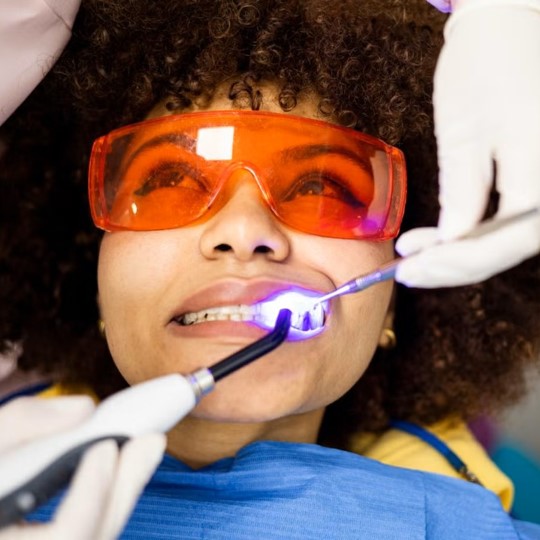
As Karin and Peter Arsenault, both D94, prepared to host Thanksgiving in 2023, they faced an unusual task. Before their guests arrived, the married dentists dismantled the makeshift laboratory they had set up in their living room to study how fluids and other debris might enter a patient’s eyes during a dental visit.
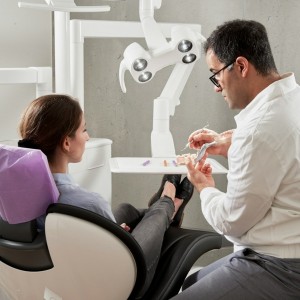
Their set-up simulated what could happen when a dentist uses a handpiece—what most of us think of as a drill. Using a manikin head to represent a patient, they sprayed colored dye from the mouth area toward the eyes at various angles, representing dental procedures.
Their work showed that patients could face risks to their eyes and vision when undergoing dental treatment, even when wearing recommended protective eyewear. Their research appeared in the Journal of the Massachusetts Dental Society last fall.
The findings didn’t surprise the Arsenaults, who both teach at Tufts University School of Dental Medicine (TUSDM). Karin Arsenault is the Hilde H. Tillman, D49, Professor in Geriatric Dentistry, Public Health, and Community Service, and director of the dental school’s geriatric dentistry program. Peter Arsenault is a professor and head of the Operative Division in the Department of Comprehensive Care.
Peter Arsenault had previously researched and studied eye safety risks for dental healthcare providers, focusing on protecting the “bottom gap”—the space or opening between the lower edge of protective eyewear, such as safety glasses, and the wearer's face. This gap is significant because it can allow the debris, aerosols, or splatter common in dental procedures to bypass the protective eyewear and reach the eyes. Patients, they hypothesized, might face similar risks.
“If patients have a routine dental procedure like a cleaning, a filling, or a crown, they may be potentially exposed to debris such as projectiles, aerosols, and spatter,” Karin Arsenault says. “Our research reveals that even if a patient wears protective eyewear, they may not be fully protected from the debris and spatter that may travel through the bottom gap.” The Arsenaults recommend talking with your dentist about appropriate eye protection.
Peter Arsenault conducted his earlier research after his eye was injured during a procedure at his private dental practice in 2016. “I was wearing all of my protective equipment, compliant eyewear and a mask, and a chunk of a filling shot up under my glasses and went into my eye,” he says. “And it was quite alarming.”
When something similar happened a few months later, he decided to figure out how common his experience was among dental practitioners. “It turns out 70% of all dentists received some degree of ocular trauma during their careers,” Peter Arsenault says.
He and Karin Arsenault conducted spray studies on manikin heads—the term for a medical model—representing the spatial relationship between the patient and the provider, to understand how and where debris, spatter, and aerosols might travel, potentially entering dental providers' eyes during procedures.
That research showed that while safety glasses effectively protect providers from perpendicular trajectories and side shields offer protection from side trajectories. But for dental profesionals, “in our world, the real vulnerability lies in the bottom gap,” Peter Arsenault says.
Recognizing that research, the National Institute for Occupational Safety and Health (NIOSH) consulted with Peter Arsenault and conducted high-level testing to validate his findings. This research led to the development of a new eye safety standard tailored for dentistry, which has been adopted by the American Dental Association (ADA). As a result, dentists are now required to wear safety glasses or face shields that provide bottom-gap protection.
The Arsenaults’ recent work revealed similar bottom-gap concerns for dental patients. “We found that, indeed, there is a bottom gap that poses a potential pathway or hazard to the dental patient’s eyes,” says Peter Arsenault.
The Arsenaults are now working to raise awareness about the importance of patient eye protection. Karin Arsenault emphasizes this concern is a public health issue for patients, especially those with compromised immune systems.
The risks extend beyond common contaminants like bacteria, viruses, and fungi—they also include chemical exposure and physical debris. Projectiles, such as tooth fragments and dental burs, which are similar to small drill bits, can be propelled from the dental drill or patient’s mouth at speeds of up to 50 mph, posing a serious threat to the patient's eyes, Petre Arsenault says. In severe cases, such exposure could result in permanent vision loss.
While the ADA and the Centers for Disease Control and Prevention (CDC) recommend dental teams provide safety glasses to their patients, "there is no official standard requiring dental patients to wear protective eyewear," says Peter Arsenault. "No governing body has mandated it."
"We hope to continue consulting with NIOSH, the ADA, and the CDC," says Peter Arsenault. "Our goal is to bring this issue to their attention, support further research, and ultimately push for legislation that protects patients."
Author: Heather Beasley Doyle
Source: https://now.tufts.edu/
 Related articles

The American Dental Association (ADA) recently commended Rep. Jeff Van Drew (R-NJ) and Rep. Herb Conaway (D-NJ), for introducing the Improving Dental Administration (IDA) Act to ensure that the more...
Market 15 April 2024

The financial sector, even in Italy, ranks among the major victims of cybercriminals.

Editorials 11 September 2025
Herbal Mouthwash Targets Gum Germs While Letting Helpful Bacteria Flourish
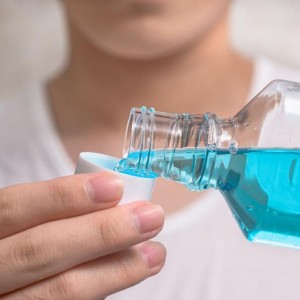
Mouthwashes have long bragged about killing 99.9% of germs in your mouth, but Rutgers Health researchers suggest this scorched-earth approach may harm oral health by eliminating beneficial bacteria...

Read more

Continuous innovation across the DEXIS ecosystem helps clinicians work with greater clarity, confidence, and efficiency
News 23 October 2026
CrownPoint Partners announced the successful closing of a $9.2 million, five-property dental sale-leaseback portfolio located throughout Michigan.
News 23 October 2026
Dentsply Sirona, Midwest Dental Expand Technology Relationship
Beginning November 1, Dentsply Sirona will expand its long-standing relationship with Midwest Dental Equipment & Supply beyond consumables to include its complete technology portfo
Editorials 23 October 2026
Honoring Excellence: Graduation Awards for CU Anschutz Dental Students and Faculty

As the University of Colorado Anschutz School of Dental Medicine celebrates the graduating DDS Class of 2025, we are proud to recognize the students and faculty members whose excep
Implantology 23 October 2026
This peer-reviewed implantology article summarizes clinical evidence from Clinical oral implants research (2026). It focuses on findings that may help dental professionals evaluate treatment...


Copyright © 2026 - All Rights Reserved
ISSN 2767-1178