


Dental school faculty to study senior citizen health outcomes using implant overdentures as alternative to traditional dentures
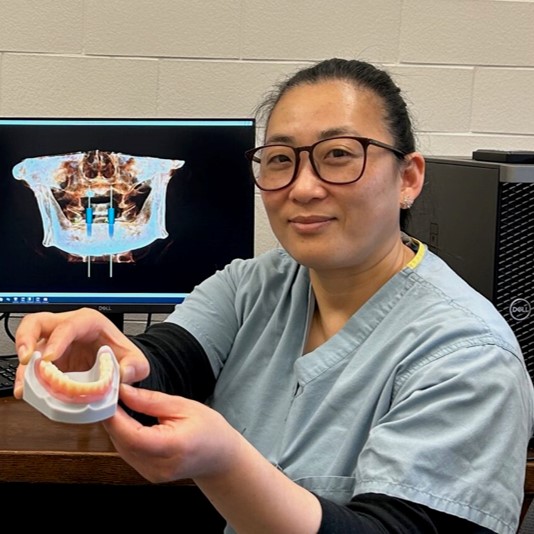
A state-wide project led by oral surgeons from the University of Michigan School of Dentistry is focused on improving the oral health and well-being of older adults who have ill-fitting dentures.
The team has received a Healthy Aging Grant of $500,000 from the Michigan Health Endowment Fund for the Senior Implant-Overdenture Restorative program, or SenIOR, which starts this month and continues through the end of 2026.
In a partnership with My Community Dental Clinics (MCDC) and the Area Agency on Aging of Western Michigan, the program will identify 100 senior citizens throughout Michigan who will benefit from implant overdentures. The dental treatment places two implants in the lower jaw to secure lower dentures in place, making them fit better and function more like natural teeth.
The study will collect data about how the implant overdentures improve the patients’ ability to chew more kinds of food, thus improving their nutrition and other aspects of their well-being. In addition, dental school faculty will provide continuing education about the implant overdenture procedure to dentists at the MCDC clinics around the state. Students at the dental school will assist with the project, which will expand the training and experience for future dentists. Team members also will deliver nutritional and dental educational talks to seniors and caregivers in order to raise awareness about the importance of dental health.
The grant summary notes that many underserved Michigan seniors are missing teeth and don’t have adequate jawbone support for traditional dentures, which rest on the patient’s gums. This can cause dentures to fit loosely, which in turn leads to recurrent oral irritation, infection and the inability to eat well. These conditions lead to numerous health issues, including nutritional deficiencies, which can cause or exacerbate cardiovascular diseases, diabetes, osteoporosis, anemia and dementia.
Despite implant-retained overdentures being widely acknowledged as one of the standard of the preferred options for patients with long-standing complete edentulism, they remain under-utilized for many seniors due to their lack of financial resources and because state Medicaid insurance only covers traditional dentures, excluding implant overdentures. The study team believes their findings will “shift insurance providers’ misconceptions of (implant overdenture) treatment from being considered a cosmetic elective procedure to recognizing it as a medical necessity.”
The team is led by Principle Investigator Dr. Hsiao Sung, a clinical assistant professor, and by Co-Principle Investigator Dr. Amy Chin, a staff dentist, both in the dental school’s Department of Oral and Maxillofacial Surgery/Hospital Dentistry. Other team members from the dental school are Dr. Ivy Wei, a clinical assistant professor in the Department of Biologic and Materials Sciences & Prosthodontics, and Dr. Domenica Sweier, a clinical professor in the Department of Cariology, Restorative Sciences and Endodontics. Two faculty members from the U-M School of Public Health are also part of the initiative – Kyle Grazier, a professor in health management and policy, and Elizabeth Hudson, an assistant professor in the Department of Nutritional Sciences.
Sung said the grant supports multiple important purposes. “First, we want to offer the treatment to senior patients in need,” she said. “But it is also educational. We want residents and dental students to have more exposure to this type of treatment, which is a 21st century treatment. Additionally, our efforts extend beyond immediate care; we are gathering vital data to build awareness and drive mindset change within the community and among insurance providers. Our goal is to demonstrate that implant overdentures are a necessity, not a luxury. They are fundamental for ensuring these patients enjoy a good quality of life.”
Chin notes that dentists have long recognized the connection between dental health and overall health, but healthcare policy makers – including those who can influence insurance coverage, for example – have been slow to advocate for widespread and comprehensive dental coverage among government and private insurance programs. “Underserved people are often the people who need implants the most because they may not have been able to afford dental care in their early years,” Chin said. “So they lose teeth earlier. And if you don’t have preventative care early, it snowballs and gets worse with aging. And then the dentures don’t fit well. And that affects their food choice, often leading them to eat softer, more processed food, which has more sodium and carbohydrates, which contributes to obesity, hypertension and other health issues. The over-denture anchored to implants makes their denture stable and they will be able to eat a wider variety of foods.”
Sung said most seniors experience alveolar bond atrophy, resulting in poorly fitting dentures that cause discomfort, leading them to set aside their dentures “in the drawer,” meaning patients don’t even use them. “It’s not because the denture is not well-made,” she said. “It is because the patient doesn’t have the bone structure to retain it.” The new implant overdentures address this issue by offering enhanced stability and retention.
Beyond the importance to the patient’s health and ability to eat properly, another issue is cost. Implant overdentures are more expensive than traditional dentures, which are paid for by the Michigan Medicaid program once every five years. “We want to make sure that all the money from the taxpayers is well-utilized,” Sung said. “So if we make a denture, that means it has to be functional. No one wants the denture to be in the drawer, or have the state pay for the denture and then it is not used.”
Staff at MCDC locations around the state will help identify seniors who qualify to receive the implant overdentures. They must be 60 years old, have missing teeth and be enrolled in Medicaid. Some of the patients who live closer to Ann Arbor will be treated at the School of Dentistry; for seniors located farther away, including in the Upper Peninsula, dental school faculty will travel to those clinics to perform the implant placements. The continuing education portion of the project will be supported in collaboration with the International Team of Implantology (ITI), which is a global association of professionals in implant dentistry, and Straumann, the world’s largest implant manufacturer.
The project team plans to finish all the implant placements and deliver the overdentures in the first year. In the second year, they will gather and compare data on morbidities, physical health, nutrition and quality of life before and after the implant-retained overdenture. A final report will share the data and conclusions about the effectiveness of the program.
Source: https://news.dent.umich.edu/
 Tag
Tag
Related articles
News 11 June 2026
New research suggests a common facial treatment given before jaw surgery could ease postsurgical discomfort and lessen the need for opioids during recovery.

New partnership will expand clinician access to practical AI education designed to help practices improve care delivery, patient communication, operational efficiency, and financia
News 30 April 2026

HuFriedyGroup, a global leader in dental instrument manufacturing, infection prevention, and education solutions, is proud to announce a new strategic partnership with Seattle Stud
News 28 April 2026

Study enrollment completion marks critical milestone in advancing bone regeneration for dental reconstruction using Theradaptive’s targeted therapeutic platform
Read more

Continuous innovation across the DEXIS ecosystem helps clinicians work with greater clarity, confidence, and efficiency
News 23 October 2026
CrownPoint Partners announced the successful closing of a $9.2 million, five-property dental sale-leaseback portfolio located throughout Michigan.
News 23 October 2026
Dentsply Sirona, Midwest Dental Expand Technology Relationship
Beginning November 1, Dentsply Sirona will expand its long-standing relationship with Midwest Dental Equipment & Supply beyond consumables to include its complete technology portfo
Editorials 23 October 2026
Honoring Excellence: Graduation Awards for CU Anschutz Dental Students and Faculty

As the University of Colorado Anschutz School of Dental Medicine celebrates the graduating DDS Class of 2025, we are proud to recognize the students and faculty members whose excep
Implantology 23 October 2026
This peer-reviewed implantology article summarizes clinical evidence from Clinical oral implants research (2026). It focuses on findings that may help dental professionals evaluate treatment...



Copyright © 2026 - All Rights Reserved
ISSN 2767-1178