


Dr. Andrei Ionescu wins the Marshall Postdoctoral Award
Simona Chirico

From October 1st to 5th the annual meeting of the Academy of Dental Materials (ADM) was held in Jackson Hole (Wyoming, USA), entitled: "Materials to Enable the Evolution/Revolution of Digital Dentistry" (for more details read the article: https://www.dentistry33.com/dentistry33/editorials/142/academy-of-dental-materials-annual-meeting-2019.html )
During this meeting, ADM offers “Marshall Postdoctoral Award” in recognition of excellence in dental biomaterials research.The primary purpose of the award is to encourage and recognize outstanding research performed by individuals in the transitional post-doctoral stage of their careers.This award was created in honor of Grayson and Sally Marshall, who have excelled in mentorship roles and have made great contributions to the ADM during their careers. Both have been Fellow members of the ADM since 1983 and are currently Emeritus members.
This year, we are very glad to announce that the award went to Dr. Andrei C. Ionescu (University of Milan, Italy), with is research entitled: "Antimicrobial properties of PMMA resin containing graphene (A.C. Ionescu, S. Sauro, P.M. Pires, A. Lòpez-Castellano, A.M. Alambiaga-Caravaca, E. Brambilla)".
Here below you can find the abstract of his research:
Purpose/aim:
Modern prosthetic dentistry is increasingly focusing on digital procedures, including CAD/CAM technologies. In this context, PMMA is being widely employed as material for prosthetic and restorative devices. Secondary caries is still the main reason for the failure of dental resin-based restorations. Therefore, an antimicrobial activity expressed by these materials is regarded as beneficial for their longevity. This study aimed to test the physical, chemical, and microbiological behavior of a PMMA resin for CAD/CAM applications containing graphene.
Materials and methods: Specimens (n=48) were made from<50ppm graphene-containing PMMA disks and from conventional PMMA disks for CAD/CAM applications. Specimens were finished with abrasive paper up to 4000 grit, and a half was subjected to soaking in absolute ethanol for 24 h. This protocol was introduced to evaluate the microbiological behavior of the tested samples after softening of the surface, thus accelerating aging of the surfaces of restorative resins. Material characteristics were assessed in terms of surface roughness, microhardness, ultimate tensile strength, solubility, and water sorption. Elution of methyl-methacrylate after specimen treatment was determined using HPLC. After 24h pre-incubation with sterile human saliva, the microbiological behavior of the materials was assessed using two models: Streptococcus mutans biofilm formation in a continuous-flow bioreactor simulating shear forces (30 ml/h) for 24 h, and artificial oral microcosm based on mixed plaque inoculum developed using the same setup for 24h. The viable biomass adhering to the specimens’ surfaces was measured using a tetrazolium dye-based test. Statistical analysis included verification of normality of distribution and homoscedasticity, then multi-way ANOVA and Student’s t-test (α= .05).
Results: Finishing protocol produced no significant differ- ences in surface roughness between tested materials. Ethanol treatment significantly reduced surface microhardness in both materials, but to a lesser extent on graphene-containing PMMA. No difference in ultimate tensile strength was found between materials. Graphene-containing PMMA showed sig- nificantly lower water sorption and solubility compared to conventional PMMA. After ethanol treatment, a significantly lower amount of leachates was identified for graphene- containing PMMA. Graphene addition significantly reduced biofilm formation compared to control in both microbiological models. Interestingly, specimen treatment produced the opposite (S. mutans model) or no effect (artificial oral microcosm) on biofilm formation.
Conclusions: Graphene-additioned PMMA is a promising material from both mechanical and microbiological point of view. Ethanol treatment influenced surface characteristics of the materials, leaving on graphene-additioned PMMA a sur- face more prone to bacterial colonization.
For additional informations: https://doi.org/10.1016/j.dental.2019.08.095
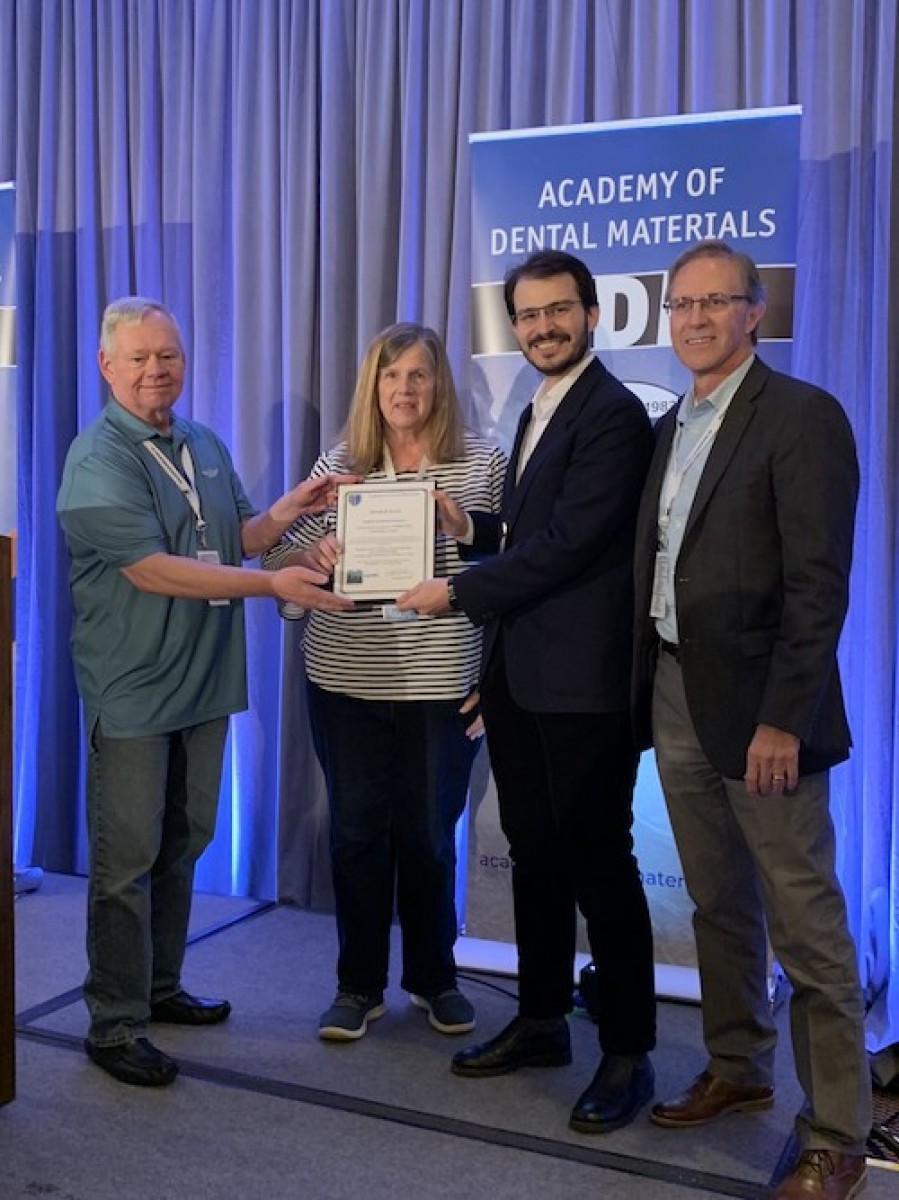
Dr. Andrei Ionescu during the proclamation with: Bill Marshall, Sally Marshall, Jeff Stansbury
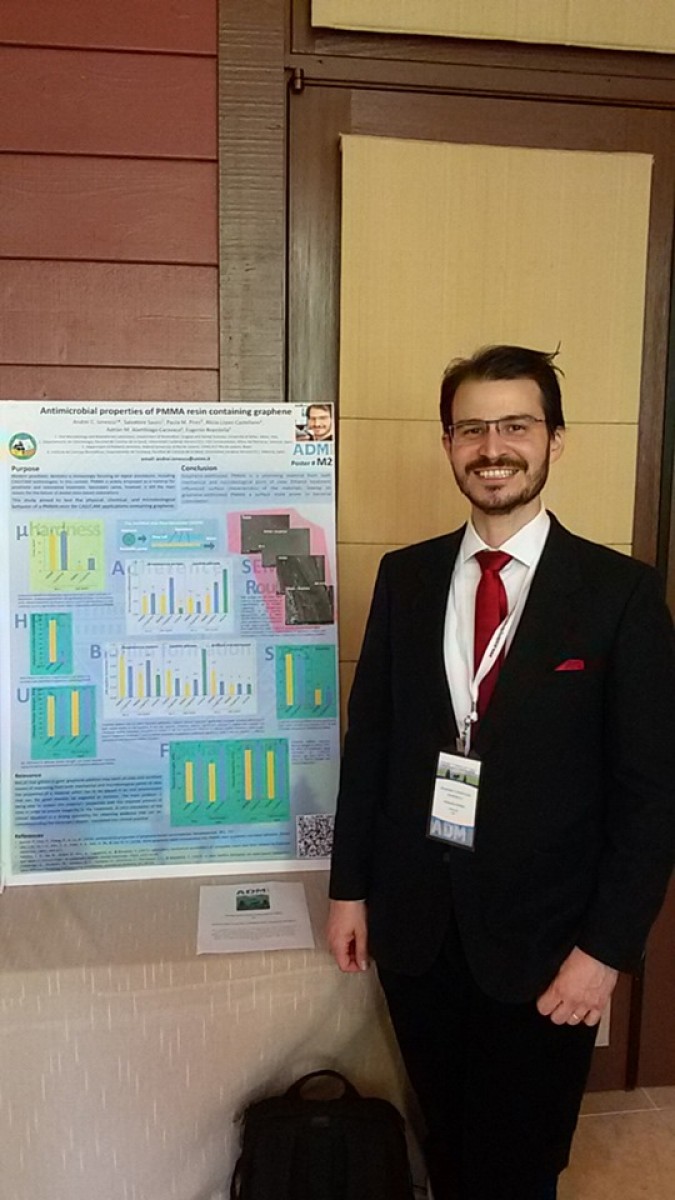
Dr. Andrei Ionescu with his poster
 Tag
Tag
Related articles
Editorials 22 April 2024

If there were an indicator for change in music, this would be off the charts if it wanted to measure how many and what changes Miles Davis has made since, at eighteen, he was enlisted, almost by...
Editorials 10 October 2023

Research is an endless quest. That’s why it has always fascinated Georgios Kotsakis. The moment he figures out an answer, he feels a new question he needs to creatively tackle pops up.
Editorials 31 December 2021

Dear readers,The approach of New Year is usually a festive period and, for some of us, an occasion to look back and sum up our impressions of the year that we are about to leave behind. We can...
Editorials 08 October 2021
Dear Dentistry33 readers,After a long period without the possibility of meeting collogues and friend in person, I am finally pleased to present you the 22nd Annual Congress organized by the Italian...
Editorials 04 August 2021

It has been approximately one and a half year since the Covid-19 pandemic changed the course of the world and influenced the lifestyle of many people, regardless of their background and profession....
Read more
Products 13 October 2026

New Resources Help Dental Exhibitors Evaluate Their Investment and Explore the Personify ShowFlow™ Trade Show Success System
News 13 October 2026

New patient apps extend The Aspen Group’s mission to remove barriers to care, giving patients greater visibility, convenience, and control from booking through treatment
Editorials 13 October 2026

The forerunner of what’s now Texas A&M College of Dentistry opened 120 years ago in Dallas with the mission of educating dentists to provide quality care to patients in North Texas
Oral pathology 13 October 2026
This peer-reviewed oral pathology article summarizes clinical evidence from Oral oncology (2026). It focuses on findings that may help dental professionals evaluate treatment decisions, patient...


Copyright © 2026 - All Rights Reserved
ISSN 2767-1178