


Full-Mouth Rehabilitation in an Adolescent With Amelogenesis Imperfecta
Amelogenesis imperfecta (AI) is a group of hereditary developmental disorders that affect the structure and clinical appearance of dental enamel, with an estimated prevalence ranging from 1:700 to 1:14,000 across populations.
Patients with AI commonly present with aesthetic concerns, dental sensitivity, increased caries risk, decreased vertical dimension of occlusion, and psychosocial issues related to appearance. 3 The management of AI in adolescent patients presents unique challenges due to ongoing growth and development, requiring careful consideration of long-term treatment outcomes while addressing immediate aesthetic and functional needs.
Traditional approaches to managing AI have included stainless steel crowns, direct composite restorations, and laboratory-fabricated restorations. Recent advances in digital dentistry and CAD/CAM technology have transformed treatment options, allowing for more conservative, precise, and efficient rehabilitation. 4 The use of intraoral scanning, digital design, and additive manufacturing has enabled clinicians to provide high-quality restorations with reduced chair time and laboratory dependency.
This case report presents the comprehensive management of a 13-year-old male with hypocalcified AI affecting all permanent teeth. Using full-coverage restorations fabricated with the SprintRay Midas 3D printer using Crown HT material, this case highlights the application of digital workflow in pediatric/adolescent restorative dentistry.
A 13-year-old male presented to our office with chief complaints of dental sensitivity and poor aesthetics. Medical history was non-contributory. Family history revealed that the patient’s father had similar dental features, suggesting an autosomal dominant inheritance pattern.
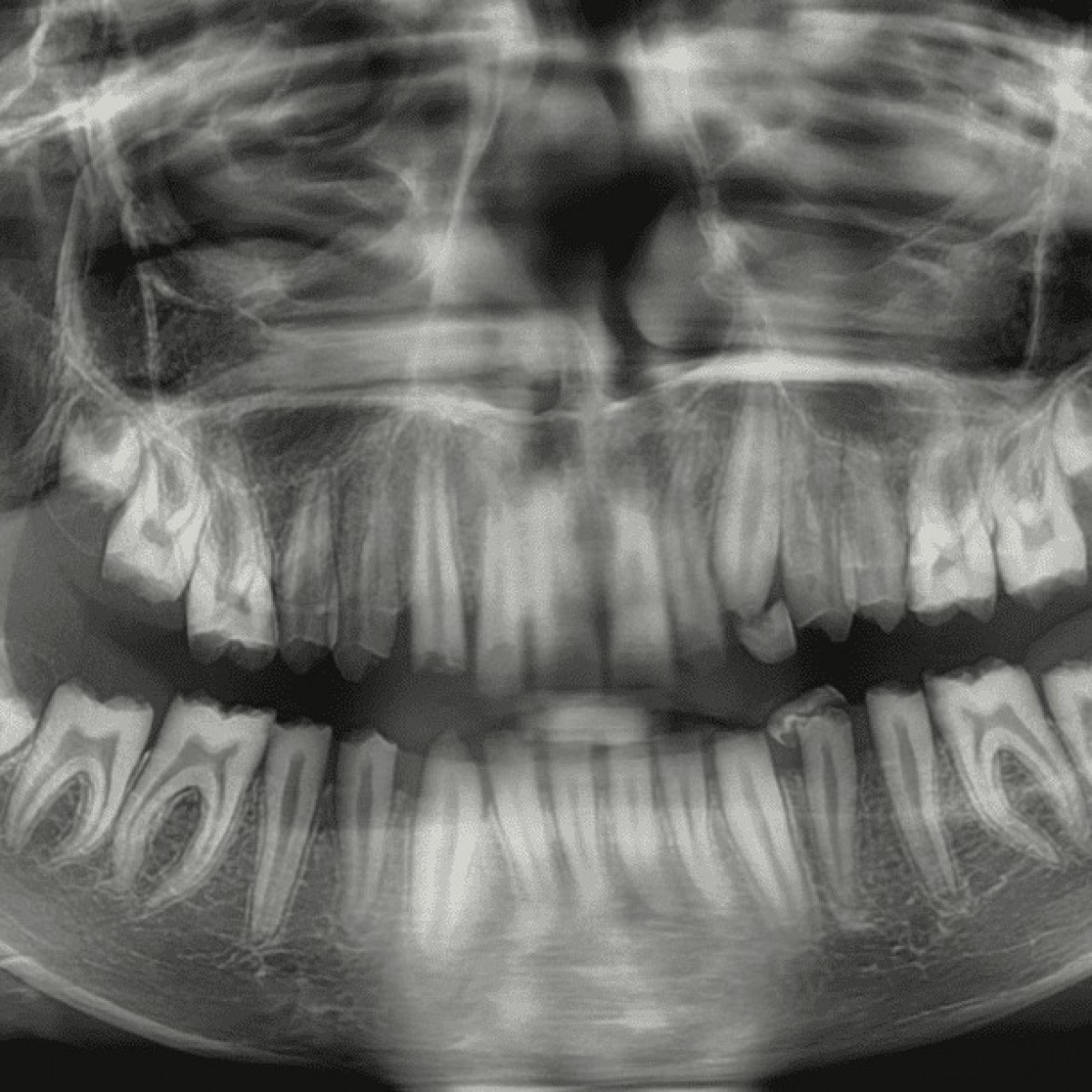
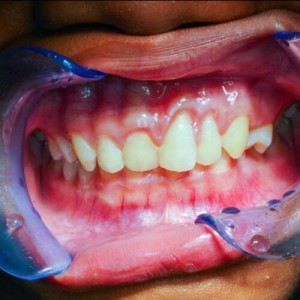
Clinical examination revealed generalized yellow-brown discoloration of all erupted permanent teeth with rough, pitted surfaces. The enamel was soft and prone to chipping, with post-eruptive breakdown evident on multiple teeth (Figure 1). Radiographic examination showed reduced enamel density with normal dentin and pulp morphology (Figure 2). The diagnosis was consistent with hypocalcified type amelogenesis imperfecta.
Intraoral findings revealed generalized yellow-brown discoloration affecting all permanent teeth, along with multiple areas of enamel breakdown and chipping. The patient also exhibited significant dental hypersensitivity to both thermal and tactile stimuli. Mild gingivitis was present, with localized areas of moderate inflammation, while the occlusion demonstrated a bilateral Class I molar relationship. No active carious lesions were identified during the examination. Psychosocial assessment further revealed a substantial impact on the patient’s self-esteem and social interactions, as the patient expressed reluctance to smile or participate in social activities because of dental appearance.
Treatment planning focused on alleviating dental hypersensitivity, restoring aesthetics and function, protecting the remaining tooth structure, establishing proper occlusal relationships, improving oral hygiene and gingival health, and enhancing psychosocial well-being.
After consultation with the patient and his parents, and considering the severity of enamel involvement, the patient’s age, and aesthetic concerns, the treatment plan consisted of full-coverage restorations for all permanent teeth, utilizing a digital workflow with the Midas 3D printer and Crown HT material.
Initial therapy included oral hygiene instruction, professional prophylaxis, and application of desensitizing agents. A diagnostic digital wax-up was created to visualize the final outcome and guide tooth preparation.
The treatment utilized a complete digital workflow:
Tooth preparation was conservative, preserving as much tooth structure as possible while gently smoothing the sharpest enamel. A supragingival preparation design was utilized where possible to maintain gingival health.
The definitive restorations were printed using the Midas 3D printer with Crown HT material, selecting shade BL for anterior teeth and a shade appropriate for the patient’s age for posterior teeth to achieve a natural appearance (Figure 3).
The printed restorations were bonded using a self-adhesive resin cement (PANAVIA V5 [Kuraray America]) following the manufacturer’s instructions. Occlusal adjustments were performed to establish stable occlusal contacts and functional movements.
The entire rehabilitation process was completed over 2 months with a total of 4 appointments.
Post-treatment evaluation revealed significant improvement in aesthetics, with natural-looking restorations that harmonized with the patient’s facial features (Figure 4). Functional assessment demonstrated proper occlusal contacts in maximum intercuspation and smooth, interference-free excursive movements.
The patient reported immediate resolution of dental sensitivity and significant improvement in masticatory efficiency. Gingival response to the restorations was favorable, with no signs of inflammation at the 1-month followup.
This case highlights several important aspects in the management of amelogenesis imperfecta in adolescent patients:
The use of Crown HT material with the Midas 3D printer provided several advantages in this case:
The digital workflow employed in this case offered significant advantages:
Treatment of AI in adolescent patients requires special consideration of several factors:
The severity of enamel involvement and functional compromises guided our approach of full-coverage restorations. Alternative approaches, such as direct composite restorations or partial-coverage designs, may be appropriate in less severe cases or for younger patients.
Continued monitoring is essential to evaluate long-term performance and address any emerging issues related to growth and development.
This case report demonstrates the successful rehabilitation of a 13-year-old patient with amelogenesis imperfecta using CAD/CAM technology and 3D-printed Crown HT material. The digital workflow with the Midas 3D printer provided an efficient, precise, and predictable treatment approach that addressed both functional and aesthetic concerns while considering the specific needs of an adolescent patient.
The immediate follow-up results indicate excellent clinical performance of the restorations with significant improvement in the patient’s quality of life. This approach represents a promising treatment modality for young patients with severe developmental dental anomalies, leveraging digital technology to achieve optimal outcomes.
Future research should focus on the long-term performance of 3D-printed restorations in growing patients and further refinement of materials and protocols specific to pediatric and adolescent populations.
Dr. McMahon is a graduate of the University of Pittsburgh (Pitt) School of Dental Medicine. She maintains a private practice focused on cosmetic dentistry in Pittsburgh. Dr. McMahon is accredited by the American Academy of Cosmetic Dentistry and is an invited Fellow of the prestigious American Society for Dental Aesthetics. She is a past clinical instructor in prosthodontics and operative dentistry at Pitt. Dr. McMahon frequently lectures across the United States on minimally invasive dentistry and conservative cosmetic dentistry for teenagers and young adults and has been annually voted by her peers as a top dentist in Pittsburgh for more than 20 years. She can be reached at drsusan@wowinsmile.com.
Disclosure: Dr. McMahon reports no disclosures.
Source: https://www.dentalcetoday.com/
 Related articles
CaviSense Inc., a Harvard/Tufts spin-out and developer of a radiation-free diagnostic technology for active tooth demineralization.

The expansion is in response to demand and success attained in Dental Implants GPS’ inaugural Southern California centers in Dana Point and Huntington Beach.
Restorative dentistry 02 March 2026
Esthetic-functional rehabilitation: orthodontics and restorative approach. A clinical case
Aim of this paper was to bring the attention to the feasibility of using unconventional and customized dental treatment helped by composite materials for direct restorations.
Prosthodontics 27 February 2026
Prosthetic implant rehabilitation using the scan-analog protocol: a clinical case
A digital workflow for prosthetic implant rehabilitation can start either from intraoral scans or from the scan of the patient cast models. However, the possibility of scanning oral impressions is...
Prosthodontics 13 October 2025
Periodontics, implantology, and prosthodontics integrated: the zenith‐driven rehabilitation
A customized treatment plan is important to reach results that will satisfy the patient providing esthetics, function, and long-term stability.
Read more

Jen Kim Field, chief sustainability officer at Henry Schein and president of the Henry Schein Cares Foundation, answers questions for Dentistry Today about the group’s achievements
News 12 October 2026
The education-first program offered learning for the entire dental practice, with practical insights spanning the full patient journey and focused on improving workflows, collabora
News 12 October 2026

AAO and Stand for the Silent Unite Communities This Month to Shine a Light on Bullying Prevention
Editorials 12 October 2026
Expanded coverage: Texas A&M’s Plemons named 2026 Texas Dentist of the Year

Sometimes a small act of generosity can make a tremendous impression, especially on a 7-year-old.
Endodontics 12 October 2026
This peer-reviewed endodontics article summarizes clinical evidence from Journal of dentistry (2026). It focuses on findings that may help dental professionals evaluate treatment decisions, patient...


Copyright © 2026 - All Rights Reserved
ISSN 2767-1178