


Full-mouth adhesive treatment in Bulimia-Related Dental Erosions: a clinical report
Authors: Francesca Muzzarelli, Lorella Marinucci, Stefano Cianetti, Guido Lombardo, Cinzia Barilotti, Stefano Pagano
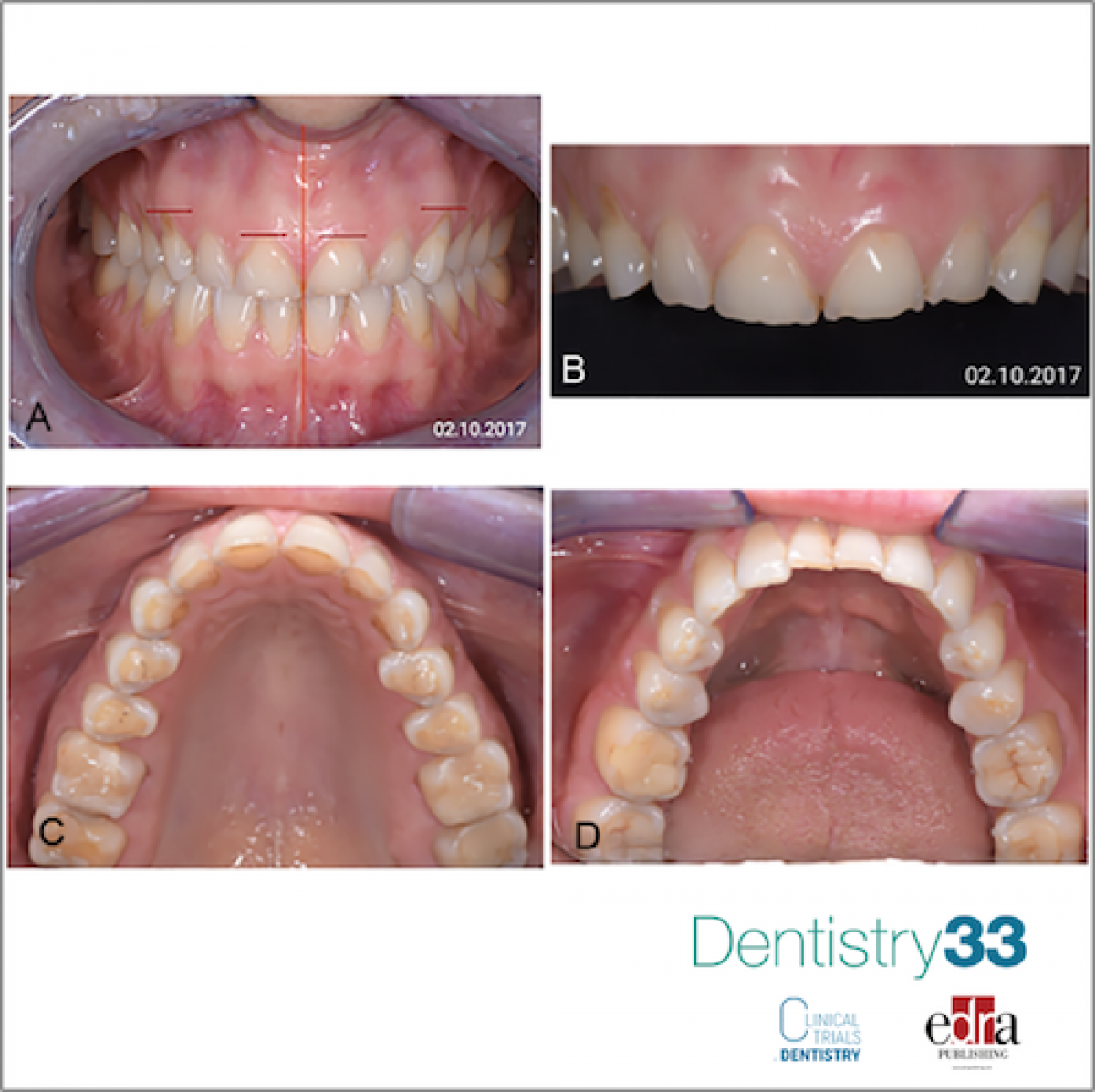
Dental erosion, which is defined as the gradual but irreversible loss of hard tissue is a major dental issue as it may be linked to systemic diseases such as eating disorders or gastroesophageal reflux (GERD), giving rise to difficulties in diagnosis. In both pathological forms, the presence of gastric juices in the oral cavity causes the erosion of the palatal surfaces of the upper elements, often associated with variable sensitivity; carious lesions are generally not associated. Erosions associated with gastroesophageal reflux are often associated with mucosal irritation, oral ulcers and altered taste. It may be due to mechanical or chemical causes, which often lead to problems in treatment. Compared to traditional classifications, the ACE classification sees these lesions divided mainly related to the anterior sector and to the therapeutic intervention strategy. Early diagnosis is crucial to maximize therapeutic alternatives. The treatment of erosions is closely related to the amount of enamel and dentinal tissue involved as well as to the vertical dimension to be obtained in order to obtain satisfactory aesthetic results for the patient. Best erosion treatment involves a multi-disciplinary team and may range from direct composite reconstructions and fixed prostheses to innovative indirect reconstruction systems that aim at preserving as much tissue as possible. The new CAD-CAM technology offers important advantages in terms of result forecasting, accuracy, precision and better patient-dentist communication.
The principle aims of treatment are aesthetic rehabilitation, recovery of functional mastication, establishment of the correct vertical dimension and achievement of stable and reproducible outcomes. In this regard, a multidisciplinary treatment that involves various professional figures would seem to guarantee good and predictable results.
The present clinical report describes the treatment of asymptomatic dental erosion in a patient with eating disorders associated with bruxism and cervical myalgia. The patient requested esthetic rehabilitation without invasive interventions. A multi-disciplinary approach included esthetic analysis which was followed by posture assessment using a stabilometric platform and a podoscope. A modified 3-step rehabilitation technique was supported by digital technology. Composite restorations were inserted in the posterior areas and double veneers in the anterior. The outcome was stable and easy to monitor.
The main objectives of prosthetic rehabilitation are preserving as much residual dental tissue as possible and achieving stable occlusal rehabilitation with a multidisciplinary approach, involving dentists, physiatrists and posturologists. Treatment depends on careful assessment of postural and temporal-mandibular abnormalities, as well as tooth damage. A multidisciplinary approach together with the advantages offered by CAD-CAM technology provides acceptable, predictable outcomes when treating dental erosive lesions. It is often particularly problematic to propose invasive therapeutic solutions, in the absence of relevant clinical symptoms. New technologies, together with adhesive strategies in the prosthetic field, allow the partial overcoming of this problem.
The proposed treatment represents a valid alternative to more invasive prosthetic reconstructions and highlights the importance of the multidisciplinary approach to the treatment of dental erosions.
 Related articles
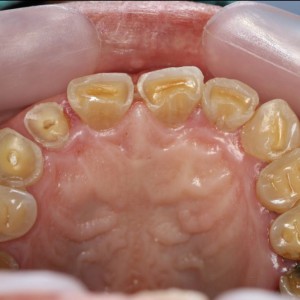
Dental erosion is the loss of mineralized tooth substance caused by exposure to acids, it is of non-bacterial origin and given its high prevalence and the cost associated with its treatment its...
Oral Hygiene & Prevention 25 April 2023
The association between erosive toothwear and asthma – is it significant? A meta-analysis
The association of asthma with oral conditions such as dental caries, dental erosion, periodontal diseases and oral mucosal changes has been the subject of debate among dental practitioners. Existing...

Dental erosion can affect the long-term health of the mouth. This condition is associated with the loss of hard dental tissues due to the chemical action of dietary or stomach acids.Patient education...
Read more
Products 20 October 2026
News 20 October 2026

In recognition of National Dental Hygiene Month, Delta Dental highlights key findings from its 2026 State of America’s Oral Health and Wellness Report , a nationwide analysis of co
News 20 October 2026

Abra Health Group has launched The Dental Bank, a new community impact initiative designed to make essential oral health resources more accessible to individuals and families throu
Editorials 20 October 2026
Woman’s skull likely proof of ancient nose amputation, says College of Dentistry professor

Qian Wang, professor in biomedical sciences at Texas A&M College of Dentistry in Dallas, identified what he and other researchers believe is likely one of the first examples of an
Endodontics 20 October 2026

This peer-reviewed endodontics article summarizes clinical evidence from Clinical oral investigations (2026). It focuses on findings that may help dental professionals evaluate treatment decisions,...


Copyright © 2026 - All Rights Reserved
ISSN 2767-1178