


Orthodontic treatment to correct the gummy smile and biprotrusion: a clinical case
An original article published on Maxillaris. Authors: Beatriz Solano Mendoza; María Luisa Vidal Bernárdez

Orthodontic treatment in adults is very frequent and mostly concerns aesthetic problems. Therefore, different alternatives appear aesthetics such as lingual orthodontics or lateral with aligners. In this article we present a clinical case with crowding inferior and biprotrusion, accompanied by a gummy smile, that needed distancing to solve this discrepancy.
We decided to treat it with alienators, accepting the challenge of facing difficulties with the help of appliances auxiliary (micro-screws).
CASE DESCRIPTION
A 25-years-old female patient came to our attention to resolve some esthetic problems.
Figures 1 a-b-c: Pretreatment extraoral photographs. This is a dolichofacial patient with a class II profile, accompanied by gingival smile and lack of projection with lack of lip seal.

Figure 1 a-c
Figures 2 a-f: Initial intraoral situation: class I molar and canine with a large crowding at the anterior-inferior level of -6 mm, which it isn’t similar in the upper arch, due to microdontia in the upper lateral incisors. It is accompanied by a large proclination of the lower incisor 62º. At the vertical level, a slight overbite is observed, being less than 1/3, even open bite at level 22.

Figures 2 a-f
Figure 3: Initial orthopantomography. We observe root resorption at the level of the upper lateral incisors and the premolar lower left, as well as chronic periodontitis, more pronounced in the distal lateral and mesial incisors and distal of the canine upper left.

Figure 3
Figures 4 a-c: Teleradiography (a) and initial trace (b). This is a dolichofacial patient, with an SNA angle of 75º, a SNB of 70º and a skeletal class II represented by an ANB angle of 5º and a Witts of 5 and an occlusal plane9 100º.

PURPOSE
Our main objectives for this patient were: to improve the gingival smile, correct the overbite, decrease the oral corridors, solve the anterior-inferior discrepancy, center the midlines and not increase the root resorption, nor aggravate the periodontal situation. Similarly, we want to produce a previous rotation of the occlusal plane, in order to improve the projection of the chin.
TREATMENT EVOLUTION
After the patient was controlled periodontally, she started orthodontic treatment with the aligners system, in which an intrusion of the complete upper arch was planned, both anteriorly, for correction of the gingival smile, and posteriorly, to improve mandibular overbite and anterior rotation. For maintenance of class I but with correction of crowding and proclination of the lower incisor, a bimaxillary displacement of 1.2 mm in the upper molars and 1.1 mm in the molars lower (fig. 5). Space in the upper arcade enabled the future reconstruction of 12 and 22. For said treatment, 46 aligners were planned (with a sequence of change every seven days).
Table 1: Initial and final cephalometric values of Steniter and Jararacback-MSE9 .
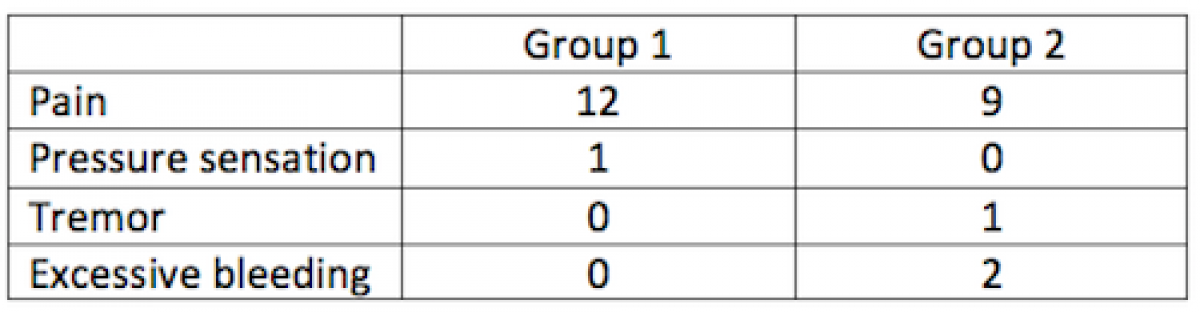
Table 1
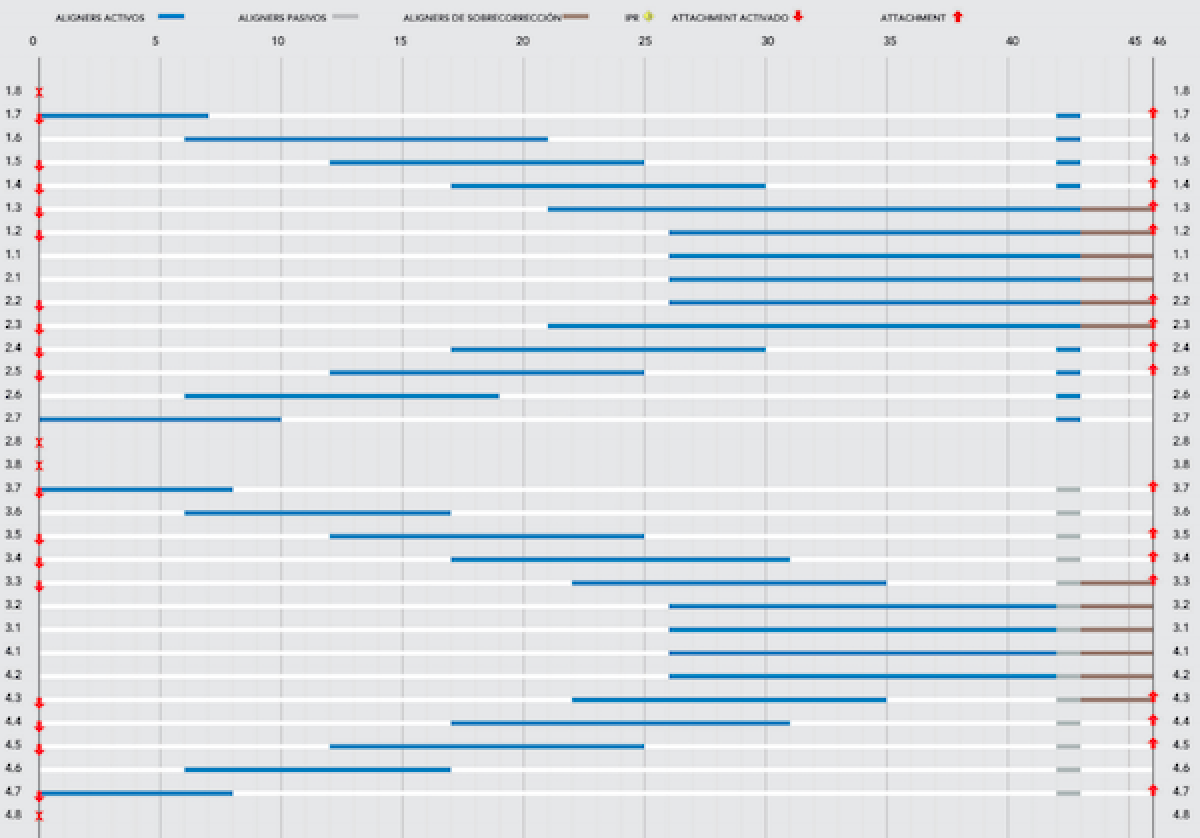
Figure 5: Invisalign® movement table.
The distancing effect exerts a strength of the same intensity but in the opposite direction and, as we are faced with a class I relationship, the distancing in both arches is necessary, so it was programmed placement of bone anchor using two micro-screws. The distancing and intrusion movement was performed simultaneously, so a bite jump was programmed, which which is going to manifest as a mandibular anterotation (fig. 6). The intrusion was planned at the level of the second and first molars and even of the upper and lower incisors, despite starting the patient from a situation of little overbite, in order to improve the gingival smile; therefore the intrusion scheduled was higher later than previous, being 1 and 1.5 mm in the first and second molars and 0.8 mm in the lower second molars. The distancing of the second molars was performed with the protocol less than 1/2, in order to have the maximum number of teeth as an anchor and thus avoid movement mesialization of adjacent teeth. Once reached the final position of the second molars, the placement of the micro-screws (10 × 1.6 mm) as close to its mesial root of 17 and 27, and thus allow the distraction of the first molars and accelerate the protocol distance to 1/3.

Figures 6 a-c: ClinCheck virtual planning.
Figures 7 a-b: The bone anchorage was used directly by means of elastics (3/16 "and 6 oz.) Of the canines superior to the MT.

Figures 7 a-b
Figures 8 a-b: Elastic from the upper MT to the lower premolar button. Once the second premolar reached the class relationship I, its position was fixed by means of metallic ligation 012 from the button to the MT and we began to lean on the micro-screws To perform the distancing of the lower arch, with an elastic (3/16 "and 6 oz.) to a lower button.

Figures 8 a-b
Once the 46 aligners were completed, therefinement measures for expansion and extrusion of 23,necessary to finish the treatment. There were a total of 19 aligners (with a seven-day change protocol). The final photographs (figs. 10 and 11) show a class I relationshipwith 1/3 overbite and absence of gingival smile.
Figure 9: Coronary elongation at 12 to level the gingival margin with 22, since the probing depth was 2.5 mm and the biological depth must be respected. For the rehabilitation of the microdontia of both lateral incisors, we opted for feldspathic veneers.

Figure 9
Figures 10 a-f: Final intraoral photographs. A correct molar and canine class I, adequate protrusion and overbite and lines were obtained.

Figures 10 a-f
Figure 11: Final smile after the treatment

Figure 11
Figures 12 a-b: Comparison of the photographs extraoral frontals pre and aftercare. Highlight the improvement of gingival smile, decrease oral corridors and lower third more proportionate.
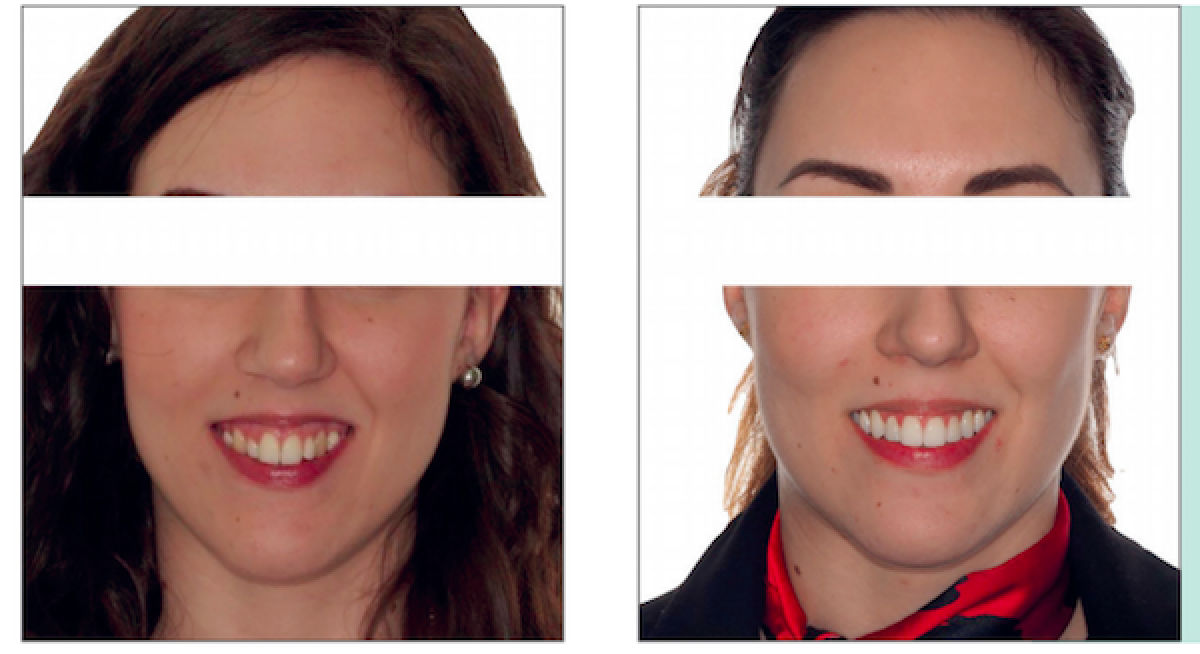
Figures 12 a-b
Figure 13: Final orthopantography, reflects that there has been no periodontal or root resorptions despite of having had a treatment of orthodontics.

Figure 13
Figures 14 a-b: Final tracing (a) and traced overlays, pre and pos (b). In cephalometry a change in the Wits could be observed appraisal of 5 to 2 mm and a change in the occlusal plane from 100º to 93º, corresponding to the mandibular anterior rotation that occurred, which we observe in the same way in the overlays.

Figures 14 a-b
Distalization is the most predictable motion for Invisalign® removable appliances. The distancing protocols are defined, but we can modify them and add variants as long as they are respected, as well as the principles biomechanical.
With the illustration of this clinical case we can see an alternative to extractions in class I malocclusions with biprotrusion and gingival smile.
For this, we will combine micro-screws with the bimaxillary distancing movement with the use of aligners, so that we achieve optimal results.
For the original article: https://www.maxillaris.com/revcms_get_binary.aspx?cont_id=0ed5cac1-f427-46ed-b49b-fce746f75800
 Related articles
News 05 June 2026

(Nasdaq: ALGN), a leading global medical device company that designs, manufactures, and sells the Invisalign® System of clear aligners, iTero™ intraoral scanners, and exocad™ CAD/C
Products 17 December 2025

Align Technology, Inc. announced commercial availability in Thailand of the Invisalign System with mandibular advancement featuring occlusal blocks designed specifically to address Class II skeletal...
News 30 June 2025
Align Technology Launches Brand Campaign Focused on Invisalign Treatment for Kids and Teens

Align Technology, Inc. (“Align”) (Nasdaq: ALGN), a leading global medical device company that designs, manufactures, and sells the Invisalign System of clear aligners, iTero intraoral scanners,...
News 26 May 2025

The Invisalign Palatal Expander is applicable to skeletal and dental malocclusion in primary, mixed, and permanent dentition and will be commercially available during the second half of 2025.
News 23 January 2025
Align Technology Announces NFL Quarterback Patrick Mahomes Joins the Invisalign Brand Smile Squad

Align Technology announced that Patrick Mahomes, quarterback for the National Football League’s (NFL) Kansas City Chiefs, has joined the Invisalign Smile Squad as an ambassador for the brand.
Read more

Jen Kim Field, chief sustainability officer at Henry Schein and president of the Henry Schein Cares Foundation, answers questions for Dentistry Today about the group’s achievements
News 12 October 2026
The education-first program offered learning for the entire dental practice, with practical insights spanning the full patient journey and focused on improving workflows, collabora
News 12 October 2026
AAO and Stand for the Silent Unite Communities This Month to Shine a Light on Bullying Prevention
Editorials 12 October 2026
Expanded coverage: Texas A&M’s Plemons named 2026 Texas Dentist of the Year

Sometimes a small act of generosity can make a tremendous impression, especially on a 7-year-old.
Endodontics 12 October 2026
This peer-reviewed endodontics article summarizes clinical evidence from Journal of dentistry (2026). It focuses on findings that may help dental professionals evaluate treatment decisions, patient...



Copyright © 2026 - All Rights Reserved
ISSN 2767-1178