


Third molar surgery: articaine 4% versus mepivacaine 2%
Lara Figini

There is a variety of anesthetics that can obtain the specific requirements of different clinical treatments. For tooth extraction it is necessary to use resources to control suffering and discomfort such as adequate anesthetics techniques. In fact the type of anesthetics used can influence the management of pain in such procedures.
The most common local anesthetics used in dentistry are the tertiary amine. In particular, articaine is probably the most frequently used agents. It is an intermediate-duration local anesthetic and thanks to the peculiar thiophene ring, it allows his molecules a greater lipid solubility and consequently a rapid diffusion across membranes.
Articaine was approved for use in the United States in April 2000. Since that moment, it has been compared to a number of local anesthetics. Despite a great number of evidence of articaine safety in both adults and children, a possible relationship between paresthesia and articaine has been suggested. The cause is not completely understood, but it could be related to the higher concentration of local anesthetic agent. The possibility of this adverse event has led to suggestions to avoid the use of high-concentration anesthetic formulation for nerve block anesthesia.
The Authors in this controlled, clinical, split-mouth study want to compare the efficacy of 4% articaine hydrochloride and 2% mepivacaine hydrochloride, both associated with epinephrine at a ratio of 1:100,000, used in the extraction of lower third molars. The objective was to analyze the anesthetic volume used in relation to their effectiveness on pain intensity during and after surgery, hemodynamic parameters and patient and surgeon satisfaction.
Material and Methods
A sample of 20 patients requiring bilateral extraction of teeth has been selected. The eligible patients were randomly distributed into two group:
Group 1 - Patients undergoing extraction of the lower third molar under local anesthesia with 4% articaine chloridrate and epinephrine at a ratio of 1:100,000.
Group 2- Patients undergoing extraction of the lower third molar with local anesthesia with 2% mepivacaine chloridrate and epinephrine at a ratio of 1:100,000.
Local anaesthesia -performed with an anaesthetic drug different to that used in the opposite side- was administered by using the inferior alveolar nerve block technique and his action was determined and recorded when the patient reported loss of sensibility in the lower lip and in the anterior half of the tongue. A single experienced surgeon was assigned to perform the tooth extractions.
Pain was the main parameter evaluated by visual analogue scale (VAS), during and immediately after the surgery. Hemodynamic parameters, adverse events, presence of paresthesia and satisfaction of patients and surgeon were also analysed.
Results:
-The mean amount of anaesthetic solution used and the mean onset time and duration was in favour of Group 1, with a differencenot statistically significant;
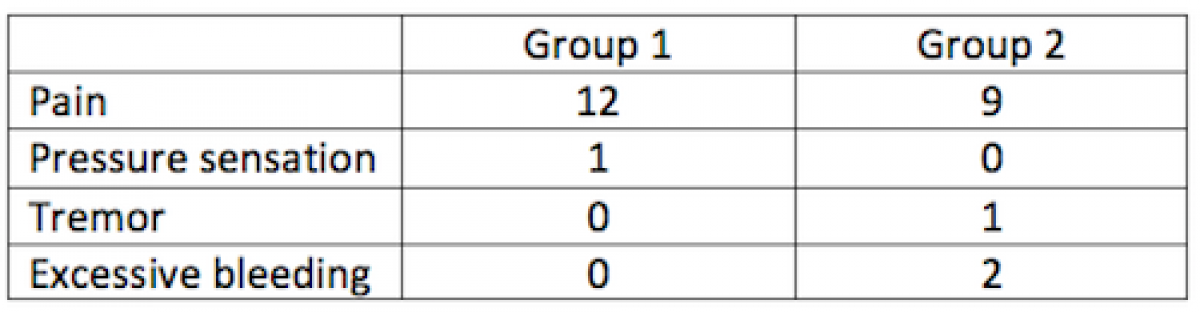
-The comparison of pain perception during and immediately after (at 0, 2, 4and 6 hours) surgery between both groups was the main variable of the study. In particular the greater difference was found during the surgery, in which Group 1 had a mean value of 1.10 point compared to 2.05 points of Group 2. Nonethelessthe values found immediately after the surgery was on the opposite, with pain management greater in Group 2; (table1)
-Occurrence of paresthesia (reversible within a 30- day period) was observed in the post- operative controls, with three cases in Group 1 and one case in Group 2, recording no significant difference between both groups (p=0.292).
Conclusions:
Evaluation and comparison between 4% articaine and 2% mepivacaine can help both patients and clinicians to minimised discomfort and avoid adverse events during and after surgery. Data from this study revealed that both anesthetics are efficient and safe in the management of pain for extraction of third molars, in which less amount of mepivacaine is needed. Nonetheless articaine was highlighted by the surgeon during divulsion and suture.
For additional information: Volume and effectiveness assessment of articaine 4% versus mepivacaine 2% used in third molar surgery: randomized, double-blind, split-mouth controlled clinical trial
 Read more
Continuous innovation across the DEXIS ecosystem helps clinicians work with greater clarity, confidence, and efficiency
News 23 October 2026
CrownPoint Partners announced the successful closing of a $9.2 million, five-property dental sale-leaseback portfolio located throughout Michigan.
News 23 October 2026
Dentsply Sirona, Midwest Dental Expand Technology Relationship

Beginning November 1, Dentsply Sirona will expand its long-standing relationship with Midwest Dental Equipment & Supply beyond consumables to include its complete technology portfo
Editorials 23 October 2026
Honoring Excellence: Graduation Awards for CU Anschutz Dental Students and Faculty
As the University of Colorado Anschutz School of Dental Medicine celebrates the graduating DDS Class of 2025, we are proud to recognize the students and faculty members whose excep
Implantology 23 October 2026
This peer-reviewed implantology article summarizes clinical evidence from Clinical oral implants research (2026). It focuses on findings that may help dental professionals evaluate treatment...


Copyright © 2026 - All Rights Reserved
ISSN 2767-1178