


Longitudinal epidemiologic analysis of three decades of TMD population
Authors: Emanuela Serritella, Paola Di Giacomo, Chiara Vompi, Gianni Falisi, Carlo Di Paolo
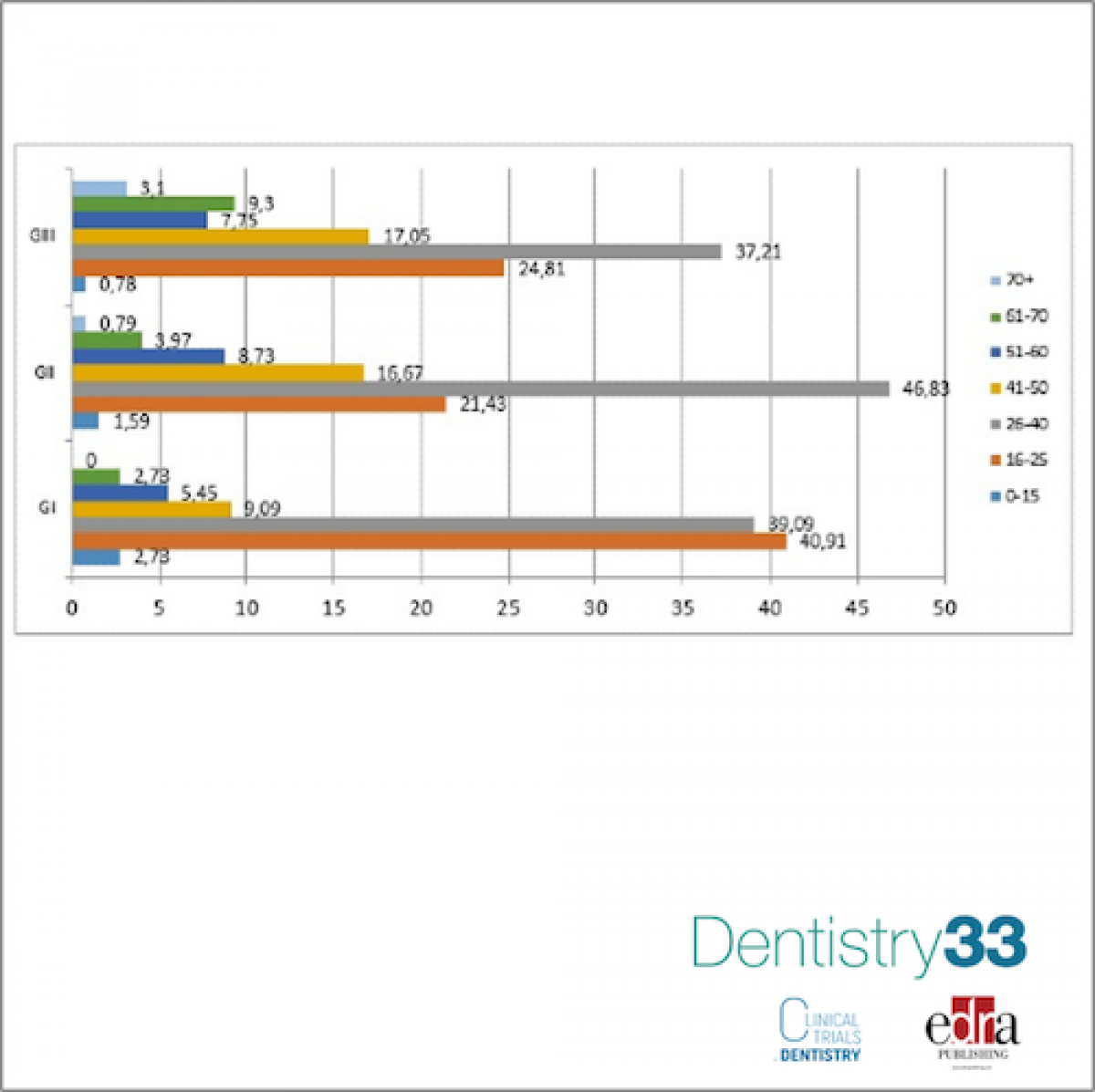
Aim: This study aims to compare the epidemiological data of three cohorts of dysfunctional patients attending to the Clinical Gnathology Service of “Policlinico Umberto I University Hospital -Sapienza University of Rome”, in order to highlight the salient characteristics of Temporomandibular disorders (TMD) and patients who are affected, and understand their evolution over time.
Materials and Methods: A homogeneous population of 387 dysfunctional patients, belonging to three different decades, consecutively extracted from the medical records in the archive, which contained all their personal, anamnestic and clinical data, was selected. All patients were divided into three homogeneous groups of 129 subjects: GI (1990-1993), GII (2000-2003) and GIII (2010-2013). A descriptive statistical analysis of all the clinical and anamnestic data was performed.
Results: The female gender (F) is far more interested in the development of TMD, although the study groups of more recent times shows an increasing trend in the incidence on the male one (M): in GI, the patients of M and F sex are respectively 14.84% and 85.16%; in GII are 15.50% and 84.50%; and in GIII are 20.16% and 79.84%. Regarding the age, in all three groups the most affected range is between 16 and 40 years: 80% in GI, the 68.26% in GII and the 62.02% in GIII. However, the highest age groups, from 41 to 70 years and over, shows a progressive increase in incidence, from the 90s (GI) to today (GIII): the 17.27% in GI; the 30,16% in GII; the 37,20% in GIII. The most frequent TMDs are the joint diseases (GI: 85%; GII: 54.3%; GIII: 51.2%). The disc displacement with reduction (DDWR) is present in the 44,89% of GI patients, the 40,31% of GII, and the 34,11% of GIII. The disc displacement without reduction (DDWoR) is present in the 40,15% of GI patients, the 13,96% of GII, and in the 17.06% of GIII. GIII shows an increased incidence of muscular pathologies (37.2%) compared to previous decades (GI: 10.2%; GII: 35.6%). The parafunctions are a datum of remarkable incidence in all the study groups, especially in GIII. Clenching is present in the 17,05% of GI, in the 30.23% of GII, and in the 62.8% of GIII. Bruxism is present in the 14.96% of GI, in the 11,63% of GII, and in the 35,66% of GIII. Joint pain is the symptom with higher incidence in all analyzed groups, being reported by the 74,42% of GI, the 79.07% of GII and the 69.77% of GIII. This symptom, whether present on the right, on the left or bilaterally, is mostly referred as moderate/severe by patients of GI, GII and GIII, and shows no remarkable discrepancies between the different decades. Headache is a symptom mostly referred as bilateral, and is the comorbidity most reported all three groups: 45.74% in GI, 57.36% in GII, and 66.67% in GIII. Neck pain occurs mostly bilaterally and is reported by a higher percentage of GIII patients (61,24%), compared to GII (41.87%).
Conclusions: the TMD patient, compared to the past, is on average less young and afflicted by painful and chronic diseases, almost constantly accompanied by painful symptoms associated with the purely articular or muscular one, such as headache and neck pain. These features make the dysfunctional patient more complex to be examined, so the specialist need to train properly in order to have a valid diagnostic and therapeutic expertise.
Clinical significance: the dysfunctional patient has changed over time several characteristics that must be considered in clinical practice.
 Related articles
Editorials 06 March 2026
HSDM researchers join national effort to improve care for temporomandibular disorders

Multidisciplinary research initiative aims to transform how temporomandibular disorders are understood, diagnosed, and treated
Prosthodontics 13 June 2025

The second part of this review, evaluating the literature on the relationship between dental occlusion and temporomandibular disorders (TMDs), focuses on the aetiological importance of tooth loss and...
Oral Hygiene & Prevention 28 November 2023
New Center Will Investigate And Discover Treatments for Temporomandibular Disorders

It has a disc in the middle and then two bony structures that articulate together to open and close the jaw. But, with all that talking and eating, the jaw joint is used more than the knee. Between 5...
Oral surgery 12 September 2023
Rutgers team treats patient suffering from trigeminal neuralgia

By Kardelen Koldas, Rutgers School of Dental Medicine
Alberto Gracia had trigeminal neuralgia. It’s a condition where the trigeminal nerve — responsible for sensation to the face — is contacted by a blood vessel. This creates episodic electric...

The inconclusiveness and scarcity of research focusing on the association between oral behavior and painful TMD accentuates the necessity for further studies in this specific area.
Read more
Products 14 October 2026

Royal Philips (NYSE: PHG, AEX: PHIA) announced that the Philips Sonicare Next-Generation DiamondClean 9900 Prestige, its most advanced and intelligent toothbrush to date, is now av

Key transaction by Heartland Dental and its supported practices expands opportunities for supported doctors, teams, and practices while strengthening Heartland Dental’s supported f
News 14 October 2026
Henry Schein Cares Celebrates 25 Years of Corporate Citizenship

Henry Schein Cares, Henry Schein, Inc.’s global corporate citizenship program, is celebrating a quarter century of bringing together Team Schein Members, customers, supplier partne
Editorials 14 October 2026
Scholarship at the CU Anschutz School of Dental Medicine reflects the collective contributions of our faculty, staff, residents and students.
Oral Hygiene & Prevention 14 October 2026
Propolis-containing formulations in caries prevention - a systematic review and meta-analysis.
This peer-reviewed oral hygiene & prevention article summarizes clinical evidence from Clinical oral investigations (2026). It focuses on findings that may help dental professionals evaluate...



Copyright © 2026 - All Rights Reserved
ISSN 2767-1178