


Early implant loading in the atrophic posterior maxilla: an 11-year randomised controlled trial of 1-stage lateral versus crestal sinus lift and 8-mm-long hydroxyapatite-coated implants
Authors: Gioacchino Cannizzaro, Pietro Felice, Daniela Rita Ippolito, Matteo Lazzarini, Eugenio Velasco-Ortega, Marco Esposito
OBJECTIVES
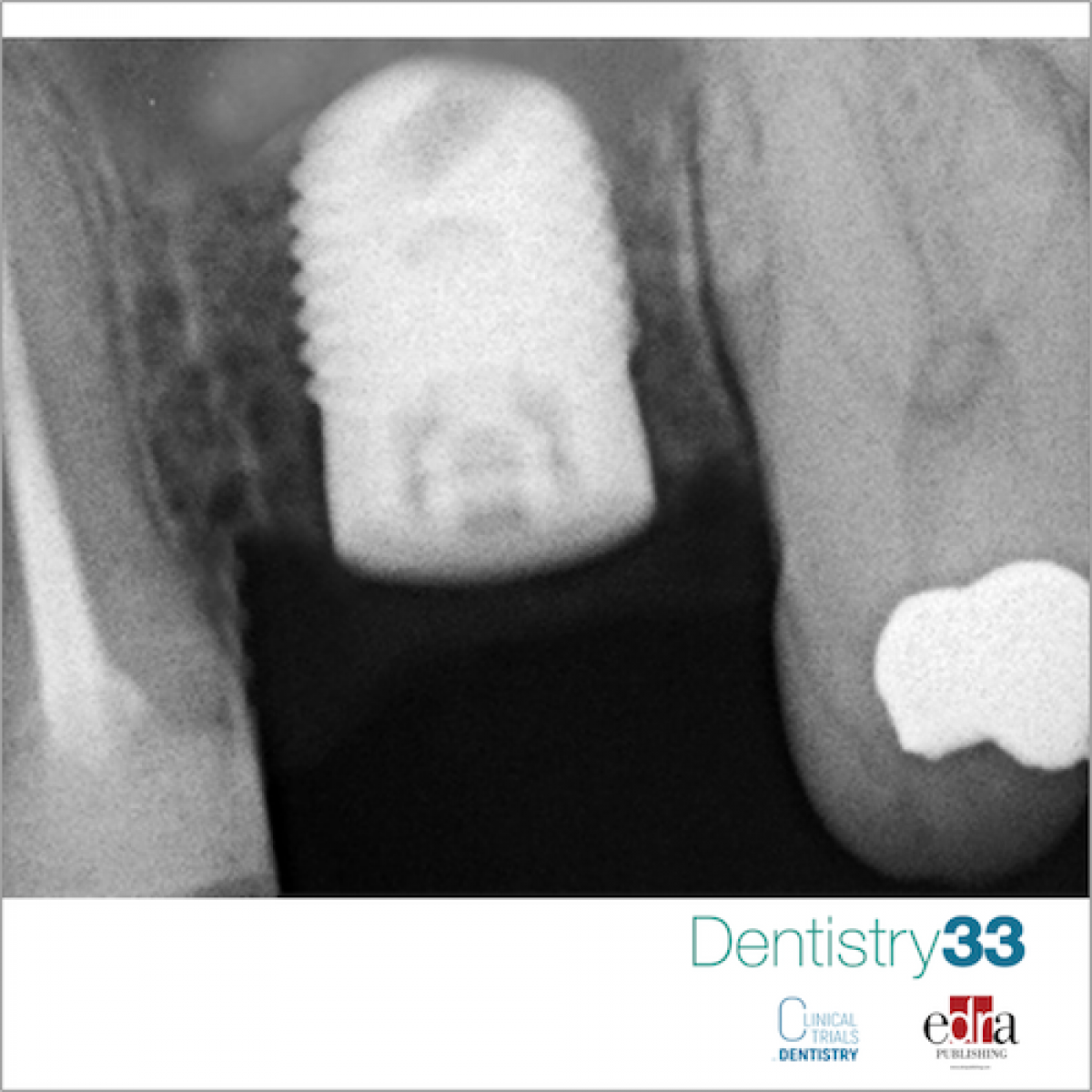
To compare 10- to 16-mm-long implants inserted into maxillary sinuses augmented with a lateral approach versus 8-mm-long implants placed in crestally augmented sinuses, both loaded early after 45 days.
MATERIALS AND METHODS
Forty partially or fully edentulous patients having 3 to 6 mm of residual crestal bone height and at least 4 mm thickness below the maxillary sinuses were randomised according to a parallel group design to receive either one to three 10- to 16-mm-long hydroxyapatite- coated implants (20 patients) after lateral sinus lift with 50% anorganic bovine (Bio-Oss) and 50% autogenous bone, or 8-mm-long implants (20 patients) after crestal sinus lift with autogenous bone. All implants were submerged and left to heal for 45 days before being loaded. Within one week after abutment connection, implants were loaded with screw-retained fully acrylic provisional prostheses. Definitive metal-ceramic prostheses were provisionally cemented 45 days after abutment connection. Outcome measures were: prosthesis or implant failure, any complications, and radiographic peri-implant marginal bone level changes. In addition, the stability of individual implants was assessed via Osstell and Periotest by blinded outcome assessors, although Periotesting was discontinued after the fifth year in function. All patients were followed up to 11 years after loading.
RESULTS
One patient per group dropped out. One implant failed in the short implant group versus five implants in three patients from the longer implant group, the difference being not statistically significant (difference in proportions: 0.11; P = 0.604; 95% CI = -0.15 to 0.36). Three prostheses in the long implant group could not be fitted or were replaced versus one crown on short implants, the difference being not statistically significant (difference in proportions: 0.11; P = 0.604; 95% CI = -0.15 to 0.36). Six complications occurred in six patients from the short implant group versus ten complications in seven patients from the long implant group, the difference being not statistically significant different (difference in proportions: 0.053; P = 1.000; 95% CI = -0.265 to 0.357); however, two major postoperative complications occurred in the longer implant group: one abscess and one sinusitis, both of which determined the complete failure of the treatment in two patients (four implants lost). After 11 years, a total of 1.26 mm of peri-implant marginal bone had been lost at long implants and 0.64 mm at short implants, and the difference between the two groups was statistically significant (difference: 0.62 mm, 95% CI = 0.25 to 0.99; P=0.002).
CONCLUSIONS
In atrophic maxillary sinuses with a residual bone height of 3 to 6 mm, 8-mm short implants placed in simultaneously crestally lifted sinus might be a preferable choice than one-stage lateral sinus lift for placing longer implants, since the former appear be associated with lower morbidity. Implants placed with an insertion torque superior to 35 Ncm can be early loaded at 6 weeks.
 Read more
Products 14 October 2026
Royal Philips (NYSE: PHG, AEX: PHIA) announced that the Philips Sonicare Next-Generation DiamondClean 9900 Prestige, its most advanced and intelligent toothbrush to date, is now av

Key transaction by Heartland Dental and its supported practices expands opportunities for supported doctors, teams, and practices while strengthening Heartland Dental’s supported f
News 14 October 2026
Henry Schein Cares Celebrates 25 Years of Corporate Citizenship

Henry Schein Cares, Henry Schein, Inc.’s global corporate citizenship program, is celebrating a quarter century of bringing together Team Schein Members, customers, supplier partne
Editorials 14 October 2026
Scholarship at the CU Anschutz School of Dental Medicine reflects the collective contributions of our faculty, staff, residents and students.
Oral Hygiene & Prevention 14 October 2026
Propolis-containing formulations in caries prevention - a systematic review and meta-analysis.
This peer-reviewed oral hygiene & prevention article summarizes clinical evidence from Clinical oral investigations (2026). It focuses on findings that may help dental professionals evaluate...



Copyright © 2026 - All Rights Reserved
ISSN 2767-1178