


Accuracy of guided implant surgery: four protocols compared
Lara Figini
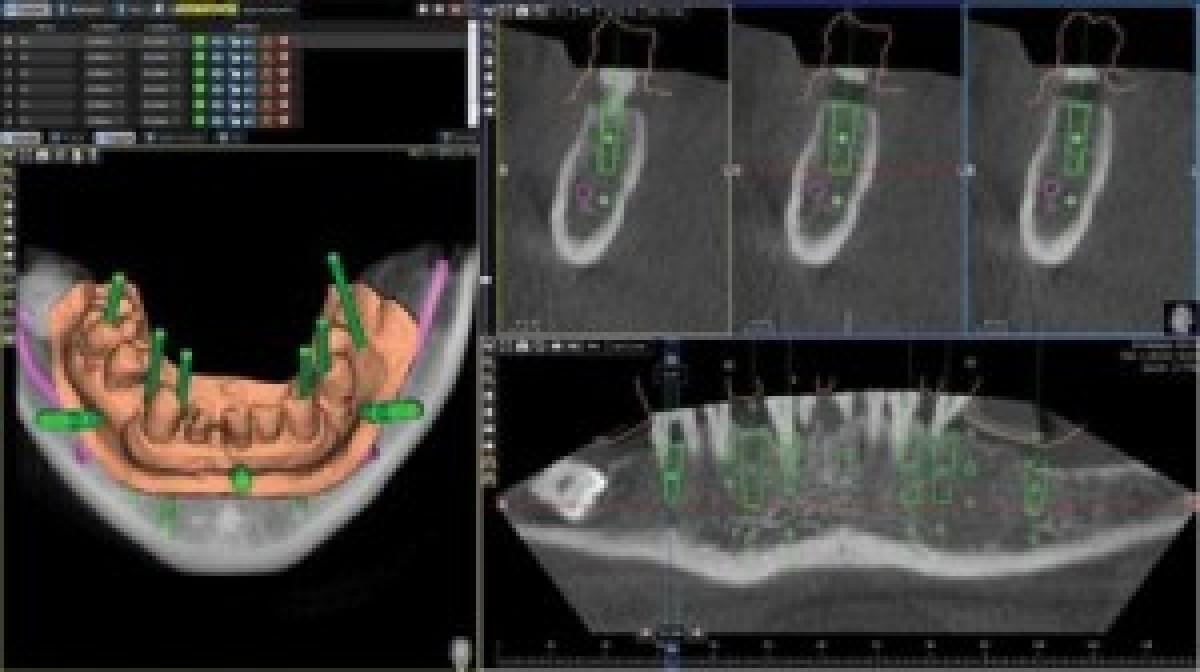
In recent years, there has been an increase in demand for implant-supported fixed prostheses. Correct placement of dental implants is critical to achieving both functional and aesthetic success. In addition, well-planned surgery minimizes risks such as sinus perforation, dehiscence, fenestration and damage to the mandibular nerve and prevents contact between a dental implant and the root of an adjacent tooth. Three implant surgical approaches are currently in use: freehand, computer-guided, and computerized-navigated surgery.
Computer Guided Surgery involves 3D planning and development of a static resin surgical template. The surgical template design is created by superimposing the data obtained by Cone Beam (CBCT) with that of the digital impression. The planned implant position can be transferred to the patient with the surgical template. Computerized-navigated surgery, also called dynamic guided surgery, on the other hand is based on motion tracking technology, which allows for real-time monitoring of the drill and modification of the implant position during surgery.
Materials and Methods
In an Italian retrospective clinical study, published on Journal of Prosthodontic Research October 2020, the authors compared the 2D and 3D position accuracy of four guided implant surgical protocols using linear and angular deviation analysis. DICOM and .STL files obtained from a CBCT and those obtained from a digital impression were overlaid with the software to plan the implant position. The fifty-six patients included in this retrospective study were treated consecutively with computer-guided implantology between March 2016 and September 2017. These patients were divided into 4 groups:
- FGA group: guided implantology with implant positioning using a manual adapter.
- FGM Group: guided implantology with implant positioning using a guided mounter connected to the implant.
- PG group: guided implantology with manual implant placement.
- MS group: guided implantology that included surgical templates with mucosal support only and with fully guided implant placement. The position of 120 implants was assessed by superimposing the planned and final position recorded with a digital impression.
Results:
All 120 implants were placed without complications. The mean (± SD) differences between planned and final 3D positions for all implants were 0.978 ± 0.476mm at the implant head and 1.20 ± 0.51mm at the implant apex. The mean angular deviation was found to be 3.31 ° ± 1.99 °. Considering the 2D positions (excluding the apico-coronal axis), the mean position differences were 0.618 ± 0.421 mm at the implant head and 0.93 ± 0.54 mm at the implant apex. The results of this study indicate that the use of dental-supported surgical templates may be more accurate than the use of mucosa-supported guides.
Conclusions:
From the data of this study, which must be confirmed in other similar studies, it can be concluded that guided surgery offers good accuracy and predictability regarding the position of the implant. The use of tooth-supported surgical templates can be more accurate than the use of mucosal-supported guides, while both partially and fully guided templates can simplify surgery and aid in optimal implant placement.
Clinical implications:
Careful observance of surgical protocols can reduce the differences in accuracy between partially guided and fully guided approaches. Using a digital impression to assess the final implant position can avoid a second CBCT. However, further randomized controlled clinical trials on the accuracy of various guided surgery protocols are still needed to provide guidelines.
For additional information: 2D / 3D accuracies of implant position after guided surgery using different surgical protocols: A retrospective study
 Read more

Continuous innovation across the DEXIS ecosystem helps clinicians work with greater clarity, confidence, and efficiency
News 23 October 2026

CrownPoint Partners announced the successful closing of a $9.2 million, five-property dental sale-leaseback portfolio located throughout Michigan.
News 23 October 2026
Dentsply Sirona, Midwest Dental Expand Technology Relationship

Beginning November 1, Dentsply Sirona will expand its long-standing relationship with Midwest Dental Equipment & Supply beyond consumables to include its complete technology portfo
Editorials 23 October 2026
Honoring Excellence: Graduation Awards for CU Anschutz Dental Students and Faculty

As the University of Colorado Anschutz School of Dental Medicine celebrates the graduating DDS Class of 2025, we are proud to recognize the students and faculty members whose excep
Implantology 23 October 2026
This peer-reviewed implantology article summarizes clinical evidence from Clinical oral implants research (2026). It focuses on findings that may help dental professionals evaluate treatment...



Copyright © 2026 - All Rights Reserved
ISSN 2767-1178