


Penn Dental Medicine Visiting Scholar Argues for “Prosocial AI” in New Book

In her new book, Human Leadership for Humane Technology: The New AI: Agency Ignited (Palgrave Macmillan, 2024), Cornelia Walther explores the relationship of natural and artificial intelligence (AI) and argues that for AI to have a positive impact on humanity we must systematically and intentionally harness it as a force for social good.
Walther, who is a visiting scholar at Penn Dental Medicine’s Center for Integrative Global Oral Health and Wharton’s Neuroscience Initiative, has more than two decades of experience as a humanitarian practitioner with the United Nations, focusing on large-scale emergencies in West Africa, Asia, and Latin America, particularly in social and behavior change advocacy.
While AI’s development was originally driven by commercial interests, says Walther, its social impact is too far-reaching to leave it in a purely economic space. She advocates a “prosocial AI” that is “tailored, trained, tested, and targeted to bring out the best in and for people and planet. “We must not only seek to govern its consequences,” she argues, “but also make a conscious effort to prioritize human values and recognize our own agency in its development.”
Since AI is a reflection of ourselves, says Walther, it can reveal both the best and worst of humanity. “If we feed it with data riddled with bias, inequality, and greed, those patterns will be amplified, potentially leading to disastrous consequences,” she says. “If, however, we design, deliver and deploy AI in ways that reflect our highest aspirations for equity, justice, and well-being, the technology can become a powerful force for the common good.”
Beyond its theoretical arguments, the book offers a tangible framework for action, with suggestions that include an inspiration incubator that would bring together like-minded thinkers and practitioners from a broad variety of sectors to think about the challenges that come with AI and to start designing prosocial AI applications.
One section of the book includes personal essays from a wide range of individuals—including but not limited to a storywriter, an academic, and a key leader in education at Microsoft— whose stories shed light on how real people navigate the challenges and opportunities of an AI-infused world.
Ultimately, Walther says she is neither pro nor anti AI. The technology is neutral, she says. “What’s happening right now with AI is an invitation to face our own humanity. Whether it’s a treasure chest or Pandora’s box, that depends on us. We have a choice.”
Source: https://www.dental.upenn.edu/
 Related articles
Editorials 14 November 2025
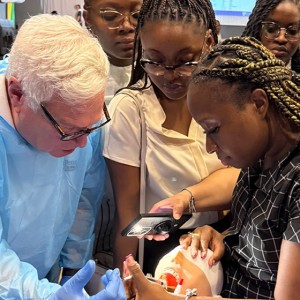
Penn Dental Medicine shared its expertise in caring for persons with disabilities with dental care providers from throughout Jamaica at a 1 ½ -day hands-on continuing education program, held October...
Editorials 23 July 2025

The Center for Innovation & Precision Dentistry (CiPD) at Penn Dental Medicine proudly hosted its Fourth Annual CiPD Symposium on May 29 bringing together a dynamic community of dentists,...

Oral healthcare providers and patients will soon receive more frequent, evidence-informed recommendations to advance oral and overall health with the establishment of the ADA Living Guideline...
Editorials 26 May 2025

Groundbreaking program to provide evidence-informed guidelines in real time to support patient care and advance public health
Editorials 03 February 2025
White Coat Ceremony Welcomes New Class of Foreign Trained Dentists to Penn Dental Medicine

Penn Dental Medicine welcomed 38 foreign-trained dentists to the study of dental medicine as part of the DMD Class of 2027 with its White Coat Ceremony, held January 8 at Penn Dental Medicine.
Read more
Continuous innovation across the DEXIS ecosystem helps clinicians work with greater clarity, confidence, and efficiency
News 23 October 2026

CrownPoint Partners announced the successful closing of a $9.2 million, five-property dental sale-leaseback portfolio located throughout Michigan.
News 23 October 2026
Dentsply Sirona, Midwest Dental Expand Technology Relationship
Beginning November 1, Dentsply Sirona will expand its long-standing relationship with Midwest Dental Equipment & Supply beyond consumables to include its complete technology portfo
Editorials 23 October 2026
Honoring Excellence: Graduation Awards for CU Anschutz Dental Students and Faculty

As the University of Colorado Anschutz School of Dental Medicine celebrates the graduating DDS Class of 2025, we are proud to recognize the students and faculty members whose excep
Implantology 23 October 2026
This peer-reviewed implantology article summarizes clinical evidence from Clinical oral implants research (2026). It focuses on findings that may help dental professionals evaluate treatment...


Copyright © 2026 - All Rights Reserved
ISSN 2767-1178