


Esophytic labial mucosal lesion
Author: E. Di Iorio
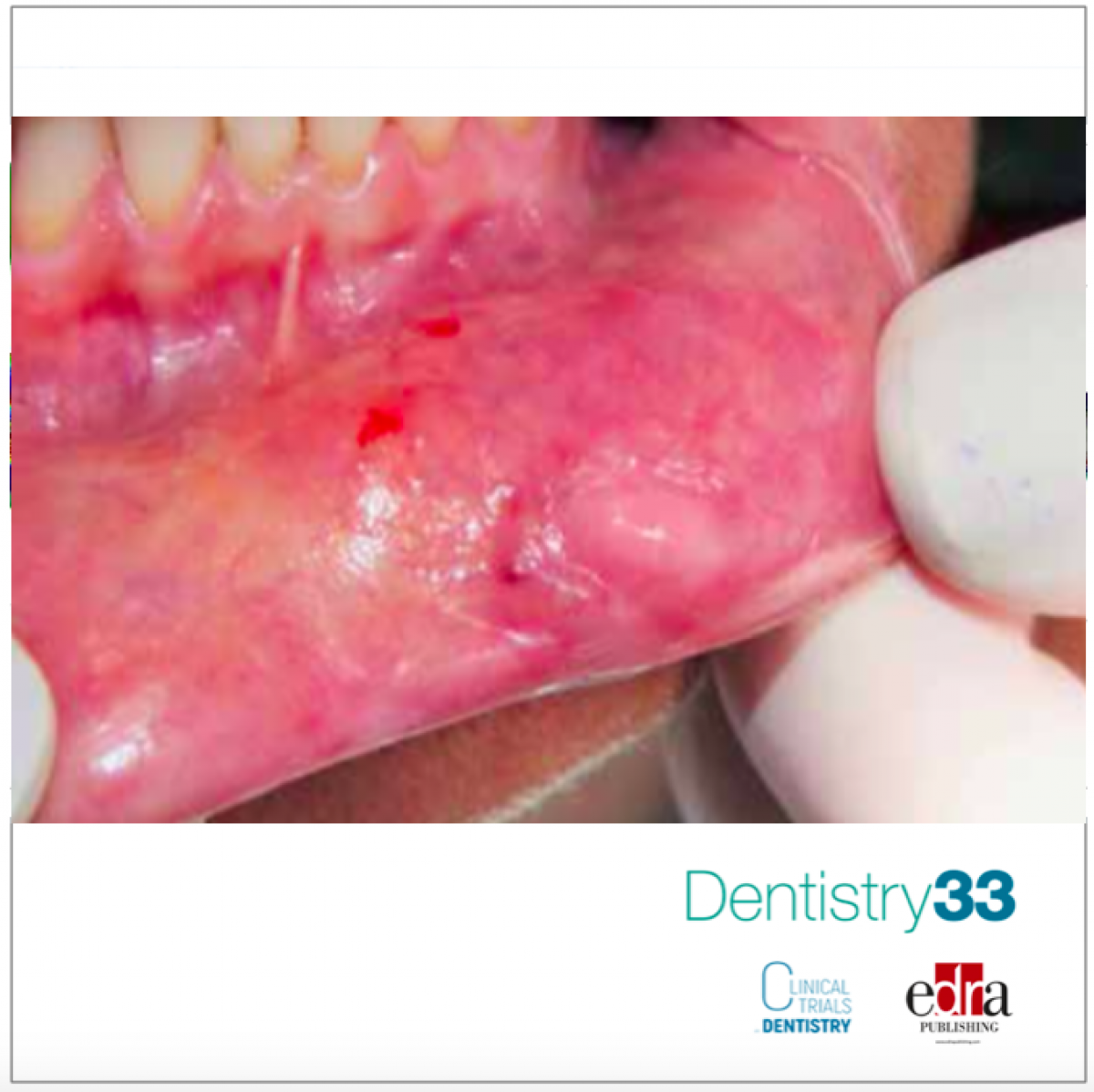
A 56-year-old patient in good health comes to our attention who reports the presence in the lower lip of a painless swelling which, due to an increase in size, has become subject to chewing trauma.
Clinical examination shows the presence at the level of the vermilion border of the lower lip of a swelling with clear edges of diminished consistency covered by intact mucosa. Once the patient's informed consent has been obtained, the surgical removal of the neoformation is scheduled, which will be subjected to histological examination for the correct diagnostic classification.
DIAGNOSIS AND CARE
Comforted by the clinical aspect of the lesion which presented clinical characteristics of benignity and to reduce the risk of catricial outcomes in an area of considerable aesthetic impact, it was decided to use a 980 nm diode laser source to perform the excision (fig. 2). As amply demonstrated by the scientific literature, these equipment, correctly used, do not interfere with the execution of the histological examination. However, it is prudent to limit its use to removing only the lesions that show clinical characteristics of benignity and in any case keeping a safe distance from areas whose clinical characteristics may leave diagnostic doubts.
From histological examination, the lesion appears to be a fibrolipoma, a histological variant of lipoma, a relatively uncommon benign neoplasm in the oral cavity that is more often localized in the mucous membrane or in the oral floor.
Clinically, it appears as an asymptomatic rounded mass, sometimes tending to yellow in color, covered by a thin intact mucous membrane, sometimes the site of subtle telangiectasias. Over time it can take on considerable dimensions and become subject to chronic trauma, an event that must always be considered due to the possible risk of onset of pathological pictures of a dysplastic or metaplastic nature. From the histological point of view in fibrolipoma, in addition to adipocytes that show a different degree of cellular maturity, there is a component of fibrous tissue. Other histological subtypes are angiolipoma, myxoid lipoma, spindle cell lipoma and intramuscular lipoma. In the differential diagnosis, other connective tissue lesions should be placed such as: neurofibroma, traumatic fibroma, mucocele, neoplasms of the minor salivary glands, etc. Surgical treatment is the therapy of choice for all the variants mentioned

Fig2

Fig3
 Read more
Products 14 October 2026
Royal Philips (NYSE: PHG, AEX: PHIA) announced that the Philips Sonicare Next-Generation DiamondClean 9900 Prestige, its most advanced and intelligent toothbrush to date, is now av

Key transaction by Heartland Dental and its supported practices expands opportunities for supported doctors, teams, and practices while strengthening Heartland Dental’s supported f
News 14 October 2026
Henry Schein Cares Celebrates 25 Years of Corporate Citizenship

Henry Schein Cares, Henry Schein, Inc.’s global corporate citizenship program, is celebrating a quarter century of bringing together Team Schein Members, customers, supplier partne
Editorials 14 October 2026

Scholarship at the CU Anschutz School of Dental Medicine reflects the collective contributions of our faculty, staff, residents and students.
Oral Hygiene & Prevention 14 October 2026
Propolis-containing formulations in caries prevention - a systematic review and meta-analysis.

This peer-reviewed oral hygiene & prevention article summarizes clinical evidence from Clinical oral investigations (2026). It focuses on findings that may help dental professionals evaluate...



Copyright © 2026 - All Rights Reserved
ISSN 2767-1178