


IMMEDIATELY LOADED ZYGOMATIC IMPLANTS VERSUS CONVENTIONAL DENTAL IMPLANTS IN AUGMENTED ATROPHIC MAXILLAE: THREE-YEAR POST-LOADING RESULTS FROM A MULTICENTRE RANDOMISED CONTROLLED TRIAL
Authors: P. Felice, C. Barausse, R. Davó, R. Pistilli, C. Marti-Pages, A. Ferrer-Fuertes, A. Ferri, M. Esposito
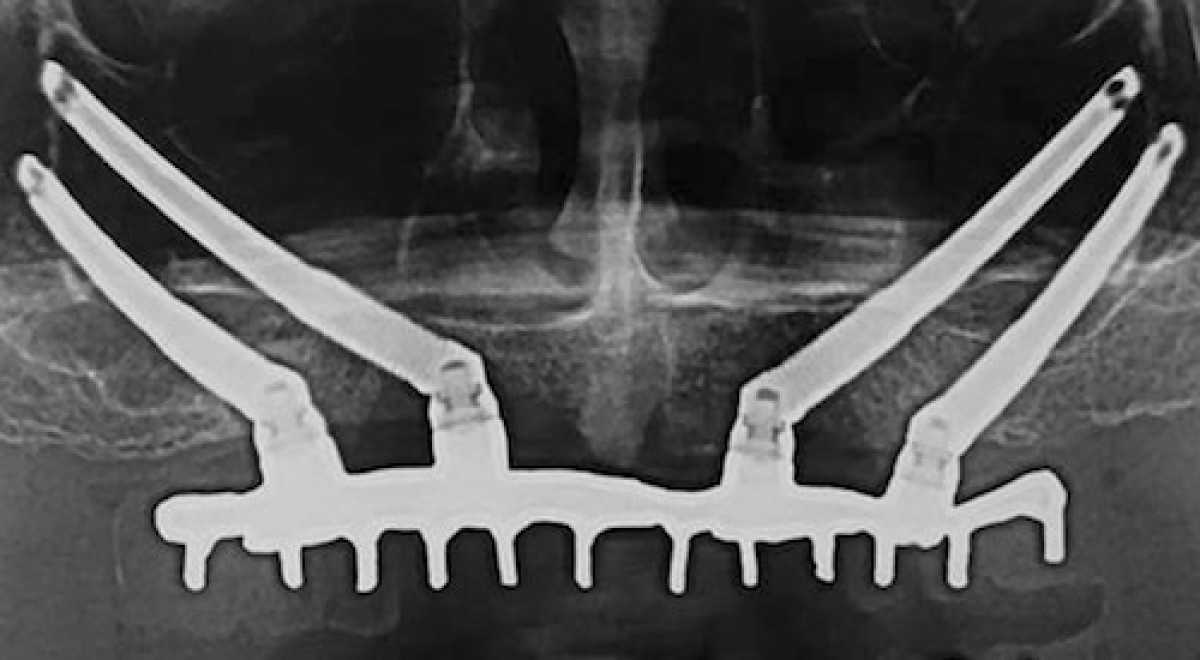
PURPOSE. To compare the clinical outcomes of immediately loaded cross-arch maxillary prostheses supported by zygomatic implants versus conventional implants placed in augmented bone.
MATERIALS AND METHODS.
Seventy-one edentulous patients with severely atrophic maxillae not having sufficient bone volumes for placing dental implants, or when it was possible to place only two implants of minimal diameter 3.5 mm and length of 8 mm in the frontal area and there was less than 4 mm of bone height subantrally were randomised according to a parallel-group design to receive either zygomatic implants (35 patients) to be loaded immediately or xenograft followed, after 6 months of graft consolidation, by placement of six to eight conventional dental implants submerged for 4 months (36 patients). Outcome measures were: prosthesis, implant and augmentation failures, any complications, quality of life (OHIP-14), number of days with totally or partially impaired activity, time to function, and number of dental visits, as assessed by independent assessors. Patients were followed up to 3 years after loading.
RESULTS.
Eight patients from the augmentation group dropped out versus three from the zygomatic group. One augmentation procedure failed. Eight prostheses could not be fitted or failed in the augmentation group versus two prostheses in the zygomatic group, the difference being not statistically significant (difference in proportions = 18.18%; 95% CI: 1.44 to 34.91; P = 0.082). Nine patients in the augmentation group lost 42 implants versus three patients who lost six zygomatic implants, the difference being not statistically significant (difference in proportions = 21.65%; 95% CI: 2.02 to 41.20; P = 0.052). Sixteen augmented patients were affected by 30 complications versus 29 zygomatic patients (55 complications), the difference being statistically significant (difference in proportions = -30.87 %; 95% CI: -51.88 to -9.86; P = 0.007). The 3-year OHIP-14 score was 4.11±7.27 in augmented patients and 4.51±6.23 in zygomatic patients, with no statistically significant differences between groups (mean difference = 0.40; 95% CI: -2.80 to 3.61; P = 0.624). Both groups had significantly improved OHIP-14 scores from before rehabilitation (P < 0.01 for both augmentation and zygomatic patients). Days of total infirmity were, on average, 7.42±3.17 in the augmentation group and 7.17±1.96 in the zygomatic group, the difference not being statistically significant (mean difference = -0.25; 95% CI: -1.52 to 1.02; P = 0.692). Days of partial infirmity were on average, 14.24±4.64 in the augmented group and 12.17±3.82 in the zygomatic group, the difference being statistically significant (mean difference = -2.07; 95% CI: -4.12 to -0.02; P = 0.048). The mean number of days to functional prosthesis fitting were 444.32±207.86 in augmentation patients and 1.34±2.27 in zygomatic patients, the difference being statistically significant (mean difference = -442.98; 95% CI: -513.10 to -372.86; P < 0.001). The average number of dental appointments was 23.00±11.80 for augmentation patients and 20.05±6.23 for zygomatic patients, the difference not being statistically significant (mean difference = -2.94; 95% CI: -7.62 to 1.74; P = 0.213).
CONCLUSIONS.
On the one hand, three-year post-loading data suggest that immediately loaded zygomatic implants are associated with fewer prosthesis failures (two versus eight patients), implant failures (three patients lost 6 zygomatic implants versus nine augmentation patients who lost 42 implants) and less time needed for functional loading (1.3 days versus 444.3 days) as compared to augmentation procedures and conventionally loaded dental implants. On the other hand, significantly more complications were reported for zygomatic implants; since there was an apparent increase in severe sinusitis at zygomatic implants over time, long-term data are required; however, in the short-term, zygomatic implants proved to be a better rehabilitation strategy for severely atrophic maxillae.
For additional information: http://www.clinicaltrialsindentistry.com/immediately-loaded-zygomatic-implants-versus-conventional-dental-implants-in-augmented-atrophic-maxillae-three-year-post-loading-results-from-a-multicentre-randomised-controlled-trial/
 Related articles
Implantology 16 July 2021
Authors: Pietro Felice, Carlo Barausse, Rubén Davó, Roberto Pistilli, Carlos Marti-Pages, Ada Ferrer-Fuertes, Agnese Ferri, Marco Esposito
PurposeTo compare the clinical outcomes of immediately loaded cross-arch maxillary prostheses supported by zygomatic implants versus conventional implants placed in augmented bone.Materials and...
Read more
Products 13 October 2026

New Resources Help Dental Exhibitors Evaluate Their Investment and Explore the Personify ShowFlow™ Trade Show Success System
News 13 October 2026
New patient apps extend The Aspen Group’s mission to remove barriers to care, giving patients greater visibility, convenience, and control from booking through treatment
Editorials 13 October 2026

The forerunner of what’s now Texas A&M College of Dentistry opened 120 years ago in Dallas with the mission of educating dentists to provide quality care to patients in North Texas
Oral pathology 13 October 2026

This peer-reviewed oral pathology article summarizes clinical evidence from Oral oncology (2026). It focuses on findings that may help dental professionals evaluate treatment decisions, patient...



Copyright © 2026 - All Rights Reserved
ISSN 2767-1178