


Accuracy of interdental cavity measurements performed on digital radiographs
Authors: Francesco Malaguti, Veronica Chinellato, Jessica Miola, Alberto Borella, Roberto Farina
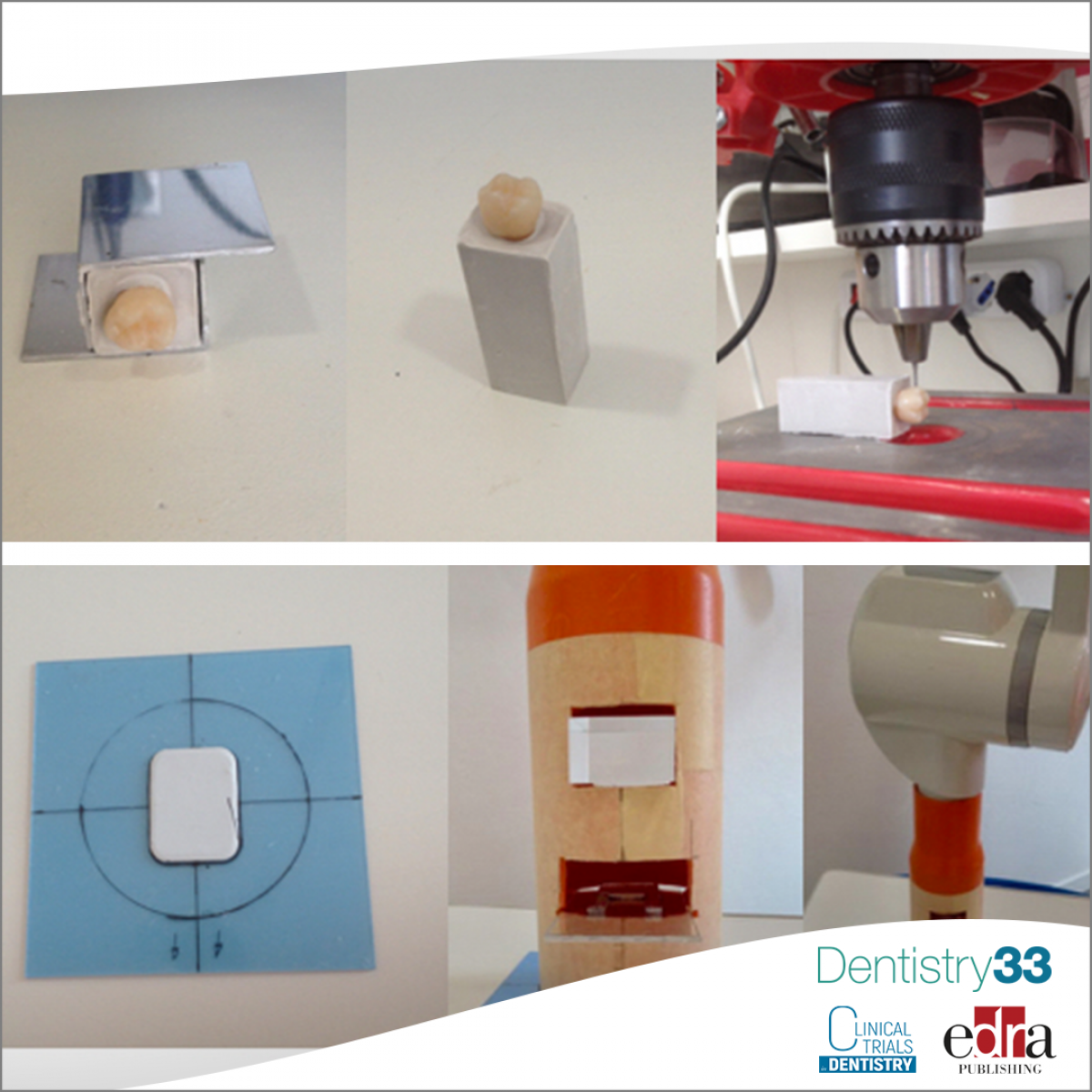
The aim of the present study was to evaluate the accuracy of linear radiographic measurements (taken on radiographs obtained with three different systems - analogic; photo-stimulable phosphor plate, PSP; and charge-coupled devices, CCD) of artificial interdental cavities.
Materials and methods
For the study, 9 posterior teeth extracted for periodontal reasons with intact crown and roots were used. Each tooth was mounted in a plaster support. At the mesial and distal aspect of each crown, two artificial cavities (one on each side) were made using cylindrical burs of different diameters, which were mounted on a calibrated milling machine. The study was conducted on a total of 18 artificial interdental cavities. For each tooth, radiographs were then taken with each of the following radiographic systems: analogic, PSP, and CCD. Two radiographs were taken with each system: one with the interposition of plexiglass between the X-ray tube and the radiographic device to simulate the presence of perioral soft tissues, the second without the interposition of plexiglass. Analogic radiographs were digitized. Each digitized analogic image as well as each radiographic image obtained with either PSP or CCD systems was calibrated. On each image, a calibrated and blind operator measured the apico-coronal (height) and mesio-distal (depth) dimensions of each cavity.
Results
The study showed that: (i) linear measurements of artificial interdental cavities of known size performed on radiographs taken with the three investigated systems are characterized by low average errors (within 0.3 mm); (ii) the magnitude of the variability of these errors may be clinically relevant, exceeding 0.5 mm and, therefore, representing a relevant aspect in identifying the most accurate system; (iii) CCD system is characterized by a non-significant tendency to show higher accuracy than the other two systems.
Conclusions
Similar accuracy was observed for linear measurements of artificial interdental cavities performed on radiographs taken with the three investigated systems (analogic, PSP, CCD).
Clinical significance
Based on the results of the present study, the three investigated radiographic systems allow for similar accuracy of linear measurements of interdental cavities. Although these observations must be tested further in clinical studies, the results seem to suggest that all (analogic, PSP and CCD) can be used in daily practice for the evaluation of interproximal carious lesions. The choice of one radiographic system rather than another, therefore, should be based on parameters different from those evaluated in the present study. Among these: radiation dose, costs, patient's preference, eco-sustainability of the devices, image processing time and usability in a dental practice setting.
 Tag
Tag
Read more
Europe 11 October 2026 - 30 November -0001
Scandinavian Dental Fair 2026: Event Preview and Professional Highlights

The Scandinavian Dental Fair 2026 will take place from November 11, 2026 to November 13, 2026 in TBD, Sweden/Denmark, offering dental professionals a focused environment for continuing education,...
Edra Professional Books 10 October 2026
Esthetics and function in complete denture prosthesis is an Edra professional dentistry reference focused on clinical practice, education and treatment planning.
Products 09 October 2026
Oral-B and Crest, Official Oral Care Partners of the NFL, recently announced the launch of new special-edition products, giving fans even more ways to celebrate their love of the g
News 09 October 2026
Apex Dental Partners, a dental partnership organization supporting dentists and affiliated practices, has been named No.
News 09 October 2026

New education website and fully funded Swiss fellowship program debut at the 2026 Orthopaedic Trauma Association Annual Meeting in Nashville



Copyright © 2026 - All Rights Reserved
ISSN 2767-1178